That question has a clear answer: yes, and the timing couldn't be better.
Bundling a roof replacement with solar installation is one of the most financially sound home improvement decisions an LA-area homeowner can make right now. California electricity rates are among the highest in the country — 33.35 cents/kWh versus the national average of 18.83 cents/kWh as of March 2026 — which means every month you delay going solar is money left on the table. This article breaks down exactly why the combined approach works, what it costs, and how to do it right.
Key Takeaways
- Bundling roof and solar saves roughly $4,000 compared to doing each project separately
- Removing and reinstalling solar panels for a later roof job costs $1,500–$7,000+ — a cost you avoid entirely by doing both at once
- The federal solar tax credit covers 30% of installation costs for purchased systems
- LA-area homeowners can expect an estimated $58,351 in 20-year savings from solar
- Using one contractor for both jobs eliminates scheduling conflicts and coordination headaches
Why Roof Replacement Is the Perfect Window to Go Solar
Solar panels last 25–30+ years, and so does a quality roof. Install both together and they age in sync — likely replaced again at the same time, decades from now.
The Lifespan Alignment Argument
NREL's PV reliability research uses 30 years as the standard module service lifetime. A new architectural asphalt roof lasts 20–30 years; metal roofing runs 40–80 years; tile can exceed 50 years. Choose the right material now and you avoid the single most expensive mistake in residential solar: replacing a roof mid-solar-lifespan.
If you install solar on a roof that's already 10 years old, you may face a removal and reinstallation job in 5–8 years. That adds $1,500–$7,000+ to a project you've already paid for.
The Single-Contractor Advantage
When one contractor handles both trades, you gain several concrete advantages:
- One point of contact for scheduling, permitting, and coordination
- No finger-pointing between separate roofers and solar installers if something goes wrong
- Reduced delays from overlapping trades and permit processes
- Roof designed for solar from day one — mounting points planned into the installation, not retrofitted later
CA Home Solar, which has handled both roofing and solar for Southern California homeowners for 36 years, assigns a dedicated project manager to each job to coordinate every stage from site survey through final utility interconnection. That continuity matters when you're navigating both a roofing permit and a solar permit simultaneously.
Compatibility Is Locked In
That single-contractor approach also solves a problem most homeowners don't anticipate: not every roof is equally solar-friendly. Certain tile profiles and low-slope configurations require specific mounting hardware. When a single contractor designs both together, the roof is built with the solar system in mind — no compatibility surprises, no structural concerns discovered after the shingles are already down.
The True Cost Comparison: Together vs. Separately
The Bundled Savings Case
DOE research citing NREL data puts the average savings at approximately $4,000 when a roof replacement and solar installation are combined versus done as separate projects. The breakdown:
| Scenario | Average Cost |
|---|---|
| Roof replacement (separate) | $10,000 |
| Solar installation (separate) | $19,000 |
| Total if done separately | $29,000 |
| Combined project | $25,000 |
| Savings | ~$4,000 |
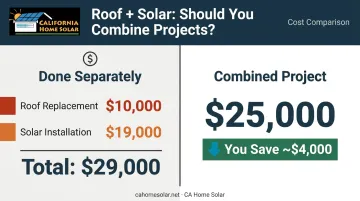
Note: These are 2021 NREL baseline figures. Current combined project costs average closer to $40,000 nationally, reflecting both inflation and larger system sizes, but the relative savings from bundling remain.
The Removal and Reinstallation Trap
If you install solar now and replace the roof in five years, you'll pay a solar contractor to remove every panel, store them safely, and reinstall them after the roofing crew finishes. That runs $200–$300 per panel, with total costs ranging from $1,500 to over $7,000 depending on system size. It's an entirely avoidable cost.
The Home Value Upside
Both upgrades independently add resale value — and in LA's market, where median home values sit well above the national average, the returns are meaningful:
- A new asphalt roof recoups an average of $21,501 on a $31,871 job cost (68%), per the JLC 2025 Cost vs. Value Report
- Homes with solar sell for 4.1% more on average, per Zillow Research — a percentage that compounds significantly at Southern California price points
What the Numbers Look Like Over Time
A combined $40,000 project looks different once lifetime utility savings enter the picture. EnergySage estimates:
- $58,351 in savings over 20 years for a Los Angeles-area solar owner
- $128,461 over 25 years for an average California system
- ~7.6-year payback period — after which the system generates savings on every bill
With SCE and LADWP rates continuing to climb, those projections will likely prove conservative.
Making Sure Your Roof and Solar Panels Last the Distance
Choosing the right roofing material at the time of installation is a decision with 25–30 year consequences. Here's how the main options stack up for Southern California solar homeowners:
| Material | Lifespan | Solar Compatibility |
|---|---|---|
| Architectural asphalt shingles | 25–30 years | Excellent — standard mounting hardware works well |
| Metal (standing seam) | 40–80 years | Excellent — clamp-on mounts require no penetrations |
| Concrete/clay tile | 50–100+ years | Good — requires tile hooks; some profiles need reinforcement |
EnergySage identifies asphalt and standing-seam metal as the most straightforward roofing materials for solar installation. Metal is worth serious consideration for homeowners who want their roof to outlast their solar system by a wide margin.
The Hidden Benefit: Solar Protects Your Roof
Rooftop solar panels don't just generate power — they also shield the roof surface below. A UCSD study measured the difference directly, finding:
- Daytime ceiling temperatures under panels ran up to 2.5°C cooler than exposed roof sections
- Heat transfer to the roof dropped 63% under tilted panels (from 18.7 W/m² exposed to just 7.0 W/m²)
- Annual cooling load for PV-covered roofs fell by an estimated 38%
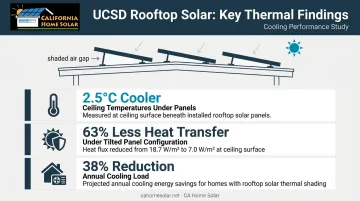
Less heat cycling means less thermal stress on shingles and underlayment — the materials under your panels age more slowly than those left exposed to full Southern California sun.
For even greater temperature control, pairing solar with cool roof materials makes sense in this climate. Highly reflective roofing can keep surface temperatures more than 50°F cooler than standard dark roofs on a hot summer day, cutting air conditioning demand by up to 30%.
Signs Your Roof May Need Replacing Before Solar
Before booking a solar installation, do a quick self-check on roof condition. Red flags that warrant a professional inspection:
- Cracked, curling, or missing shingles — granule loss is especially telling on asphalt roofs
- Granule accumulation in gutters — signals shingles are near end of life
- Sagging areas — potential structural or decking issues underneath
- Water stains on interior ceilings — active or historical leaks
- Visible daylight through attic boards — gaps that compromise weatherproofing
The Age Rule of Thumb
If your asphalt roof is more than 10 years old, get a professional inspection before signing any solar contract. Most roofing professionals recommend replacement before solar installation at this age threshold.
The logic is purely financial. Install solar on a borderline roof and you're likely paying for panel removal and reinstallation within a few years — plus the roof replacement cost you deferred. Fix the roof first and you avoid paying for that removal twice.
Why Delayed Replacement Makes Problems Worse
That financial risk compounds into a structural one. A damaged roof under solar panels is far harder to diagnose — leaks are difficult to identify and even harder to access for repair when panels are in the way. Water intrusion that would surface quickly on an open roof stays hidden longer under panels and spreads further before anyone catches it. Replacing the roof before installation protects both the home's structure and the solar investment above it.
California Incentives and Financing
The Federal 30% Tax Credit
Homeowners who purchase (not lease) a solar system can claim the federal Residential Clean Energy Credit, 30% of installation costs through 2032, on their federal tax return. The ITC applies to the solar portion of a combined project. On a $25,000 solar installation, that's a $7,500 reduction in tax liability — not a deduction, a credit.
CA Home Solar's policy is purchase-only: they don't offer leases or PPAs, which means their customers are always ITC-eligible.
NEM 3.0: Size Your System for Consumption
California's Net Billing Tariff (NBT), in effect for new interconnections since April 15, 2023, changed how excess solar generation is compensated. Exports to the grid are now credited at grid-value rates — typically well below retail. For SCE customers in particular, this means a solar system sized to maximize exports is less financially optimal than one sized around your actual household consumption and time-of-use patterns.
LADWP customers operate under a separate NEM Rider and should confirm current terms directly with the utility. For a full picture of state and local incentive programs, check the DSIRE California database.
Financing Options
CA Home Solar works with several PACE financing programs that cover both solar and roofing:
- HERO Program — CA Home Solar is a registered HERO contractor. Eligible upgrades include solar, roofing, windows, and HVAC:
- Repaid through annual property taxes (no upfront costs)
- Approval based on home equity, not credit score
- Flexible 5–25 year repayment terms
- California First and YGrene — additional PACE programs with comparable structures and property-tax repayment
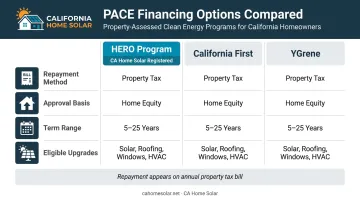
PACE financing is not a grant program — repayment appears as a line item on annual property tax bills. Confirm terms carefully before signing.
Low-Income Programs
The DAC-SASH program provides $8.5M annually through 2030 for income-qualifying homeowners in disadvantaged communities. To qualify, you must:
- Be a customer of SCE, PG&E, or SDG&E
- Reside in a top 25% disadvantaged community
- Hold active CARE or FERA enrollment
Note: SASH, the predecessor program, has been fully reserved since 2021 and is no longer accepting applications.
What to Look for in a Roof + Solar Contractor
Verify Credentials Before Signing
California requires separate license classifications for roofing and solar work:
- C-39 — Roofing contractor (waterproofing, shingles, tile, metal roofing, membrane)
- C-46 — Solar contractor (thermal and photovoltaic systems)
Any contractor handling both trades should hold both licenses — or clearly disclose which work is subcontracted and to whom. Verify license status directly through the CSLB. Also ask about NABCEP certification, which validates installer knowledge and field competency.
Questions to Ask Before Signing
- Do you handle roofing and solar in-house, or subcontract one trade?
- What warranties cover the roof, the panels, and the penetration points specifically?
- How do you manage permitting for a combined project — one permit or two?
- Are you familiar with SCE and LADWP interconnection timelines and requirements?
- What happens if the roof or solar system needs service during the warranty period?
Get Multiple Quotes, Prioritize Local Experience
Get at least 2–3 quotes for any combined project. When comparing contractors, local utility experience is a real differentiator. A contractor who knows SCE and LADWP interconnection processes — not just solar in general — can significantly cut delays between installation and Permission to Operate.
California Home Solar has served Southern California for 36 years and handles the full process from site survey through final utility interconnection. That end-to-end ownership keeps roofing and solar timelines coordinated on a single project.
Frequently Asked Questions
Do I need to replace my roof before installing solar panels?
It depends on age and condition. If your asphalt roof is over 10–15 years old or showing wear, replacing it before or alongside solar installation is strongly recommended. Installing solar on a failing roof means paying $1,500–$7,000+ to remove and reinstall panels when the roof eventually gives out.
How much does a solar system cost for a 2,000 sq ft house?
System cost depends on energy consumption, not square footage. EnergySage puts the average California system at 8.81 kW and $22,284 before incentives (roughly $2.53/W), dropping to around $15,600 after the 30% federal tax credit. Your actual usage — not home size — determines the right system size.
Why is my electric bill still high if I have solar panels?
Common causes include an undersized system, increased electricity use after installation, or California's shift to NEM 3.0 time-of-use rates. Under the Net Billing Tariff, exports earn less than retail — so systems sized around consumption rather than export perform better financially.
Will solar panels void my roof warranty?
Solar panels may void the existing roofing warranty on the sections they cover. When CA Home Solar handles both the roof and the solar installation, penetration points are covered under a single contractor warranty. Confirm warranty terms from both the roofing and solar sides before signing any contract.
Can I finance both a roof replacement and solar installation together?
Yes. PACE programs like HERO — CA Home Solar is a registered contractor — allow homeowners to finance both roofing and solar improvements together with no money down, repaid through property taxes over 5–25 years.
How long does the combined process take?
Roof replacement takes a few days to a few weeks, and solar design, permitting, installation, and utility interconnection add roughly 6–12 weeks. A single contractor handling both can overlap phases and cut total project time.