This guide explains what wattage actually means, what the current residential average looks like in 2025, what drives real-world output, and how Southern California homeowners can use this information to size a system correctly.
Key Takeaways
- Modern residential panels are rated 400–460W, with 420–450W being the current sweet spot for new installations
- Wattage is measured under lab conditions (STC) — real daily output will be lower
- System wattage (all panels combined) determines your electricity generation, not individual panel wattage
- Southern California's 5–6 peak sun hours per day mean fewer panels may be needed versus cloudier regions
- The right wattage balances roof space, efficiency, consumption, and budget — higher isn't always better for your specific home
What Solar Panel Wattage Actually Means
Wattage is the rated power output of a single panel, measured in watts (W). It represents the maximum electricity that panel can produce under controlled laboratory conditions — not what it generates every hour of every day.
Standard Test Conditions (STC)
Every panel you compare is rated using the same industry benchmark: 1,000 W/m² of irradiance, a cell temperature of 25°C, and an air mass of 1.5. These conditions are rarely replicated on an actual rooftop, which is why real-world output falls below the nameplate rating. STC exists to give manufacturers a standardized basis for comparison — treat it as a ceiling, not a daily average.
Panel Wattage vs. System Wattage
Panel wattage is the output of one panel — a number many homeowners confuse with total system output. System wattage — also called system capacity — is the combined total of all panels installed. Twenty panels at 400W each equals an 8,000W (8kW) system. That system figure is what determines how much electricity your home actually generates.
From Watts to Kilowatt-Hours
Wattage is a design parameter, not a delivery guarantee. What matters for your utility bill is the kilowatt-hours (kWh) the system produces over time. The bridge between rated wattage and real energy production is the production ratio — annual kWh generated per installed kW of capacity. In Southern California, this ratio lands high thanks to strong year-round sun, typically 1.4–1.6 for the Los Angeles area.
Typical Wattage Ranges for Residential Solar Panels
Residential Solar Panels
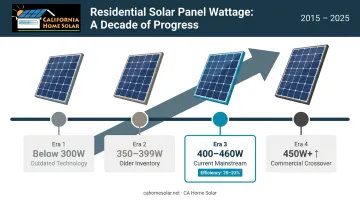
The residential wattage landscape has shifted significantly over the past decade:
| Wattage Range | Status |
|---|---|
| Below 300W | Largely outdated (8–10+ year-old systems) |
| 350–399W | Older inventory, still in use |
| 400–460W | Current mainstream residential range |
| 450W+ | Crossover into commercial sizing |
According to Lawrence Berkeley National Laboratory's Tracking the Sun 2024 report, the median installed panel wattage for residential systems has risen steadily, with the 400–460W range now representing the clear majority of new home installations. Most installers are now quoting systems centered around the 420–450W range.
This shift happened because advances in monocrystalline cell technology and half-cut cell designs made 400W+ panels cost-competitive with older lower-wattage models — without requiring a noticeably larger physical footprint. Efficiency ratings for premium panels in this range typically land between 20–23%, which matters when your usable roof area is limited.
Commercial and Utility-Scale Panels
Panels above 500W exist, but they're not the right fit for most residential rooftops. Three practical constraints hold them back:
- Physical size: They're larger and heavier, harder to arrange around chimneys, vents, or irregular roof shapes
- No performance advantage: A 6kW system built from twelve 500W panels performs identically to one built from fifteen 400W panels
- What actually drives savings: Total system capacity matched to your annual consumption — not the wattage of any individual panel
What Affects Real-World Solar Output Beyond the Wattage Rating
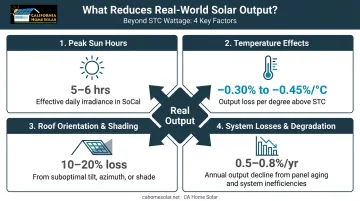
The gap between a panel's STC rating and its actual field output is predictable — and four main factors drive it: location, temperature, roof geometry, and system losses. Understanding each one helps homeowners set accurate expectations before installation.
Peak Sun Hours and Location
A 400W panel in Los Angeles — where solar irradiance averages roughly 5–6 peak sun hours per day — produces noticeably more daily energy than the same panel installed in Seattle or Chicago. Peak sun hours aren't simply hours of daylight; they represent the equivalent hours of full-intensity (1,000 W/m²) sunlight. Southern California's figure is one of the strongest in the country, which directly benefits system output.
Temperature Effects
Heat actually reduces solar panel output — the opposite of what many homeowners expect. As cell temperature climbs above 25°C, power production drops — a real consideration during Southern California summers when rooftop temperatures can exceed 60°C. The temperature coefficient (expressed as % output loss per °C above 25°C) is a spec worth comparing. A panel with a coefficient of -0.30%/°C performs noticeably better in heat than one rated at -0.45%/°C.
Temperature isn't the only site-specific factor. How your roof is oriented and whether it sees any shade both shape how much of that rated wattage you'll actually capture.
Roof Orientation, Tilt, and Shading
- South-facing roofs at an optimal tilt (typically 15–30° in SoCal) maximize annual output
- East/west-facing panels typically produce 10–20% less than south-facing equivalents
- Partial shading — from trees, chimneys, or HVAC equipment — can cut output significantly; in a traditional string inverter setup, shade on one panel reduces production across the entire string
CA Home Solar installs both Enphase IQ8 microinverters and SolarEdge power optimizers for residential jobs where shading is identified during the site assessment. Both technologies isolate each panel's output, preventing one shaded panel from dragging down the rest of the system.
System Losses and Degradation
Even without shading, real-world output is reduced by:
- Inverter conversion losses (typically 3–5%)
- Wiring losses
- Soiling from dust and debris (especially relevant in LA's drier months)
- Annual panel degradation of roughly 0.5–0.8% per year
At that degradation rate, a quality 400W panel still produces around 90% of its rated output after 25 years. Most reputable manufacturers back this with linear performance warranties guaranteeing 80–90% output at year 25.
How Panel Wattage Determines Your System Size
The Core Calculation
The formula for sizing a residential solar system:
Number of panels = Annual kWh usage ÷ Production ratio ÷ Panel wattage
A typical Southern California home uses approximately 6,500–8,500 kWh per year (California households average lower consumption than the national figure, partly due to mild winters). Using a production ratio of 1.5 for the LA area and 400W panels:
- 7,500 kWh ÷ 1.5 ÷ 0.4 kW = 12,500W ÷ 400W = ~12–13 panels (approximately 5kW system)
System Size Reference Table
| Annual Usage (kWh) | Estimated System Size | Approx. Panels (400W) |
|---|---|---|
| 6,000 | ~4 kW | 10 panels |
| 8,000 | ~5.3 kW | 14 panels |
| 10,000 | ~6.7 kW | 17 panels |
| 12,000 | ~8 kW | 20 panels |
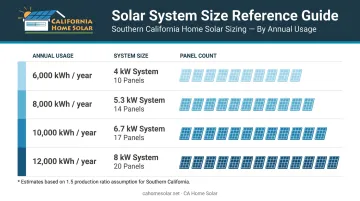
Assumes production ratio of 1.5 for Southern California. Actual results vary by roof orientation, shading, and system losses.
What About a 2,000 Sq Ft Home?
Square footage alone doesn't determine panel count. Energy habits, appliance loads (especially EV charging or a pool pump), and local sun hours matter more.
A 2,000 sq ft home in Southern California typically consumes 7,000–9,000 kWh annually, translating to roughly 15–20 panels at 400W each (6–8kW system). The same home in a cloudier region would need more panels to reach the same annual production.
Choosing the Right Panel Wattage for Southern California Homes
Practical Trade-Offs
Higher-wattage panels (420–460W) make sense when:
- Roof space is limited or irregular
- Fewer panels are preferred for aesthetic reasons
- You want to maximize output from a constrained area
Lower-wattage panels carry a lower per-panel cost, but require more panels and more mounting hardware to reach the same system capacity. On a large south-facing roof with no shading, cost-per-watt typically matters more than the per-panel wattage figure.
NEM Policy and System Sizing
California's current Net Billing Tariff (NEM 3.0), overseen by the CPUC, changed the economics of over-sizing a solar system. Under NEM 3.0, excess energy exported to the grid earns significantly less credit than under the previous NEM 2.0 structure. This makes sizing your system to closely match annual consumption the more financially sound approach for most Southern California homeowners — rather than building the largest system possible.
Getting the Sizing Right
CA Home Solar conducts personalized site assessments for homeowners across Los Angeles County, evaluating roof area, orientation, shading, and 12 months of utility bills to recommend the right panel wattage and system size. The result is a system sized to your actual usage — not an oversized installation that loses value under NEM 3.0. CA Home Solar has appeared on Solar Power World's Top 500 Solar Contractors list multiple times, including 2023 and 2025, and brings 36 years of local installation experience to every assessment.
Common Misconceptions About Solar Panel Wattage
"Higher wattage always means a more efficient panel."
Wattage and efficiency are separate specs entirely. A 500W panel isn't inherently more efficient than a 400W panel — it's simply larger, with more or bigger cells. Efficiency measures the percentage of sunlight converted to electricity, and that number lives on its own line of the spec sheet. A compact 400W panel rated at 22% efficiency outperforms a bulkier 450W panel at 19% efficiency on a space-constrained roof.
"My panels will produce their rated wattage every day."
STC wattage is a lab benchmark, not a daily performance guarantee. Actual output fluctuates with cloud cover, temperature, time of day, and season — sometimes significantly. Track monthly and annual kWh production against your installer's projected figures. That comparison tells you far more than the nameplate wattage ever will.
"I need the highest-watt panels available to maximize savings."
Savings depend on total system capacity and production ratio — not individual panel wattage. If your system is already correctly sized for your annual consumption, chasing a higher per-panel wattage adds cost without improving your return on investment.
Quick reality check on all three:
- Higher-watt panels are larger, not necessarily more efficient
- Rated wattage is a lab result; monthly kWh output is what actually matters
- A properly sized system beats a high-wattage one that's oversized for your usage
Frequently Asked Questions
How many watts of solar do I need to power a typical 2,000 sq ft house?
A 2,000 sq ft Southern California home typically needs 6–8 kW of total system capacity — roughly 15–20 panels at 400W each. Actual needs depend more on energy consumption habits, appliance loads, and local sun hours than on square footage alone.
What is the average wattage of a residential solar panel in 2025?
The current average for newly installed residential panels is approximately 400–450W, up from 300–350W a decade ago. Improvements in monocrystalline cell technology and half-cut cell designs drove this shift while keeping panel dimensions roughly the same 65×39-inch footprint.
What is the difference between panel wattage and system wattage?
Panel wattage is the rated output of a single panel (for example, 400W). System wattage is the combined capacity of all panels installed — 20 panels × 400W = 8,000W or 8kW. Your system's total capacity — not any single panel's rating — determines how much electricity your home generates.
Do higher-wattage solar panels produce more electricity in real-world conditions?
Higher-wattage panels do produce more electricity per panel, but real-world output depends on panel efficiency, cell temperature, shading, and roof orientation — factors that can reduce actual yield 10–25% below the rated wattage.
How does Southern California's climate affect solar panel wattage needs?
Southern California's 5–6 peak sun hours per day mean systems here produce more energy per installed kW than in cloudier regions, often allowing homeowners to achieve the same energy output with a system 5–10% smaller than they'd need in a less sunny climate. Summer heat can reduce output relative to STC ratings, making temperature coefficient an important spec to compare.
How long do solar panels maintain their rated wattage output?
Most quality panels degrade at roughly 0.5–0.8% per year, meaning a 400W panel typically produces around 90% of its rated output after 20–25 years. Reputable manufacturers back this with linear performance warranties — standard panels typically guarantee 80% output at year 25, while premium lines guarantee 90%.