The stakes are higher here than in most states. California's Title 24 energy codes set mandatory performance thresholds for commercial windows, and the updated 2025 Building Energy Efficiency Standards take effect January 1, 2026, with stricter requirements across the board. Choose the wrong window and you're facing permit rejections, occupancy delays, and ongoing HVAC overruns.
This guide covers the best energy-efficient commercial windows available to California buyers, the performance metrics that matter, and how to reduce upfront costs through available incentives.
Key Takeaways
- Commercial windows in California must comply with Title 24 Part 6 — NFRC-certified U-Factor and SHGC ratings are required, not optional
- Key metrics to compare: U-Factor (heat transfer), SHGC (solar heat gain), and VLT (visible light transmittance)
- Top brands for California commercial projects: Milgard, Kawneer, Pella, JELD-WEN, and Marvin, each suited to different building types and budgets
- The IRS Section 25C credit (30%, up to $600/year for windows) applies to residential and mixed-use properties
- SCE offers business efficiency rebate programs worth checking for commercial window upgrades in Southern California
- Proper installation by a licensed contractor is not optional — it directly determines whether a compliant window actually performs as rated
Why Energy-Efficient Commercial Windows Matter in California
According to Lawrence Berkeley National Laboratory research on commercial fenestration, commercial building windows affect loads representing more than 6 quads — roughly 6% of annual U.S. primary energy use. For a California commercial property owner paying 25.54 cents/kWh, that exposure adds up fast.
Understanding which products actually qualify as energy-efficient — and what the code requires — is where the specification process begins.
What "Energy-Efficient" Actually Means for Commercial Windows
Three performance ratings determine whether a commercial window qualifies as energy-efficient under California's code:
- U-Factor — measures the rate of non-solar heat transfer through the window; lower is better
- SHGC (Solar Heat Gain Coefficient) — measures how much solar radiation passes through; lower values reduce cooling loads in hot climates
- VLT (Visible Light Transmittance) — measures how much daylight enters; higher values reduce artificial lighting needs
For California commercial projects, products must carry NFRC-certified ratings for all three. Products without NFRC certification default to less favorable CEC default values during compliance calculations.
Title 24 Requirements You Need to Know
The current 2022 standards (effective January 1, 2023) set fixed commercial window U-Factor maximums that vary by climate zone. The 2025 update takes effect January 1, 2026, adding a mandatory vertical fenestration U-Factor of 0.47 for new construction and 0.58 for alterations under the new code sections.
Under the current 2022 nonresidential standards, key Southern California climate zones require:
| Climate Zone | Fixed Window Max U-Factor | Operable Window Max U-Factor |
|---|---|---|
| CZ 6 (LA Coast) | 0.36 | 0.46 |
| CZ 8 (LA Basin) | 0.36 | 0.46 |
| CZ 9 (Inland Valley) | 0.34 | 0.46 |
| CZ 10 (Inland So. Cal) | 0.36 | 0.46 |
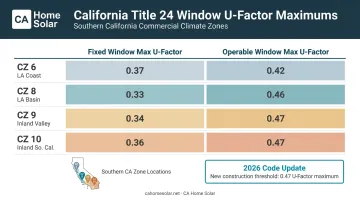
Non-compliance blocks permits and can delay occupancy — which means window selection needs to clear the compliance hurdle before any aesthetic or budget preferences enter the conversation.
Best Energy-Efficient Commercial Windows for California
The five brands below were evaluated on:
- NFRC-certified performance data
- Title 24 applicability for California's nonresidential code
- Frame technology and thermal performance
- Availability through California contractors
- Commercial project track record
Milgard Windows & Doors
Milgard has manufacturing facilities across California, including Simi Valley and Temecula, and has served the Western U.S. market since 1958. Their Tuscany and Trinsic series are commonly specified for low- to mid-rise commercial projects throughout Southern California.
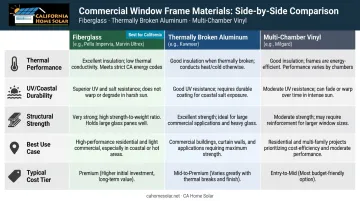
Their commercial product lines use thermally fused multi-chamber vinyl frames that reduce thermal bridging. Dual-pane and triple-pane configurations are available with Low-E glass and argon fill. Products are NFRC-tested and certified.
Important note: Milgard's Full Lifetime Warranty is documented for residential installations. For commercial projects, verify warranty terms with the manufacturer or your contractor before specifying.
| Spec | Detail |
|---|---|
| Frame Material | Multi-chamber extruded vinyl |
| Energy Performance | Verify current NFRC CPD data for the specific commercial series and glazing package |
| Best Suited For | Low- to mid-rise office, retail, and mixed-use in Southern California |
Kawneer (Arconic Building Products)
Kawneer is one of North America's primary manufacturers of commercial aluminum curtain wall and storefront systems. Their products appear on mid- to high-rise commercial, institutional, and government buildings across California — including the Riverside Main Library, which used Kawneer's 1600 Wall System 1 Curtain Wall.
The key differentiator for California compliance is Kawneer's thermally broken aluminum framing. Their Trifab 451UT system, for example, achieves U-Factor ranges of 0.19 to 0.51 depending on center-of-glass configuration — well within Title 24 thresholds when properly specified. The 1600 Wall System 1 shows a U-Factor range of 0.27 to 0.59 and SHGC range of 0.06 to 0.69 across configurations.
| Spec | Detail |
|---|---|
| Frame Material | Thermally broken aluminum (named thermal break systems vary by product) |
| Energy Performance | Trifab 451UT: U-Factor 0.19–0.51; 1600 Wall System 1: U-Factor 0.27–0.59, SHGC 0.06–0.69 |
| Best Suited For | Mid- to high-rise commercial buildings, curtain wall applications, large storefront installations |

Pella Commercial (Impervia Series)
Pella's Impervia fiberglass line is well-suited to California commercial properties. Fiberglass frames conduct less heat than aluminum and outlast vinyl in UV-heavy conditions — a practical edge for coastal projects near the ocean and inland sites in the Central Valley or Inland Empire.
NFRC-style performance data for Pella Impervia commercial configurations shows strong numbers: fixed frame/direct set U-Factor of 0.15 to 0.47, SHGC of 0.18 to 0.69, and VLT up to 0.66 depending on configuration. Pella states Impervia products meet or exceed Energy Star guidelines across all 50 states, though note that Energy Star's current window specification is a residential program — Title 24 compliance for commercial work requires verification against CEC nonresidential tables.
| Spec | Detail |
|---|---|
| Frame Material | Fiberglass (Impervia series); aluminum-clad wood also available |
| Energy Performance | Fixed: U-Factor 0.15–0.47, SHGC 0.18–0.69, VLT up to 0.66 |
| Best Suited For | Coastal commercial properties, hospitality buildings, projects prioritizing long-term seal integrity |
JELD-WEN Commercial (Architectural Series)
For large-scale California commercial jobs, JELD-WEN's Architectural Series aluminum windows and W-2500 line stand out for procurement flexibility. Wide size and configuration ranges make them practical for retrofits involving dozens or hundreds of openings — a common constraint on office parks and educational campuses.
Their NFRC-rated U-factors are determined using NFRC 100 methodology, and thermally improved aluminum frame options are available. Verify exact NFRC-certified U-Factor and SHGC values through the manufacturer's current NFRC CPD entries before specifying for Title 24 compliance.
| Spec | Detail |
|---|---|
| Frame Material | Aluminum (thermally improved options available) |
| Energy Performance | Verify current NFRC CPD by selected product, frame type, and glazing package |
| Best Suited For | Large commercial retrofits, educational facilities, office parks requiring high-volume procurement |
Marvin Commercial (Elevate and Ultimate Series)
Marvin occupies the premium tier for California commercial and mixed-use projects where aesthetics and performance both matter. Their Ultrex fiberglass composite frames are 8 times stronger than vinyl and 3 times stronger than Fibrex, per Marvin's own specifications — a meaningful structural advantage for large openings subject to coastal wind loads or significant thermal cycling.
Marvin provides official NFRC certification data and energy data resources for their Elevate and Essential lines. Exact U-Factor and SHGC values vary by configuration and glazing package, so use Marvin's energy data portal or request NFRC CPD entries for your specific product selection. Marvin also maintains a dealer locator for finding certified commercial dealers by project ZIP code.
| Spec | Detail |
|---|---|
| Frame Material | Ultrex fiberglass composite |
| Energy Performance | Verify via Marvin's energy data resources or NFRC CPD by exact configuration |
| Best Suited For | Premium commercial, hospitality, and mixed-use developments where design and long-term performance justify higher upfront cost |
How to Choose the Right Commercial Window for Your California Property
The Most Common Mistake
Selecting windows based on price or aesthetics without verifying NFRC-certified performance data for the project's specific climate zone. A window that clears Energy Star's Southern zone threshold (U-Factor ≤ 0.32, SHGC ≤ 0.23) was rated under a residential program — it may or may not align with what Title 24 requires for your commercial building type, climate zone, and window-to-wall ratio.
Key Evaluation Factors
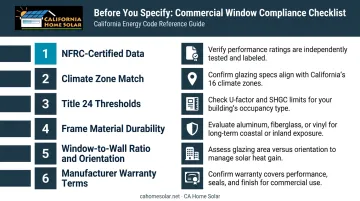
Use this checklist before specifying any commercial window for a California project:
- NFRC-certified data — confirm U-Factor, SHGC, and VLT from the current CPD, not marketing materials
- Climate zone match — verify the property's CEC climate zone using the CEC address lookup tool before comparing products
- Title 24 thresholds — check fixed vs. operable U-Factor maximums for that zone under the applicable code cycle
- Frame material durability — consider heat, UV exposure, and coastal salt air for the installation location
- Window-to-wall ratio and orientation — both affect whole-building compliance modeling
- Manufacturer warranty terms — confirm whether commercial installations are covered and under what conditions
How Installation Defects Undermine Code Compliance
Even a correctly specified, NFRC-certified window underperforms if the installation is flawed. Air infiltration through poor sealing or improper flashing defeats the thermal performance the product was rated for. California's Title 24 also sets a 0.3 cfm/sf maximum air leakage rate for manufactured fenestration — installation defects can push a project out of compliance after the product was correctly selected.
That's where contractor experience with Title 24 compliance — not just the product itself — becomes critical. CA Home Solar has been installing energy-efficient windows and handling commercial energy upgrades across Southern California for 36 years. The team manages both product specification and the code compliance documentation required to get the job permitted and inspected correctly the first time.
Conclusion
No single window brand fits every California commercial application. The right product depends on building type, climate zone, frame material requirements, and budget — and the selection process starts with NFRC-certified data matched against the Title 24 thresholds for your specific project location.
The financial case for upgrading goes deeper than the sticker price. Reduced HVAC loads, SCE and PG&E business efficiency rebates, and improved tenant comfort all factor into the long-term return. For mixed-use properties with residential components, the federal Section 25C credit — 30% of qualifying costs, up to $600/year for windows — may also apply.
Navigating those incentives alongside Title 24 compliance and product selection is easier with a contractor who knows the local requirements. CA Home Solar serves commercial property owners across Southern California with energy-efficient window installation, backed by 36 years in the Los Angeles area, HERO Registered Contractor status, and financing options to help manage upfront costs. Call 877-903-1012 or email info@cahomesolar.com to schedule a consultation.
Frequently Asked Questions
What is the tax credit for windows in California?
The federal Section 25C Energy Efficient Home Improvement Credit covers 30% of qualifying costs, with an annual cap of $600 for exterior windows and skylights. This credit applies to residential and mixed-use properties, not pure commercial buildings. Separately, SCE and PG&E offer business energy efficiency programs — check with your utility for current rebate availability specific to your project.
What is the 2026 window replacement program in California?
This refers to California's 2025 Building Energy Efficiency Standards, which take effect January 1, 2026. The update sets stricter U-Factor and SHGC thresholds for commercial and residential window installations and replacements requiring permits. Projects must use products with NFRC-certified ratings that meet the applicable thresholds for the building's climate zone.
Is it worth getting argon-filled windows?
Yes — for most California commercial buildings. Argon gas between panes improves a window's U-Factor by slowing heat transfer, which directly cuts HVAC loads in inland zones with hot summers and cooler winters. Given California's above-average commercial electricity rates, it's a cost-effective upgrade.
Is 0.27 a good U-Factor for windows?
A U-Factor of 0.27 is considered good to excellent and clears the fixed-window U-Factor maximums for Southern California climate zones CZ 6, 8, 9, and 10 under current Title 24 standards. However, full Title 24 compliance also depends on SHGC, window-to-wall ratio, orientation, and whole-building modeling — U-Factor alone doesn't confirm compliance.
What is the most energy-efficient commercial window frame material?
Fiberglass frames — such as Pella Impervia and Marvin Ultrex — offer the best thermal performance and durability for California commercial applications, outperforming both aluminum and vinyl in heat conductivity and long-term seal integrity. For curtain wall and high-rise projects where fiberglass isn't structurally suited, thermally broken aluminum is the practical alternative.
Do commercial windows in California need to meet Title 24?
Yes. All commercial window replacements and new installations requiring a building permit must comply with Title 24 Part 6. The applicable U-Factor and SHGC thresholds vary by climate zone, and non-compliant products cannot be approved for permitted work. Verify your building's climate zone through the CEC's address lookup tool before specifying products.