Introduction: Why Your Windows Are Costing You Money
You've upgraded your thermostat, sealed your attic, maybe even added insulation — but your AC bill keeps climbing every summer. Sound familiar?
For many homeowners across Los Angeles, Orange County, the San Fernando Valley, and surrounding Southern California communities, windows are the hidden culprit. According to the U.S. Department of Energy, heat gain and heat loss through windows account for 25–30% of residential heating and cooling energy use.
In California, residential electricity averaged 33.35 cents/kWh as of March 2026, nearly double the national average of 18.83 cents/kWh. That inefficiency hits hard every month.
This guide covers the core technologies that determine window thermal performance, what the key metrics mean, and how to choose the right windows for SoCal's specific climate: intense sun, mild winters, and AC running well into October.
TL;DR: Key Takeaways
- Windows cause 25–30% of home energy loss — upgrading them directly reduces cooling costs
- SHGC is the priority metric for SoCal — lower values mean less solar heat entering your home
- Double-pane windows with Low-E coating and argon fill are the practical sweet spot for most Los Angeles homes
- Fiberglass and insulated vinyl frames outperform aluminum for thermal resistance
- ENERGY STAR–certified replacements may qualify for a 30% federal tax credit up to $600
What Thermal Efficiency in Windows Actually Means
Thermal efficiency, in plain terms, is how well a window slows heat movement between indoors and outdoors. Glass alone doesn't tell the whole story — the frame, gas fills between panes, spacers, and seals all affect overall performance.
Four metrics define how a window performs thermally:
U-Factor
U-factor measures the rate at which a window transmits non-solar heat flow. Lower numbers mean better insulation. According to the NFRC Consumer Guide, the typical rating range is 0.10 to 2.00, with residential windows generally falling between 0.20 and 1.20.
For Southern California, ENERGY STAR Version 7.0 requires a U-factor of 0.28 or lower for the South-Central climate zone, which includes Los Angeles County. Always compare the whole-window U-factor — not just center-of-glass — because frames and spacers affect the real-world number.
SHGC: The Most Important Metric for SoCal
SHGC (Solar Heat Gain Coefficient) measures the fraction of solar energy entering through the glass — both directly transmitted and absorbed, then released as heat indoors. The scale runs from 0 to 1.
In Los Angeles, where the sun is intense most of the year and cooling costs dominate, SHGC is the number that most directly affects your energy bills. ENERGY STAR's South-Central zone requires SHGC of 0.23 or lower. South- and west-facing windows without adequate solar control drive up cooling loads significantly.
Visible Transmittance (VT)
There's a real trade-off with VT — coatings that cut solar heat gain can also trim visible daylight slightly. Most quality Low-E windows balance both, but comparing VT values is worthwhile when bright interior spaces matter to you.
Air Leakage (AL)
Air Leakage measures air passing through the window assembly. ENERGY STAR requires AL of 0.3 or lower. Even a thermally excellent window will underperform if drafts pass through poor weatherstripping or gaps around the frame.
Reading the NFRC Label
Every ENERGY STAR–qualified window carries an NFRC label listing all four metrics. You can also look up any certified product in the NFRC Certified Products Directory before purchasing. Compare whole-window values, not manufacturer marketing numbers.
Glazing Technologies: The Engine of Thermal Efficiency
Glass selection — pane count, coatings, and fill gas — drives most of a window's thermal performance.
Single-Pane vs. Double-Pane vs. Triple-Pane
| Glass Type | Typical U-Factor | Best For |
|---|---|---|
| Single-pane (clear, metal frame) | ~1.29 | Nothing — obsolete for efficiency |
| Double-pane (IGU, Low-E, improved frame) | 0.25–0.35 | Most homes, including SoCal |
| Triple-pane (Low-E, nonmetal frame) | As low as 0.19 | Cold climates; desert-edge areas like Lancaster/Palmdale |
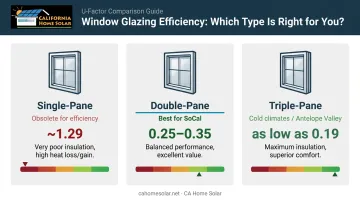
According to a DOE-sponsored measure guideline, double glazing reduces heat loss by more than 50% compared with single glazing. Triple-pane adds weight and cost with diminishing returns in warm climates — but it does make sense for Antelope Valley homes where temperature swings are more extreme.
Low-E Coatings
Low-E (low-emissivity) coatings are microscopically thin metallic layers applied to one or more pane surfaces. They reflect infrared heat while allowing visible light through, acting as a one-way thermal mirror.
Two formulation types matter for homeowners:
- Passive Low-E — tuned to retain interior heat; better for cold climates
- Solar-control Low-E — reflects solar gain outward; better for warm climates like SoCal
Both types come in two manufacturing variants: hard-coat Low-E (molten tin fused to the glass surface) and soft-coat Low-E (silver or zinc applied in a vacuum chamber). Soft-coat generally delivers superior solar control performance. CA Home Solar installs both, recommending the right formulation based on your home's orientation and climate zone.
Spectrally Selective Low-E
This is the technology that changes the equation for Southern California homes. According to the DOE's Window Types and Technologies page, spectrally selective Low-E coatings can filter 40–70% of the heat normally transmitted through insulated glass while still allowing full visible light transmission.
The practical result: you get daylight without the greenhouse effect. For west-facing living rooms and south-facing bedrooms, this is the coating to ask for specifically.
Gas Fills and Warm-Edge Spacers
The space between panes matters too:
- Argon gas — the standard fill for ½-inch gaps; inexpensive, effective, non-toxic
- Krypton gas — denser than argon; better thermal performance in thinner ¼-inch gaps; costs more
Metal spacers (the component holding panes apart) conduct heat at the glass edges, creating cold spots and condensation. Warm-edge spacers made from insulating materials — stainless steel foam, thermoplastic compounds, or silicone — reduce this edge heat transfer. Switching from aluminum to quality warm-edge spacers can reduce overall window U-factor by approximately 0.02, a meaningful whole-window improvement.
Frame Materials and Their Thermal Impact
Glass performance means little if the frame undermines it. Here's how the main options compare:
| Frame Type | Thermal Performance | Notes |
|---|---|---|
| Vinyl (multi-chamber) | Excellent | Multiple air chambers slow heat transfer; most cost-effective |
| Fiberglass | Excellent–Superior | Can be filled with insulation; dimensionally stable |
| Wood | Good | Natural insulator; requires more maintenance |
| Aluminum (no break) | Poor | Conducts heat readily; not suitable without modification |
| Aluminum (thermal break) | Moderate | Acceptable with polyurethane/polyamide break inserted |
According to Lawrence Berkeley National Laboratory, traditional thermal breaks in aluminum frames — polyamide strips or polyurethane — can show 40–90% thermal improvement over standard aluminum. For SoCal homes that want aluminum's aesthetic without the heat-transfer penalty, a quality thermal break is non-negotiable.
Fiberglass frames take a different approach to Southern California's temperature swings. Because they resist expansion and contraction across wide ranges — Pella tests their fiberglass frames from -40°F to 160°F — they hold seal integrity longer and preserve the insulating gas fill over time.
Choosing the Right Windows for Southern California's Climate
SoCal's challenge isn't extreme cold — it's relentless sun. That shifts the decision-making framework considerably compared to what you'd read in generic window guides written for Minnesota or Vermont.
Orientation Strategy
Window placement determines which technologies matter most:
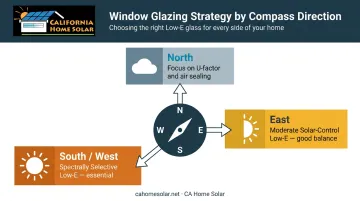
- South- and west-facing — strongest afternoon sun; spectrally selective Low-E is essential here
- East-facing — morning sun; moderate solar-control Low-E offers good balance
- North-facing — minimal direct sun; focus on U-factor and air sealing rather than SHGC
The SoCal Sweet Spot
For most homes across Los Angeles County, the San Fernando Valley, and the South Bay: double-pane IGUs with spectrally selective Low-E coating and argon gas fill. This combination delivers strong SHGC control (meeting ENERGY STAR's ≤0.23 threshold), solid insulation, and reasonable cost. Triple-pane's added weight and expense rarely pencil out here — unless you're in Lancaster or Palmdale where summer highs routinely exceed 100°F and winter nights get genuinely cold.
UV Protection
Southern California's sun doesn't just heat your home — it fades your floors, furniture, and artwork. Quality Low-E glass addresses this too. Cardinal's LoĒ-366 coating, for example, blocks up to 95% of damaging UV rays, and ENERGY STAR messaging notes that such coatings can reduce interior fading by up to 75%.
CA Home Solar's Window Services
CA Home Solar has served Southern California homeowners for 36 years, installing energy-efficient Low-E windows across both hard-coat and soft-coat options — passive solar (Low-E 180), heat-reduction (Low-E 272), and balanced solar-control (Low-E 366) variants.
As a HERO Registered Contractor, CA Home Solar also offers HERO PACE financing: zero down, flexible 5–25 year terms, no application fees, billed through your property tax. Windows can be financed alongside solar, HVAC, or roofing in a single package.
Energy Ratings, Certifications, and Financial Incentives
ENERGY STAR and Real Savings
ENERGY STAR certifies windows that meet climate-zone-specific performance thresholds set by the EPA. For Southern California (South-Central zone), that means U-factor ≤ 0.28 and SHGC ≤ 0.23 under Version 7.0 criteria.
Replacing single-pane windows with ENERGY STAR–certified windows saves an average of 13% on household energy bills nationally. In California, where electricity costs nearly twice the U.S. average, that percentage adds up to noticeably higher real-dollar savings on monthly bills.
Federal Tax Credit
Homeowners who replace windows in an existing principal residence with ENERGY STAR Most Efficient–certified products may qualify for a 30% federal tax credit, up to $600 per year. Key eligibility conditions include:
- Windows must meet ENERGY STAR Most Efficient certification standards
- Installation must be in your primary residence (not a rental property)
- Credit applies to product cost; installation costs are excluded
Eligibility windows and credit terms can change. Verify current dates and requirements with a tax professional or directly at IRS.gov before purchasing.
Resale Value
Window replacement also pays back at resale. According to the 2024 Cost vs. Value Report from JLC/Zonda, vinyl window replacement recoups an average of 67.1% of project cost nationally, and wood window replacement recoups 62.9% — returns that outperform most interior renovation projects, including bathroom remodels and kitchen updates.
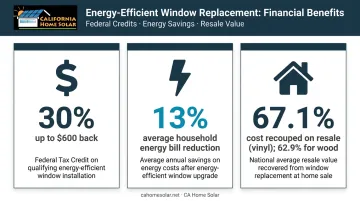
For Southern California homeowners, those figures combine with energy savings and available tax credits to build a strong financial case for upgrading to high-performance windows.
Frequently Asked Questions
Are thermally efficient windows worth the investment?
Yes. The upfront cost is offset by long-term energy savings, a potential federal tax credit up to $600, and increased resale value. In California, where electricity rates rank among the nation's highest, the payback timeline is shorter than in most other states.
Is there a tax credit for energy-efficient windows in 2026?
Current IRS guidance covers ENERGY STAR Most Efficient–certified window replacements through December 31, 2025, meaning 2026 eligibility is not yet confirmed. Qualified installations in existing principal residences can claim 30% back, up to $600. Verify the latest dates with a tax professional or at IRS.gov before purchasing.
What U-factor indicates good thermal efficiency for windows?
ENERGY STAR requires a U-factor of 0.28 or lower for the South-Central zone covering Los Angeles County. For colder climates, 0.25 or lower is the better target. Always compare whole-window U-factors, not center-of-glass measurements.
What are the most thermally efficient windows available?
Fixed (picture) windows paired with triple-pane glass, spectrally selective Low-E coatings, and krypton gas fill deliver the highest thermal performance. For most SoCal homes, double-pane with spectrally selective Low-E and argon fill hits the efficiency sweet spot at a more practical cost.
What does SHGC mean, and what's a good value for Southern California?
SHGC is the fraction of solar energy that enters through the glass. ENERGY STAR's South-Central criteria (covering Los Angeles County) require SHGC ≤ 0.23 — prioritize this metric over U-factor when choosing windows for south- or west-facing exposures.
How long do energy-efficient windows typically last?
Quality energy-efficient windows last 20–30 years or more, though Low-E seals and gas fills should be inspected periodically for seal failure. Professional installation significantly affects long-term performance. Improperly seated frames and seals can degrade rated efficiency within just a few years, so choosing a licensed installer matters as much as the window itself.