For small business owners, this creates real pressure. A restaurant running kitchen equipment through peak hours, a warehouse cooling products through a Southern California summer, or a retail storefront with heavy lighting loads — all face electricity costs that compound year over year.
Small commercial solar isn't primarily an environmental statement. For most business owners, it's a capital investment decision. The question is whether it's a good one — and the answer depends heavily on system size, financing structure, local incentives, and how well the system is designed to match actual load.
This guide breaks down realistic cost ranges, the factors that drive ROI, how to calculate payback, and the mistakes that derail otherwise solid investments.
Key Takeaways
- Small commercial solar systems (10–200 kW) cost $2.50–$4.30/W installed before incentives, per LBNL's 2023 market data
- The 30% federal Investment Tax Credit alone cuts effective system cost by nearly a third
- California's commercial electricity rates make solar ROI stronger here than in most other states
- Well-designed Southern California systems typically reach payback in 4–8 years
- Under NEM 3.0 (Net Billing Tariff), self-consumption beats export — size your array to match daytime load, not to maximize output
What Does a Small Commercial Solar Array Cost?
"Small commercial" typically covers systems from 10 kW to 200 kW — the range serving retail shops, offices, restaurants, warehouses, and light industrial facilities. Cost does not scale linearly with size, and businesses often underestimate total project cost by budgeting only for panels and installation, missing the soft costs that can add 20–30% to the total.
What soft costs include:
- Permitting and plan check fees
- Structural and electrical engineering documentation
- Utility interconnection application fees
- Project management overhead
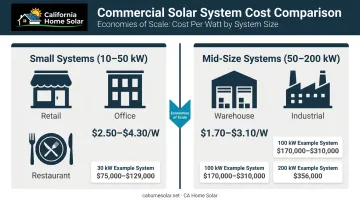
Small Systems: 10–50 kW
LBNL's 2024 Tracking the Sun report places 2023 installed prices for nonresidential systems 100 kWdc or less at $2.50–$4.30/W (20th to 80th percentile), before incentives.
For a 30 kW system, that translates to roughly $75,000–$129,000 installed.
What's typically included: Panels, string inverter, rooftop racking, basic electrical balance of system, permitting, and utility interconnection filing.
Best for: Small retail storefronts, offices, restaurants, and service businesses with moderate daytime energy loads.
Installed price within this range varies based on:
- Roof complexity and structural condition
- Local labor rates
- Inverter type and panel efficiency tier
- Whether interconnection requires utility-side upgrades
Mid-Size Systems: 50–200 kW
At this tier, economies of scale start to appear. LBNL's data shows systems greater than 100 kWdc in the $1.70–$3.10/W range, and NREL's Annual Technology Baseline models a 200 kWdc commercial rooftop system at $1.78/W in 2023, a practical reference point when evaluating larger bids.
For a 100 kW system, expect roughly $170,000–$310,000. A 200 kW system benchmarks closer to $356,000 using NREL's modeled reference.
What's typically included: Higher-efficiency panels, central or multiple string inverters, potentially ground-mount or carport configurations, advanced monitoring, and more complex engineering documentation.
Best for: Light industrial facilities, warehouses, multi-tenant commercial buildings, and businesses with high daytime consumption and adequate roof or ground space.
These ranges exclude:
- Battery storage (a meaningful additional investment)
- Structural roof upgrades if required before installation
- Electrical panel upgrades if service capacity is insufficient
California Home Solar handles both roofing and solar installation, so businesses that need a roof replacement before going solar can bundle both into one project — typically more cost-effective than scheduling them separately.
Key Factors That Affect Small Commercial Solar ROI
System price is just the starting point. The interaction between local electricity rates, system output, incentive capture, and financing structure determines whether a project earns a strong return or merely breaks even.
System Size and Load Match
Under California's Net Billing Tariff (NEM 3.0), the CPUC has confirmed that export credits use Avoided Cost Calculator values — typically lower than import rates. This changed the sizing math significantly compared to NEM 2.0.
A system that produces more than the site consumes during business hours exports the surplus at below-retail rates. Right-sizing to 80–100% of daytime load is now the ROI-optimal approach for most small commercial buyers — exporting less means earning more on every kilowatt-hour your system generates.
Local Electricity Rates and Demand Charges
SCE's TOU-GS-1 applies to businesses with demand 20 kW or less; TOU-GS-2 covers businesses with demand above 20 kW and below 200 kW. Both tariffs include:
- Energy charges — cost per kWh, varying by time-of-use period and season
- Facilities-Related Demand charges — based on maximum monthly kW draw
- Time-Related Demand charges — applied during on-peak and mid-peak periods
Solar can reduce both components. LBNL research on demand charge savings from commercial solar confirms PV can cut demand charges — though the magnitude depends on whether demand charges are tied to predefined daytime peak windows that align with solar production hours.
Roof Condition and Site Suitability
A roof approaching end of life needs replacement before solar goes on it. Shade from neighboring buildings, HVAC equipment, or parapets also cuts into output — and depending on the inverter architecture, shaded panels can drag down the performance of nearby unshaded ones as well.
A professional site assessment should include:
- Structural roof evaluation
- Shade analysis across seasonal sun angles
- Utility interconnection feasibility check
Financing Structure
How you pay for the system determines who captures the tax credit and depreciation benefits — and therefore what your effective ROI actually is.
| Method | Who Gets ITC | Notes |
|---|---|---|
| Cash purchase | Business owner | Maximum long-term return |
| Commercial loan | Business owner | Preserves capital, still captures incentives |
| C-PACE financing | Business owner | Secured by property lien, no upfront cash |
| PPA | Developer/installer | Lower risk, lower return |
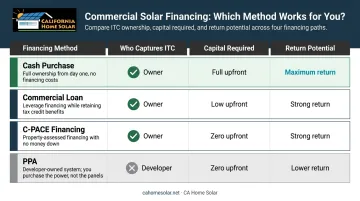
For commercial property owners who want ownership benefits without the upfront outlay, C-PACE is often the most practical path. California Home Solar is a HERO Registered Contractor and can structure C-PACE financing billed through property taxes over 5–25 year terms.
How to Calculate ROI on a Small Commercial Solar Array
Commercial solar is a capital investment — and like any investment, it needs to be evaluated with the right metrics. Three numbers matter most:
- Simple payback period — quick sanity check
- Net Present Value (NPV) — accounts for time value of money
- Internal Rate of Return (IRR) — compares against alternative investments
Simple Payback Period
The formula is straightforward:
(Total installed cost − incentives) ÷ annual savings = payback years
Example — 50 kW system in Southern California:
- Installed cost: $150,000 (at $3.00/W)
- Federal ITC (30%): −$45,000
- Net cost after ITC: $105,000
- Annual energy savings (estimated at $0.27/kWh blended rate, ~90,000 kWh/year production): ~$24,300
- Simple payback: ~4.3 years
Simple payback doesn't capture electricity rate inflation over the system's 25–30 year life, or demand charge savings — both of which strengthen the actual return. Use it as a floor estimate, not a ceiling.
The Role of Demand Charges
For commercial customers, total annual savings should be calculated in two parts:
- Energy offset savings = solar kWh produced × avoided retail rate per kWh
- Demand charge reduction = peak kW shaved × demand charge rate per kW
Demand charge savings can account for 30–50% or more of total bill reduction for businesses on commercial TOU tariffs. A small business owner who calculates expected savings using only their average kWh rate will significantly underestimate actual returns.
That self-consumption dynamic also matters under NEM 3.0: solar you use on-site avoids retail import rates, while exported surplus earns only ACC-based credits. Every kWh consumed behind the meter is worth more than every kWh sent to the grid — which reinforces why demand reduction and load matching matter so much in the ROI calculation.
Net Present Value and Long-Term Returns
NPV and IRR account for what simple payback ignores: the time value of money, future electricity rate increases, and the full production life of the system.
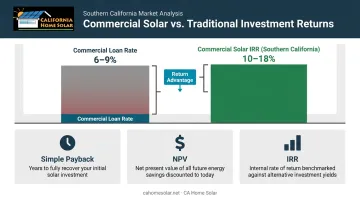
A positive NPV confirms the solar investment outperforms leaving that capital idle. IRR tells you how that return stacks up against alternatives — commercial loan rates typically run 6–9%, while well-sized commercial solar systems in Southern California often project IRRs in the 10–18% range depending on system size, rate structure, and available incentives. That gap is why solar tends to win the capital allocation comparison.
NREL's System Advisor Model (SAM) and PVWatts Calculator are free tools that Southern California business owners can use to model production with local weather data and run full financial analyses with custom assumptions.
Incentives That Improve the Economics of Small Commercial Solar
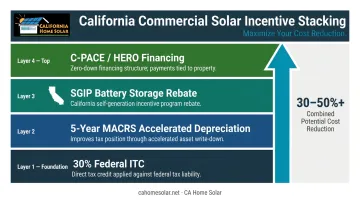
Properly stacked incentives can reduce the effective cost of a small commercial solar array by 30–50% or more. Missing even one of them can meaningfully extend payback.
Federal Investment Tax Credit (ITC)
The current 30% federal ITC applies to commercial solar systems placed in service under the Inflation Reduction Act. It's a direct credit against federal tax liability in the year the system is placed in service — not a deduction.
Additional federal benefits worth understanding:
- Domestic content bonus (+10% credit adder) for systems using qualifying U.S.-manufactured components
- Energy community bonus (+10% credit adder) for systems in designated energy communities
- 5-year MACRS accelerated depreciation, which can meaningfully improve your tax position in the first few years of ownership
Consult a CPA before committing to a system — the interaction between ITC, depreciation, and your business's tax position can materially change which financing structure makes the most sense.
California-Specific Programs and Local Incentives
Federal incentives stack with several California-specific programs — and that layering is where the real economics shift.
SGIP (Self-Generation Incentive Program) offers rebates for energy storage at non-residential facilities. Pairing battery storage with a commercial solar project can offset a meaningful portion of storage cost. Program budgets fluctuate, so confirm current availability before committing to a project.
HERO PACE Financing is available through California Home Solar as a HERO Registered Contractor. Qualifying commercial properties in Southern California can access zero-down financing with no application fees, flexible 5–25 year terms, and no impact on existing rebate or tax credit eligibility.
DSIRE's California solar program database (68 programs currently listed) is a useful starting point for additional state and local incentives. Programs change frequently — a local installer who actively tracks current offerings is one of the simplest ways to avoid missing an applicable program.
Common Mistakes That Hurt Small Commercial Solar ROI
Focusing Only on Lowest Upfront Price
The cheapest bid rarely produces the best financial outcome. Low-efficiency panels, undersized inverters, or installers who cut corners on engineering documentation lead to underperforming systems, warranty gaps, and higher long-term maintenance costs.
Ignoring Demand Charges and TOU Rate Structures
Calculating expected savings using only the average kWh rate misses the demand charge component entirely. A system that doesn't reduce peak demand during the hours that trigger charges means demand charge savings never materialize — often the largest line item on a commercial utility bill.
Over-Sizing for Export Under NEM 3.0
Under California's Net Billing Tariff, a system built to export large amounts of midday power earns credits at ACC values — generally well below retail import rates. Right-sizing to actual daytime load now drives stronger ROI than maximizing array size.
Skipping a Full Site Assessment
Proceeding without a professional shade analysis, structural roof evaluation, and utility interconnection feasibility check creates risk of costly mid-project surprises or systems that underperform projections from day one. A full facility assessment and financial evaluation before system design is how projected savings translate into actual savings. California Home Solar includes this step in every commercial project — because without it, the ROI math rarely holds up in the field.
Frequently Asked Questions
What is the typical payback period for a small commercial solar array in California?
Well-designed small commercial systems in Southern California typically reach payback in 4 to 8 years before incentives. When the 30% federal ITC and MACRS accelerated depreciation are factored in, that range often compresses to 3 to 6 years depending on system size, utility tariff, and load profile.
How do I calculate the ROI on a small commercial solar installation?
Start with the simple payback formula: net installed cost ÷ annual savings. Use this as a starting estimate, not a final answer. NPV and IRR calculations — which account for electricity rate inflation and the full 25+ year system life — give a more complete picture. NREL's free SAM tool runs both.
What incentives are available for small commercial solar in California?
The core stack includes the 30% federal ITC, 5-year MACRS depreciation, California SGIP for paired battery storage, and HERO/C-PACE financing for qualifying properties. Consult both a tax advisor and a local solar contractor — what's available and applicable varies by project specifics and current program budgets.
How does California's NEM 3.0 affect small commercial solar ROI?
NEM 3.0 (Net Billing Tariff) reduced export compensation to Avoided Cost Calculator values, which are generally below retail import rates. Systems sized and designed to maximize on-site consumption during business hours now achieve better ROI than systems designed to export surplus power.
What size solar array does my small business need?
Target 80–100% of daytime load to maximize self-consumption under NEM 3.0 and avoid oversizing. Start with a 12-month utility bill review and a professional load analysis — these two inputs are necessary for any accurate sizing recommendation.
Can I finance a small commercial solar installation without a large upfront investment?
Yes. Options include commercial solar loans, C-PACE financing (secured by a property lien, not credit score), and PPAs. California Home Solar is a HERO Registered Contractor and offers PACE financing with no upfront cost, so most businesses see utility savings before the first payment is due.