Introduction
You've just received a quote for bifacial solar panels. The installer mentioned "up to 30% more energy" — but didn't specify whether that number applies to a ground-mount system or the standard rooftop install your neighbors have.
That gap matters. A lot.
Bifacial panels generate electricity from both sides, capturing reflected light from surfaces beneath the panel in addition to direct sunlight hitting the front. How much of that reflected light actually reaches the rear depends on your installation setup, not the panel's specs.
According to IEA PVPS 2024 Trends data, more than 90% of solar modules sold in 2024 used bifacial cells. The technology is now mainstream. That widespread adoption makes the real question sharper: what separates a high-performing bifacial system from a mediocre one? It isn't the panel — it's the mount.
This article breaks down the performance difference between bifacial ground-mount and rooftop systems using 2025–2026 field data, covering the key drivers behind the output gap. Southern California homeowners will find a practical framework for choosing the right configuration for their property.
Key Takeaways
- Ground-mount bifacial systems outperform rooftop bifacial because installation configuration drives rear-side light capture
- Albedo (surface reflectivity beneath panels) is the biggest variable: white concrete (~0.53) vs. dark asphalt shingles (5–20%)
- SoCal's irradiance (~5.6 kWh/m²/day in LA) makes bifacial rear-side gains significant in real kWh output year-round
- Rooftop bifacial panels still outperform monofacial rooftop panels — especially on light-colored tile roofs or with elevated racking
- Urban SoCal homeowners typically go rooftop; those with yard space should seriously consider ground-mount
Bifacial Ground-Mount vs. Rooftop Solar: Quick Comparison
Both configurations use bifacial panels. The difference comes down to installation placement: how much clearance the panels get, what surface sits beneath them, and whether you have usable land or roof space. In Southern California, both options outperform traditional monofacial installations, but the right choice depends on your property.
| Factor | Bifacial Ground-Mount | Bifacial Rooftop |
|---|---|---|
| Typical bifacial energy gain | Higher — varies by albedo and configuration | Lower — limited by roof clearance and surface |
| Mounting clearance | 2–4+ feet above ground surface | 2–6 inches (flush) to 12+ inches (elevated) |
| Albedo controllability | High — surface can be prepared | Low — roof material is typically fixed |
| Installation cost premium | ~$0.40/W more than rooftop (LBNL 2023) | Lower baseline cost |
| Space requirements | 200+ sq ft of open yard space needed | Uses existing roof footprint |
| Best use case | Properties with usable land and southern exposure | Urban/suburban homes with limited yard space |
What Is Bifacial Ground-Mount Solar?
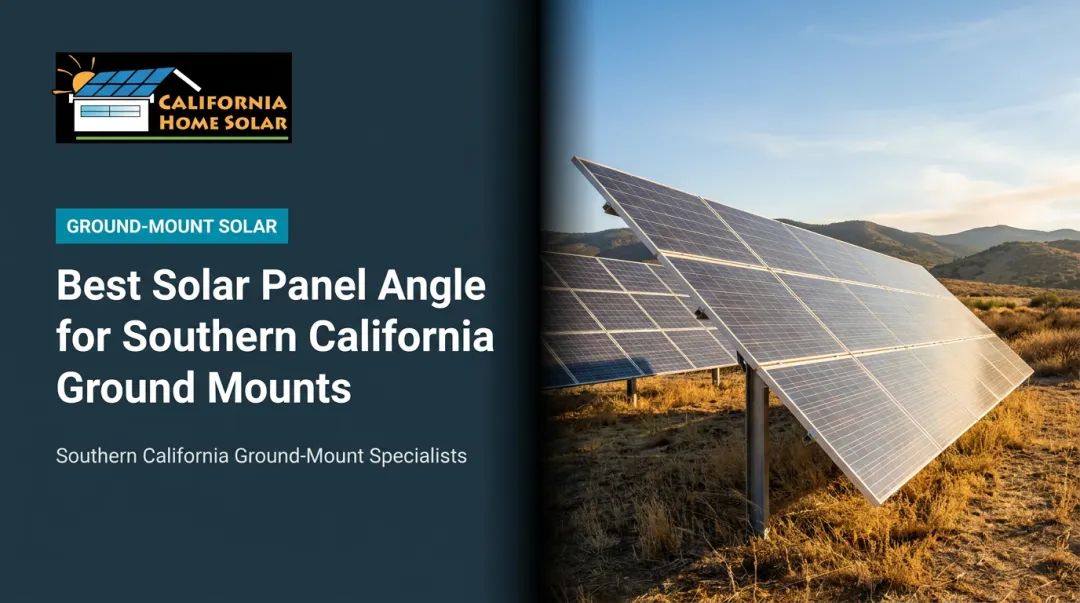
Ground-mount bifacial systems are installed on freestanding racking structures set directly on the ground or on a prepared surface. Unlike rooftop installations, the rear side of each panel has unobstructed access to light reflected from the ground below.
How the Albedo Effect Works
The key physics concept here is albedo — the fraction of sunlight a surface reflects back upward. Higher albedo means more reflected light reaching the rear of the panel, which means more electricity generated.
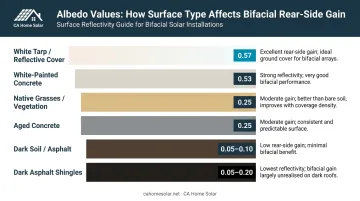
NREL's albedo dataset includes measured values for common ground surfaces:
- White-painted concrete: ~0.53 albedo
- White tarp / reflective cover: ~0.57 albedo
- Native grasses / vegetation: ~0.25 albedo
- Aged concrete: ~0.25 albedo
- Dark soil / asphalt: Classified as low-albedo (~0.05–0.10 albedo)
By contrast, dark roofing materials reflect only 5–20% of sunlight — which is why rooftop bifacial gains are far more limited. Ground-mount installations can be designed around these numbers. Spacing rows wider apart, elevating panels 2–4 feet above the surface, and preparing the ground with light-colored gravel or concrete are all practical ways to increase rear-side irradiance. Rooftop installations offer almost none of these controls.
Panel Technology in 2026
Albedo determines how much reflected light reaches the panel — but cell technology determines how much of that light becomes electricity. The two dominant bifacial cell types in 2026, TOPCon and HJT, differ in this conversion efficiency, expressed as a bifaciality coefficient:
- TOPCon: ~80–85% bifaciality (Jinko Tiger Neo 3.0: 85% ±5%)
- HJT: ~90–95% bifaciality (Canadian Solar HiHero+: up to 95%)
A higher coefficient means the panel captures a larger fraction of the ground-reflected light. On a well-prepared ground-mount surface, HJT panels will extract more rear-side gain than TOPCon — though both outperform monofacial panels significantly.
Ideal Use Cases for Ground-Mount
- Homeowners with open yard space and good southern exposure
- Properties where the roof is poorly oriented, heavily shaded, or structurally unsuitable
- Larger energy users who need more capacity than the roof can accommodate
CA Home Solar's site assessments for ground-mount projects cover available land, shading patterns, soil conditions, and optimal panel angle. These are factors a standard rooftop assessment never needs to address.
What Is Bifacial Rooftop Solar?
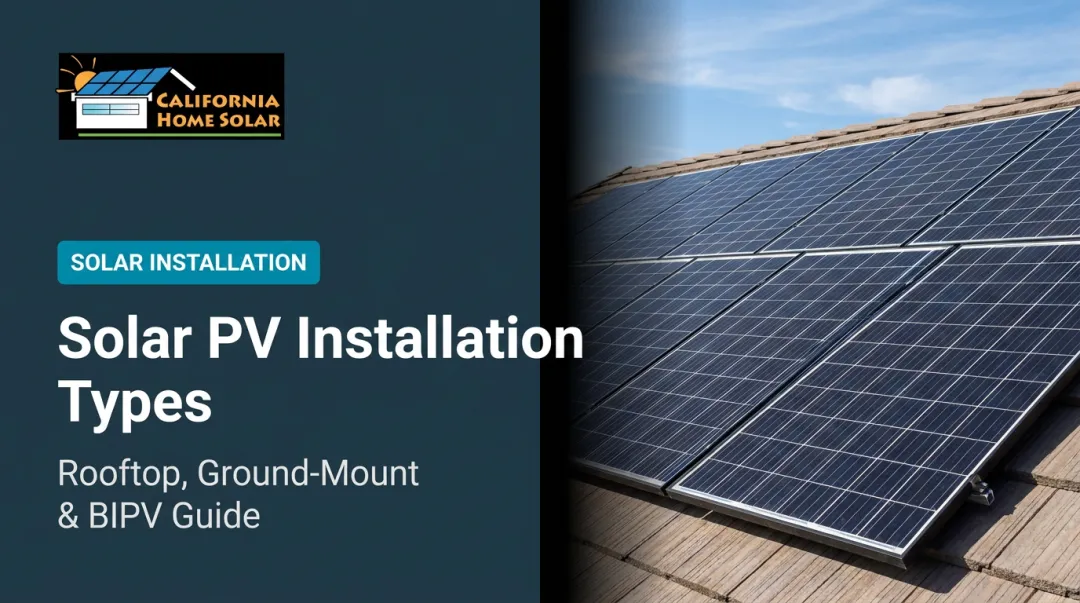
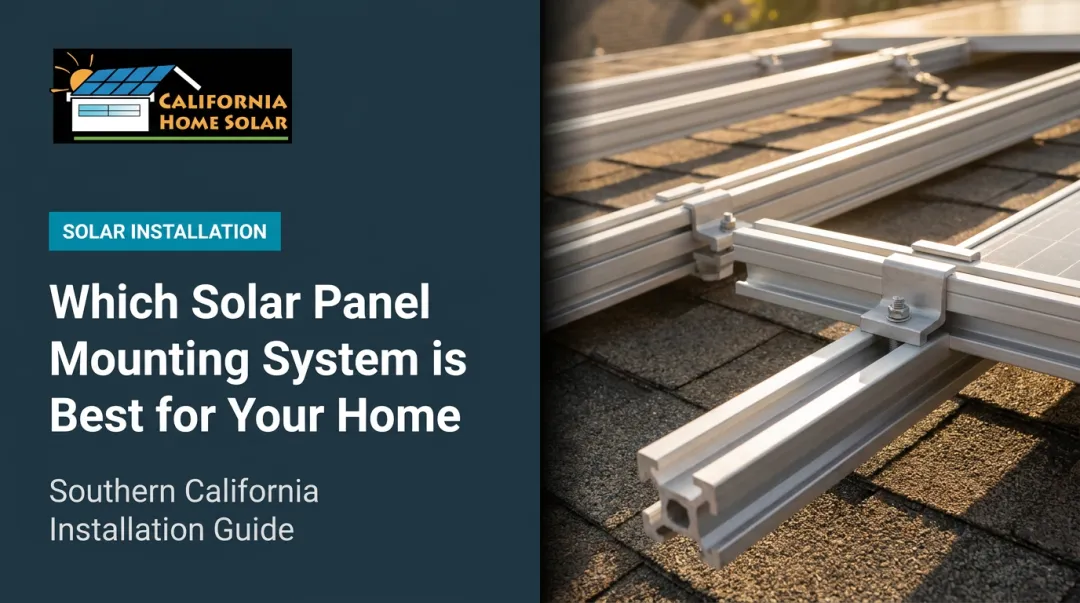
Bifacial rooftop installations place bifacial panels on a residential roof in the conventional way. The rear side of the panel faces the roof surface — and that's where the challenge starts.
Most residential rooftops offer only 2–6 inches of clearance for flush-mounted systems. At that distance, with a dark or mid-tone roof beneath the panel, very little reflected light reaches the rear side.
How Mounting Style Affects Bifacial Gain
Two rooftop mounting approaches produce meaningfully different results:
| Mounting Type | Clearance | Rear-Side Gain | Best For |
|---|---|---|---|
| Standard flush-mount | 2–6 inches | Minimal — dark asphalt shingles reflect only 5–20% of light | Budget installs; space-constrained roofs |
| Elevated tilt-mount | 12+ inches | Meaningfully higher — more reflected light reaches panel rear | Light-colored tile; flat roofs with ballasted racking |
Where SoCal Roof Types Help
That reflectivity gap matters less in Southern California, where common roofing materials outperform dark asphalt shingles by a wide margin:
- Light concrete tile: Reflects 55–90% of sunlight (LBNL)
- Clay/terra cotta tile: Can achieve sufficient reflectivity for cool roof standards depending on composition
- White TPO membrane (flat roofs): Highly reflective; excellent for elevated ballasted bifacial racking
A 2024 peer-reviewed simulation published in Energy Conversion and Management found rooftop bifacial systems can achieve energy yield gains up to 22.6% under favorable conditions — elevated mounting, light-colored roof surface, and optimal tilt. That's the ceiling, not the average, but it confirms rooftop bifacial can deliver real gains.
Ideal Use Cases for Rooftop Bifacial
- Homeowners with no usable yard space
- Properties with light-colored tile or flat membrane roofs
- Homeowners who want maximum output from their existing roof footprint
- Flat-roof residential or commercial buildings where elevated ballasted racking is feasible
Performance Data 2026: How Do They Really Compare?
The honest answer is that bifacial performance data doesn't split neatly into "ground-mount = X%" and "rooftop = Y%" universally. Configuration and surface albedo drive the outcome more than any other variable.
What the Research Actually Shows
NREL's bifacial field and modeling work establishes that bifacial energy gain is highly site-configuration-dependent, with surface albedo, panel clearance height, tilt angle, and row spacing as the primary inputs.
Key data points from credible sources:
- NREL single-axis tracking bifacial systems: 4–15% gain over monofacial baseline, with a global average around 9%
- IEA PVPS 2024: Tracking gains of 15–20% plus bifacial gains of 2–10% are additive — maximum combined gains up to 30–35% in optimal tracking + bifacial setups
- Rooftop simulation (2024 peer-reviewed): Up to 22.6% gain under favorable elevated/reflective rooftop conditions
- Oregon commercial field site (NREL): Corrected bifacial energy gain of 7.0% after measurement corrections
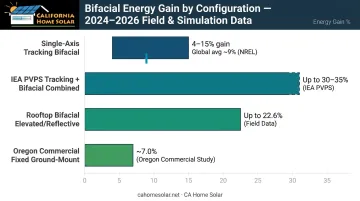
In practice, ground-mount bifacial systems with optimized surfaces and tracking consistently achieve higher gains than flush-mounted rooftop bifacial. Fixed residential ground-mount without tracking sits in the middle — better than flush rooftop, but short of peak tracking system numbers.
The Southern California Advantage
LA's solar resource is exceptional. NASA POWER data records Los Angeles at ~5.6 kWh/m²/day of global horizontal irradiance (roughly 2,060 kWh/m²/year). The direct normal irradiance figure is even higher at ~7.57 kWh/m²/day.
What this means for bifacial performance:
- The front-side baseline production is already high
- Any rear-side gain represents a meaningful absolute kWh addition — not just a percentage on a small number
- SoCal bifacial ground-mount systems deliver consistent year-round rear-side gains — northern climates rely on seasonal snow reflection, but here stable albedo surfaces and near year-round sunshine do the work
- Low humidity and minimal cloud cover mean fewer days of diffuse-only light, where bifacial advantage narrows
A suburban SoCal property with light concrete hardscape or decomposed granite beneath a ground-mount array (common in LA and Orange County) provides higher albedo than dark shingle rooftops, delivering reliable rear-side production year-round.
Which Installation Is Right for Your Home?
The Decision Framework
Choose ground-mount bifacial if:
- You have 200+ sq ft of open yard with good southern exposure
- Your roof is poorly oriented, shaded, or structurally constrained
- You want maximum system size without roof space limitations
- You're comfortable with the ~$0.40/W cost premium (LBNL 2023 data)
Choose rooftop bifacial if:
- You have limited or no usable yard space (typical for most LA/OC suburban lots)
- Your roof has light-colored tile or flat membrane — especially if elevated racking is feasible
- You want lower upfront installation cost with a meaningful upgrade over monofacial
Understanding the Cost Trade-Off
Current residential solar pricing sits at $3.39/Wdc nationally for Q4 2025 (SEIA/Wood Mackenzie), with NREL's Q1 2024 benchmark at $3.15/Wdc. LBNL's Tracking the Sun 2024 report documents a residential ground-mounting cost premium of approximately $0.40/W above rooftop installation costs.
For a 10 kW ground-mount system, that's roughly $4,000 in additional upfront cost. Whether higher bifacial energy yield offsets that premium depends on:
- Your local utility rate (SCE/SDG&E/LADWP all differ)
- NEM 3.0 (Net Billing Tariff) export credit values for your utility
- How much the ground surface albedo is optimized
- Whether battery storage is part of the system design
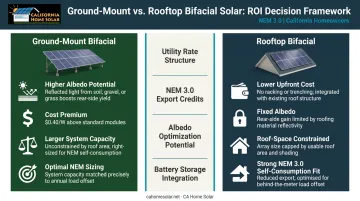
Under California's current Net Billing Tariff (effective for new interconnections after April 15, 2023), self-consumption matters more than export — which favors properly sized rooftop systems for many homeowners. Ground-mount's higher overall yield can offset this disadvantage, depending on your site conditions and usage profile.
Get a Site-Specific Assessment
Every property has variables that data tables can't capture. CA Home Solar's team, with 36 years of installation experience across Southern California, assesses roof orientation, shading patterns, available ground space, soil conditions, and local utility rate structures to identify the configuration that delivers the strongest long-term savings for your specific situation.
Conclusion
Ground-mount bifacial systems consistently show stronger performance data in 2026, primarily because albedo can be controlled and clearance can be optimized. For most urban and suburban Southern California homeowners, rooftop bifacial remains the practical right choice — the lots simply don't have the open space a ground-mount system needs.
Either way, upgrading to bifacial panels over monofacial is worth doing regardless of configuration. The key is matching the installation to your site — optimizing clearance, surface reflectivity, and panel orientation to capture the rear-side gain you're paying for. That requires an installer who knows SoCal conditions, not just panel specs — which is exactly where local experience matters. California Home Solar has been doing this work across Southern California for 36 years; contact them to get a site-specific assessment before committing to a configuration.
Frequently Asked Questions
What is the 120% rule for solar panels?
From NEC Article 705.12(B)(3), the combined amperage of your main breaker and solar backfeed breaker cannot exceed 120% of your panel's busbar rating. This governs how your solar system connects to your home's electrical panel and can limit system size if your busbar is undersized.
Do bifacial solar panels actually work on a standard rooftop?
Yes, but the gain is modest under standard flush-mount conditions because rear-side clearance is low and most roof surfaces have limited reflectivity. Gains improve meaningfully with elevated tilt-mount racking and light-colored roof materials — SoCal's clay tile and concrete tile roofs are more bifacial-friendly than dark asphalt shingles common elsewhere.
How much more energy does a ground-mount bifacial system produce vs. rooftop bifacial?
Results vary by configuration: NREL reports bifacial gains of 4–15% for single-axis tracking systems, while rooftop simulations show up to 22.6% under optimal elevated/reflective conditions. The advantage of a well-configured ground-mount over a flush rooftop installation is consistent, but the exact figure depends on your surfaces, clearance, and tilt.
Is ground-mount solar more expensive to install than rooftop solar?
LBNL's Tracking the Sun 2024 documents a residential ground-mounting cost premium of approximately $0.40/W. For a 10 kW system, that's roughly $4,000 more upfront. Higher bifacial energy yields from better albedo conditions can offset this over the system's lifetime, but the payback depends heavily on your utility rate and how well the site is optimized.
Can I add a ground-mount bifacial system if my roof is already full?
Yes. A ground-mount system can be installed as a standalone addition to an existing rooftop system, provided you have adequate land with good sun exposure. It connects to your home's electrical system and enrolls under NEM 3.0/Net Billing Tariff the same way any new solar interconnection does — though your utility and local permitting requirements will apply.