Commercial solar panels change that equation. Rather than paying rising rates on every kilowatt-hour you consume, a well-designed solar system generates electricity on-site — cutting what you purchase from the grid and stabilizing a cost that currently has no ceiling.
This article breaks down exactly how commercial solar reduces your electric bill, what financial incentives are available, and what the numbers look like for Southern California businesses.
Key Takeaways
- California commercial electricity rates are nearly double the US average, making solar savings here larger than almost anywhere else in the country
- Solar directly reduces grid consumption and demand charges, which account for 30–70% of a typical commercial electric bill
- The federal Investment Tax Credit (30%) and MACRS 5-year accelerated depreciation cut net system cost substantially
- After payback, every kilowatt-hour your system generates is essentially free
- Most commercial buildings qualify; a site assessment confirms your specific savings potential before any commitment
What Are Commercial Solar Panels?
Commercial solar panels are photovoltaic (PV) systems installed on business rooftops, ground mounts, or parking canopies that convert sunlight into electricity your facility uses directly. Every kilowatt-hour generated on-site is one you don't purchase from SCE, LADWP, or another utility.
The key distinction from residential solar isn't just scale — it's incentive structure. Commercial systems qualify for business-specific tax treatment that residential installations don't:
- Federal ITC: Claimed as a business tax credit, separate from personal income tax filings
- MACRS depreciation: 5-year accelerated cost recovery that directly reduces taxable income
- Higher offset potential: Systems sized to commercial energy loads can eliminate a much larger share of total consumption than a residential array ever could
Because commercial energy loads vary so widely by facility type, accurate sizing matters. California Home Solar has handled commercial installations across Los Angeles County for 36 years — including a 240 kW system in Pacoima — and conducts site-specific assessments so businesses see projected savings based on their actual usage, not generic estimates.
Key Ways Commercial Solar Panels Reduce Your Electric Bill
Commercial utility bills aren't a single charge. They're composed of energy consumption fees (per kWh), demand charges (per kW of peak draw), and tiered or time-of-use rate adjustments. A properly designed solar system targets more than one of these simultaneously.
Advantage 1: Direct Reduction in Grid Electricity Consumption
Every kilowatt-hour your panels produce is one you don't buy. In California, where the 2024 average commercial bill ran $1,378 per month at an average consumption of 5,398 kWh/month, even partially offsetting that consumption generates substantial annual savings.
How it works in practice:
- Panels generate electricity throughout daylight hours, powering your facility in real time
- Excess generation feeds back to the grid or charges battery storage
- Under California's Net Billing Tariff (NBT) (which applies to new interconnection applications submitted on or after April 15, 2023), export compensation is based on avoided-cost values rather than full retail rates, making self-consumption the priority in system design
When this advantage is largest: Businesses with heavy daytime energy use — office buildings, retail spaces, restaurants, warehouses, light manufacturing — see the fastest bill reductions. Time-of-use (TOU) rate customers benefit further because solar production peaks align with the highest-cost rate periods.
LADWP's A-1 TOU Rate B, for example, charges $0.14990/kWh during summer high-peak hours. Solar generation during those exact hours offsets your most expensive electricity, multiplying the per-kWh value of every watt produced.
Advantage 2: Reduction in Demand Charges
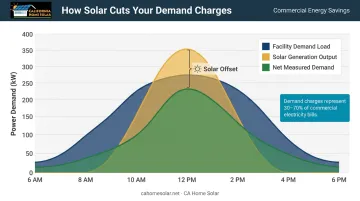
Demand charges are fees based on your facility's highest power draw during a billing period: not total consumption, but peak instantaneous draw. Research from Lawrence Berkeley National Laboratory puts demand charges at 30–70% of a commercial customer's monthly utility bill, depending on the rate schedule and facility type.
Solar addresses demand charges through timing. PV generation peaks during midday business hours, precisely when HVAC systems, equipment, and lighting push demand to its highest point. By supplying power during those peaks, solar lowers the measured demand figure, reducing the charge applied for the entire month.
The leverage effect matters here: a single brief peak moment sets the demand charge for the whole billing period. Solar doesn't need to eliminate the peak entirely. Even a modest reduction in that peak kW measurement translates directly to a lower charge on the bill.
Businesses where this matters most:
- Facilities with significant HVAC loads (common throughout LA County's climate)
- Cold storage and refrigeration operations
- Commercial kitchens and food service
- Manufacturing and light industrial facilities
- Large retail spaces with substantial lighting and climate control loads
Demand charge savings are most reliable when solar output coincides with the facility's measured demand peak. That's why interval load data and system design go hand in hand during any serious site evaluation.
Advantage 3: Protection Against Rising California Utility Rates
Solar also fixes your electricity cost going forward. The per-kWh "price" of solar-generated electricity doesn't change when the CPUC approves a rate increase or when SCE files a general rate case. Once installed, your system's cost is set.
The gap in California is already substantial: $0.2790/kWh in California versus $0.1470/kWh nationally as of March 2026. Without solar, that gap tends to widen, and every kWh your business consumes gets more expensive each year.
This benefit compounds for:
- Businesses signing long-term leases on commercial space
- Operations in growth phases where energy consumption will increase
- Any facility managing multi-year operating budgets where energy cost predictability matters
For Southern California businesses already paying above-average rates, that compounding effect makes the timing of installation a financial decision, not just an environmental one.
The Real Numbers: How Much Can a Business Save?
Actual savings depend on system size, current utility spend, rate structure, and facility load profile. The right starting point is understanding the inputs that drive the calculation:
The calculation inputs:
- Current monthly utility bill and consumption (kWh and kW demand)
- Applicable utility rate schedule (LADWP, SCE, SDG&E)
- Available roof or ground space for panels
- Expected annual system output (modeled via NREL's PVWatts tool using local solar irradiance data)
- Applicable incentives and tax position
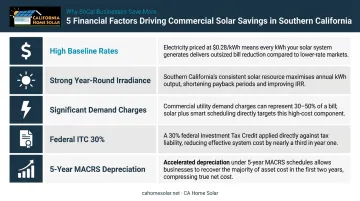
What the math typically shows for Southern California:
| Factor | Implication |
|---|---|
| High baseline rates (~$0.28/kWh) | Each kWh offset saves more than in lower-rate states |
| Strong year-round irradiance | Panels produce at or near capacity more months per year |
| Significant demand charges | Savings extend beyond energy consumption to peak kW reduction |
| Federal ITC (30%) | Reduces net system cost substantially in year one |
| 5-year MACRS depreciation | Accelerates cost recovery through reduced taxable income |
Payback and Long-Term Return
Payback timelines vary by project, but commercial solar systems consistently pay back their cost and then continue generating savings for the rest of their operational life. Panels typically carry 25-year production warranties, so post-payback savings can accumulate for well over a decade.
After payback, every kilowatt-hour generated offsets a bill you'd otherwise pay at full rate. For a Southern California business at $0.28/kWh running a 100 kW system, that can translate to $70,000–$100,000+ in avoided costs over the warranty period — on top of the initial payback.
CA Home Solar provides site-specific financial assessments for commercial properties across Los Angeles County. Projections are modeled against your actual utility bills and facility characteristics, not industry averages.
Tax Incentives and Financing That Amplify Your Savings
Federal Investment Tax Credit (ITC)
The ITC allows businesses to deduct 30% of solar system installation costs directly from federal taxes owed — as a credit, not a deduction. That's a dollar-for-dollar reduction in tax liability, not just a reduction in taxable income. For qualifying projects meeting prevailing wage and apprenticeship requirements, the 30% credit applies in full. Note that when claiming the ITC, accelerated depreciation applies to the tax basis minus half the ITC value. Confirm this adjustment with a tax advisor before finalizing your project financials.
MACRS Accelerated Depreciation
Commercial solar qualifies for 5-year MACRS cost recovery, allowing businesses to depreciate the system value rapidly and reduce taxable income across the first five years of ownership. Combined with the ITC, many businesses recover 40–50% of their gross installation cost within the first year through tax savings alone.
Key incentives available to commercial solar projects:
- Federal ITC (30% tax credit on installation costs)
- 5-year MACRS accelerated depreciation
- California Net Billing Tariff (export credits for excess generation)
- SCE Self-Generation Incentive Program (SGIP), for systems paired with energy storage
- PACE financing and related property-assessed clean energy structures
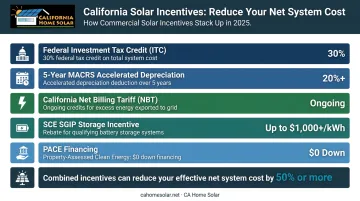
Accessing these incentives is simpler when your contractor already knows how to structure them. California Home Solar is a registered HERO contractor, which means commercial clients have direct access to PACE financing options. Their team can walk through which programs apply to a specific project and how to stack them effectively.
What Happens When You Keep Relying on Grid Rates
The math on inaction is straightforward. California commercial rates currently sit at roughly $0.28/kWh — nearly double the national average. That gap has historically held and widened over time, not narrowed.
For a business currently paying $10,000 per month in electricity:
- At even modest rate increases, that bill grows every year
- Demand charges don't decrease as operations scale — they typically rise with growing equipment loads
- The payback clock on solar doesn't start until installation — every month of delay is a month of full grid-rate exposure
The compounding effect works against businesses that wait. A growing operation faces rising rates applied to rising consumption, a cost that accelerates in both directions simultaneously. Solar installation breaks that cycle the day the system goes live.
That dynamic is especially pronounced locally. Southern California's combination of high baseline rates and strong solar irradiance means the financial case for commercial solar is clear — a site assessment puts specific numbers to it.
Frequently Asked Questions
How much can commercial solar panels reduce my electric bill?
Most commercial solar systems reduce electricity costs by 50–90%, depending on system size, energy consumption, and available roof or ground space. Some businesses in California approach near-elimination of grid electricity costs, particularly those with high daytime usage aligned with peak solar production hours.
How long does it take for commercial solar to pay for itself?
Most commercial systems in California pay for themselves in 4–7 years, depending on system size, current utility spend, and available incentives. The federal ITC and MACRS depreciation reduce net cost significantly in the early years — after payback, the system generates savings across its 25+ year lifespan.
What incentives are available for commercial solar in California?
The main incentives are the federal ITC (30% tax credit), 5-year MACRS accelerated depreciation, California's Net Billing Tariff for export credits, and SCE's SGIP program for energy storage. Together, these can cut the effective net cost by 50% or more, though the exact impact depends on your tax position and project specifics.
Do commercial solar panels still generate power on cloudy days?
Yes — panels produce output on overcast days, though at reduced levels. Southern California's high annual sun hours support strong year-round production, and net billing credits earned during peak periods help offset costs during cloudier stretches.
Is my commercial building suitable for solar panels?
Most commercial buildings are suitable. Flat roofs — common in Los Angeles commercial construction — are particularly practical for commercial PV installations. A site assessment evaluates roof condition, orientation, shading, available space, and energy load to determine system feasibility and project savings before you commit.
What does the commercial solar installation process involve?
CA Home Solar follows a structured 5-step process: facility and financial assessment, contract and scheduling, permitting and approvals, meter installation by an authorized service provider, and system activation. A dedicated project manager handles the process from assessment through energization, including permitting and utility coordination.