Solar adoption has responded accordingly. California now has over 2.3 million solar installations and 55,056 MWdc of total capacity — the most of any state in the country. But the surge in demand has also brought a flood of installers, and not all of them are worth your time or money.
Choosing the wrong company can mean permit delays, subpar equipment, warranty gaps, or a system that never delivers on its promised savings. This guide breaks down the top solar installation companies serving Southern California in 2026 — what they offer, where they fall short, and what you should verify before signing anything.
Key Takeaways
- SCE customers pay 34.5 cents/kWh — solar payback periods in SoCal are among the fastest in the US
- The best installers are separated by experience, licensing, warranty depth, and local market knowledge — price alone shouldn't drive the decision
- Under NEM 3.0, battery storage is now central to the financial case for solar — factor it into any serious quote
- California Home Solar offers 36 years of LA-area experience, Top 500 Solar Contractor recognition, and integrated roofing and HVAC services
- Always verify CSLB license status, compare warranty terms, and get at least three quotes before committing
Why Solar Makes Sense in Southern California in 2026
Southern California homeowners face some of the highest electricity rates in the country — and some of the best solar conditions. Current utility rates reflect just how much those two factors matter:
- SCE residential rate: 34.5 cents/kWh (January 2026)
- LADWP Tier 2 rate: 30.6 cents/kWh
Each kilowatt-hour your solar system generates is one you don't buy from the utility. At those rates, a properly sized system can offset hundreds of dollars monthly.
California leads the nation in solar capacity, accounting for over one-third of all US customer-sited solar installations. The economics work here in ways they simply don't in states with 12-cent rates.
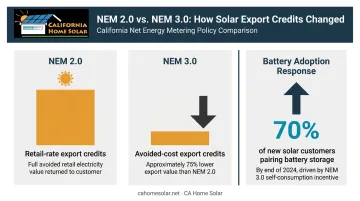
One important caveat for 2026: the financial model has shifted under NEM 3.0. Export credits are now based on avoided-cost values rather than retail rates — roughly 75% lower than NEM 2.0 credits, according to EnergySage. The result is that battery storage has gone from a nice-to-have to a near-necessity for maximizing returns. CPUC reports that by end of 2024, nearly 70% of new solar customers had paired batteries with their systems.
Choosing the right installer matters as much as the equipment itself — especially under NEM 3.0, where system design and battery integration directly affect your returns. With hundreds of contractors operating across greater Los Angeles, the companies below were selected based on local experience, licensing, equipment quality, warranty terms, and customer satisfaction in the Southern California market specifically.
Best Solar Panel Installation Companies in Southern California — 2026
These companies were evaluated across five dimensions:
- Years of experience and local knowledge
- Licensing and certifications
- Equipment quality
- Warranty comprehensiveness
- Customer satisfaction on independent review platforms
California Home Solar
California Home Solar has served Southern California homeowners and commercial property owners for 36 years, earning Solar Power World's Top 500 Solar Contractor designation in multiple years (including 2015, 2016, 2018, 2021, 2023, and 2025) and a 5-Star Yelp rating. Headquartered in Sherman Oaks, the company operates as a HERO Registered Contractor and covers an extensive footprint across Los Angeles County, from Pasadena and Burbank to Long Beach, Malibu, and the San Gabriel Valley.
Unlike national brands that hand off installation to subcontractors, California Home Solar assigns a dedicated project manager to every job. Their integrated model handles solar installation alongside roofing, HVAC upgrades, and energy-efficient windows, all in-house. That matters practically: if your roof needs work before panels go up, there's no coordination gap between two separate contractors.
Their 36 years of on-the-ground experience in LA-area utility territories (SCE, LADWP, and others) means familiarity with local permitting offices, HOA solar rights under California law, and utility interconnection requirements — factors that can significantly affect your installation timeline.
Financing options include multiple PACE programs: HERO, California First, and YGrene Energy Fund. These are repaid through property taxes over 5–25 years, require no credit score approval, and don't affect your ability to claim federal tax incentives.
| Detail | Information |
|---|---|
| Service Area | Los Angeles County and 80+ surrounding communities including Pasadena, Long Beach, Santa Monica, Burbank, Glendale, San Gabriel Valley, and more |
| Credentials | Licensed and bonded; HERO Registered Contractor; Solar Power World Top 500 (2015, 2016, 2018, 2021, 2023, 2025); 5-Star Yelp |
| Financing Options | HERO PACE, California First, YGrene Energy Fund (all property-tax repayment); additional loan programs available |
Sunrun
Sunrun is the largest residential solar installer in the US and has a significant California presence. They offer panels, Brightbox battery storage, and EV charger installations, with a full range of financing structures including leases and PPAs.
- BBB rating: A+, accredited since 2009, but the profile also shows 4,042 complaints in the prior three years
- Owned system warranty: 10-year workmanship + 10-year roof penetration warranty
- Subscription plan: 25-year maintenance, monitoring, and performance guarantee (minimum 90% of estimated output)
- Important: Lease and PPA customers cannot claim the federal 30% tax credit — the tax credit belongs to the system owner (Sunrun), not the homeowner
- A July 2024 Connecticut AG lawsuit alleged deceptive practices involving Sunrun subcontractors, including forged permits and non-functional systems; Sunrun stated it revoked access for the crews involved
| Detail | Information |
|---|---|
| Service Area | Available across California, including Southern California markets |
| Credentials | BBB A+ (4,042 complaints in prior 3 years) |
| Financing Options | Cash, solar loan, solar lease, PPA |
SunPower (Maxeon)
SunPower built its reputation on premium panel efficiency: Maxeon 7 panels reach up to 24.1% efficiency, among the highest commercially available. SunPower filed for Chapter 11 bankruptcy in August 2024 and subsequently sold assets to Complete Solaria.
- Maxeon (the panel manufacturer) spun out of SunPower in 2020 and operates independently
- Maxeon has committed to supporting SunPower-branded panels it manufactured, subject to registration requirements
- SunPower re-emerged under Complete Solaria in April 2025; service pathways now depend on your installer, which panels you have, and which entity sold them
- High-efficiency panels remain available through authorized dealers in California, valuable in SoCal given high utility rates
| Detail | Information |
|---|---|
| Service Area | California, through authorized local dealers and installers |
| Credentials | Long-term panel warranties available; post-bankruptcy service path requires verification with your specific installer |
| Financing Options | Cash purchase, solar loan; check with dealers for current lease/PPA availability |
Tesla Solar
Tesla Solar competes primarily on price, with an online-only quote process. The main draw is integration with Tesla Powerwall, a well-regarded home battery product, making it appealing to homeowners who already use Tesla products.
- Los Angeles average installed cost: $2.40/W, typical system cost $24,000 for ~10 kW (EnergySage, May 2026)
- Module warranty: 25 years for defects; 98% of rated power after year 1, declining no more than 0.45%/year
- BBB rating: F, not accredited; small complaint sample, but a consistent signal
- No verified current workmanship or weatherization warranty was confirmed in official documentation
- Customer reviews frequently cite communication delays and slow warranty response; limited equipment choice compared to local installers
| Detail | Information |
|---|---|
| Service Area | All 50 states, including California |
| Credentials | BBB F, not accredited; 25-year module performance warranty verified |
| Financing Options | Cash purchase, solar loan |
Palmetto Solar
Palmetto differentiates on post-installation support: its Protect plan offers proactive monitoring, remote diagnostics, and a 95% performance guarantee.
- BBB rating: F, not BBB accredited
- Workmanship warranty: 10 years; roof penetration warranty: 5 years
- Equipment warranty (panels, Enphase inverters): 25 years
- LightReach lease: no upfront cost, starting at $89/month in California; SCE, PG&E, and SDG&E customers qualify for PPA; LADWP customers get a solar lease
- Installation is outsourced, which can affect consistency across crews
| Detail | Information |
|---|---|
| Service Area | California and 25+ other states |
| Credentials | BBB F, not accredited; 10-year workmanship warranty |
| Financing Options | Cash, solar loan, LightReach lease/PPA |
How to Choose a Solar Company in Southern California
The Evaluation Framework
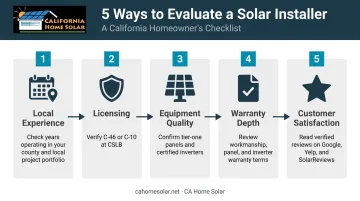
Good installers earn their reputation across five areas:
- Local experience — years operating in specific LA-area utility territories and permitting jurisdictions
- Licensing — California requires a C-46 (Solar Contractor) or C-10 (Electrical Contractor) license; verify both at the CSLB website
- Equipment quality — panel efficiency, inverter brand, and battery compatibility
- Warranty depth — equipment, workmanship, and roof penetration warranties are three separate things; all three matter
- Customer satisfaction — check BBB complaint volumes, not just ratings; a high rating with thousands of complaints tells a different story
Common Mistakes to Avoid
- A $2,000 discount means nothing if the warranty is weak or the installer doesn't know your utility's interconnection process
- Unlicensed contractors operate in every market; 60 seconds at cslb.ca.gov protects you
- Leases and PPAs eliminate your eligibility for the federal tax credit; for most homeowners, owning the system produces better long-term returns
- A roof with fewer than 10 years of life remaining should be addressed before solar goes on top — companies like California Home Solar handle both in-house
Southern California-Specific Factors
Beyond general vetting, two regional factors separate competent local installers from the rest.
Utility territory matters more in Southern California than in most states. SCE and LADWP have different interconnection timelines, export rate structures, and application processes. An installer who has processed dozens of applications with your specific utility will move faster and hit fewer surprises than one doing it for the first time.
California also gives homeowners strong HOA solar rights (associations generally cannot block an installation), but navigating specific CC&Rs (HOA governing documents) often requires hands-on local experience.
What to Know Before Going Solar in Southern California
Two factors matter most right now: how California's net metering rules affect your return on investment, and which financial incentives are still on the table in 2026.
NEM 3.0 and Battery Storage
Under NEM 3.0 (Net Billing Tariff), solar export credits are based on hourly avoided-cost values — not the retail rate you pay for electricity. The result: power sent to the grid is now worth far less than power you consume yourself or store in a battery.
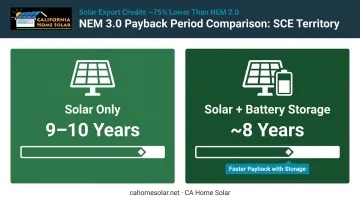
EnergySage's payback estimates under NEM 3.0 reflect this shift clearly. A standard 8 kW solar-only system runs 9–10 years to break even. Add battery storage in SCE territory and that drops to roughly 8 years. If you're going solar in 2026 without evaluating storage options (Tesla Powerwall, Enphase IQ Battery, or equivalent), you're leaving money on the table.
California Solar Incentives in 2026
| Incentive | Details |
|---|---|
| Federal Residential Clean Energy Credit | IRS documentation states 30% for qualifying property placed in service through December 31, 2025. For 2026 installations, verify current credit availability with a tax professional before assuming eligibility |
| California Property Tax Exclusion | Solar installations excluded from property tax assessment through fiscal year 2025–26; scheduled to sunset January 1, 2027 — act before this window closes |
| SGIP Battery Rebate | Small Residential Storage: $150/kWh; Equity Resiliency: $1,000/kWh; available budget remains as of June 2026 |
| SCE/LADWP Rebates | Both utilities currently direct homeowners to SGIP for battery/storage incentives; no separate general residential solar panel rebate is currently active |
Note on lease/PPA financing: If you finance through a lease or PPA, the system owner (not you) claims any applicable federal tax credits. This should factor heavily into your financing decision.
Conclusion
The best solar company for your home isn't necessarily the cheapest quote or the biggest brand name. It's the company that understands your utility territory, handles permitting without delays, backs its work with meaningful warranties, and will still be operating when you need service in year 12.
Before signing anything, make sure you:
- Get at least three quotes from licensed California contractors
- Verify CSLB credentials before committing
- Compare all three warranty types side by side
- Confirm how your ownership model affects your federal tax credit eligibility
For homeowners across Southern California — from the San Fernando Valley and Los Angeles County to Orange County communities like Anaheim, Irvine, and Huntington Beach — California Home Solar brings 36 years of local expertise, repeated Solar Power World Top 500 recognition, and the ability to handle solar, roofing, HVAC, and windows under one contractor. One point of contact, one license to verify, one warranty conversation.
Contact California Home Solar at 877-903-1012 or visit cahomesolar.com to schedule a free consultation.
Frequently Asked Questions
What is the average cost of installing solar panels?
Nationally, the average installed cost is $2.66/W, putting a 10 kW system at roughly $26,600 before incentives (EnergySage, May 2026). In Los Angeles, the average runs closer to $2.40/W. The federal tax credit — if applicable to your installation year and ownership model — significantly reduces your net cost.
What appliances cannot be used with solar power?
Nearly all home appliances run on solar. High-draw appliances — large HVAC systems, EV chargers, electric water heaters — may require a larger system or battery storage to cover usage during evening or low-sun hours. This is especially relevant under NEM 3.0, where self-consumption matters more than ever.
Are solar panels worth it in Southern California?
Yes, for most homeowners. High utility rates, strong sun exposure, and available incentives produce some of the fastest payback periods in the US. Under NEM 3.0, EnergySage estimates payback at 9–10 years for solar alone and roughly 8 years for solar-plus-battery in SCE territory.
What solar incentives are available in California in 2026?
Key incentives available in 2026:
- Federal 30% Residential Clean Energy Credit — verify eligibility with a tax professional
- California property tax exclusion for solar — sunset scheduled January 1, 2027
- SGIP battery storage rebates — $150/kWh for standard residential installations
- LADWP and SCE programs — primarily direct customers to SGIP for battery incentives
How long does solar panel installation take in Southern California?
Physical installation takes one to two days. The full process — contract signing through permitting, inspections, and utility interconnection — typically runs 60–90 days in the Los Angeles area. SCE interconnection approval alone generally takes under 10 business days once the application is submitted.
How do I verify a solar contractor is licensed in California?
Visit the California Contractors State License Board website and search by company name or license number. You can confirm license classification (look for C-46 Solar or C-10 Electrical), bond status, and any disciplinary history — all free, all public, and worth doing before signing any agreement.