The stakes are higher than aesthetics. Replace the wrong window in a designated historic district and you risk fines, mandatory removal, or losing historic property tax benefits. Choose poorly and you may also diminish resale value. This guide walks through the full decision: when to repair versus replace, how Southern California's preservation rules work, which materials pass review boards, what the project costs, and how to finance it.
Key Takeaways
- Repair and weatherstripping should always be evaluated before replacement—a low-e storm window can match thermal performance at roughly one-third the cost
- Historic Preservation Commissions in cities like Pasadena, Beverly Hills, and West Hollywood require approval before replacement—skipping it can mean forced reversal
- Wood and aluminum-clad wood are the safest material choices on primary (street-facing) elevations; vinyl carries the highest approval risk
- Simulated divided lites (SDL) with exterior grids and between-glass spacers are the most accepted energy-efficient option for historic-style windows
- ENERGY STAR-certified replacement windows lower household energy bills by an average of up to 13%—a significant advantage in Southern California's cooling-heavy climate
Should You Repair or Replace Your Historic Windows?
Repair is always the first option preservation experts and review boards prefer—and sometimes the right financial choice too.
What Restoration Actually Involves
Historic window restoration typically includes:
- Replacing or consolidating rotten wood sections with epoxy fill or dutchman patches
- Re-glazing panes with fresh glazing compound
- Freeing painted-shut sashes and lubricating hardware
- Installing weatherstripping and door sweeps
- Adding a low-e storm window over the repaired unit
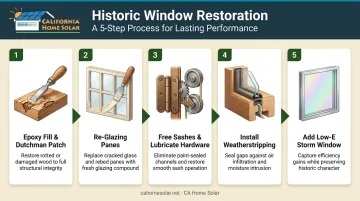
That last step matters more than most homeowners realize. According to the Department of Energy, low-e storm windows can save 10% to 30% on heating and cooling costs and deliver similar energy savings to full window replacement at about one-third the cost. The National Park Service cites a 2002 study confirming that a storm window over a restored historic window can achieve thermal performance comparable to a new low-e vinyl replacement.
When Replacement Becomes Necessary
Restoration stops making sense when:
- Wood rot has spread into the frame, not just the sash
- Failed glazing compound has allowed moisture into the wall assembly
- Lead paint contamination makes safe sash repair cost-prohibitive
- The frame is so racked or out of square it cannot be properly sealed
- Multiple panes are broken and the frame is structurally compromised
Here's a trade-off worth discussing with your contractor before committing: windows painted shut over decades actually create a decent air seal. Re-opening them through restoration can increase air infiltration until new weatherstripping fully seats—which is a real trade-off to discuss with your contractor before committing to a restoration path.
The Energy Efficiency Case for Replacement
Modern double- or triple-pane insulated glass with low-e coatings clearly outperforms original single-pane glass. ENERGY STAR data shows certified replacements lower household energy bills by an average of up to 13% nationally. In Southern California, where solar heat gain drives cooling loads for six or more months of the year, the performance gap between old and new glass adds up fast.
The practical side of restoration compounds this. Skilled historic window restorers are genuinely hard to find outside major metros — locating a qualified craftsman can take months, and their labor rates reflect that scarcity. For many homeowners, replacement with a period-appropriate modern window delivers a better long-term outcome than a restoration handled by a generalist.
If you're weighing both options, California Home Solar offers free consultations to help you evaluate your specific windows before committing. Their team installs energy-efficient low-e windows throughout Los Angeles County and can assess whether restoration or replacement makes more practical sense for your project.
Navigating Historic Preservation Regulations in Southern California
When it comes to historic windows, federal guidelines set the floor—but local commissions typically set the actual rules you'll follow.
Federal vs. Local Authority
Properties listed on the National Register of Historic Places fall under the Secretary of the Interior's Standards for Rehabilitation, administered by the National Park Service. Standard 6 requires repair before replacement and, where replacement is justified, mandates that new windows match the originals in design, color, texture, and visual qualities.
However, most Southern California homeowners are subject to locally designated historic districts, not federal oversight. Local commissions are often more specific—and more demanding—than federal guidelines.
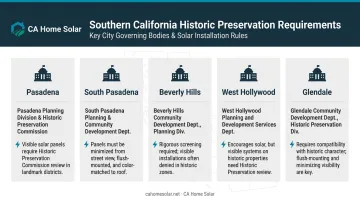
| City | Governing Body | Key Requirement |
|---|---|---|
| Pasadena | Historic Preservation Commission | Certificate of Appropriateness; major changes (two or more design features altered) go to HPC |
| South Pasadena | Cultural Heritage Commission | COA application requires window schedule with sizes, materials, operation type, and muntin details |
| Beverly Hills | Cultural Heritage Commission | Pre-application staff meeting required for CHC-reviewed COAs |
| West Hollywood | Historic Preservation Commission | Five-member commission, established 1989 |
| Glendale | Historic Preservation Commission | Design review for all work at historic properties |
What the Approval Package Requires
Pasadena's Certificate of Appropriateness process illustrates the typical standard. A complete application typically includes:
- Color photos of the building and existing windows
- A window schedule tied to floor plans
- Existing and proposed dimensions
- Manufacturer cut sheets
- Head/jamb/sill detail drawings showing recess depth
Starting work without approval can result in fines or a required reversal of the installation.
Review panels generally require replacement windows to match originals in:
- Frame profile thickness and recess depth
- Muntin/grille configuration
- Operation type (double-hung, casement, etc.)
- Color and exterior finish
- Rough opening size (no reduction in daylight opening)
The Mills Act: California's Most Useful Preservation Incentive
The Mills Act (California Government Code Sections 50280–50290) is the most broadly available financial incentive for Southern California historic homeowners. Cities contract directly with property owners to reduce assessed property taxes in exchange for a commitment to maintain the historic property according to preservation standards.
Active Mills Act programs exist in Los Angeles, Pasadena, South Pasadena, Beverly Hills, Glendale, and Long Beach. For many homeowners, the property tax reduction offsets a meaningful portion of preservation costs, including quality window replacements, over the life of the contract.
Two additional incentives are worth checking before you budget: California's State Historic Rehabilitation Tax Credit is not currently accepting applications (all funding categories are exhausted), and no LA County-wide window-specific grant program was verified during research for this article.
Best Window Materials for Historic Homes
Material choice is both an energy decision and a preservation decision. On primary elevations, visual and material compatibility governs—energy performance must fit within that constraint.
Wood
The most historically accurate choice. Original pre-1960 windows were almost universally wood, and most historic review panels accept wood replacements on primary elevations. Wood accepts custom profiles and can be painted to exactly match existing trim.
Downsides: periodic painting and sealing required, susceptible to moisture damage, highest cost per unit.
Aluminum-Clad Wood
A hybrid with wood interiors (authentic appearance, paintable) and aluminum cladding on the exterior (weather-resistant, low-maintenance). The 2025 JLC Cost vs. Value Report benchmarks a 10-window wood replacement with colored aluminum-clad exterior at $26,781 installed—useful as a real-world reference point, not a historic-custom quote.
This is the most practical material for homeowners who need review board approval but want to reduce long-term maintenance compared to all-wood frames.
Fiberglass
Fiberglass frames closely mimic wood profiles, accept paint, and stand up reliably to Southern California's sun and UV exposure. Minimal expansion and contraction protects the insulated glass seal over time. Costlier than vinyl but less than wood; now accepted by many historic commissions as a substitute on secondary elevations.
Vinyl
Most affordable, excellent energy performance, zero painting required. The trade-off: vinyl cannot be painted to match existing trim colors and may not replicate the profile depth of original wood windows. NPS guidance effectively restricts vinyl on primary, street-facing elevations where original windows were wood or metal. It may be approved on rear or non-street-facing facades where visibility is limited.
Thermally Broken Aluminum
The right choice for mid-century modern, Eichler-style, or commercial-influenced residential architecture where slim metal frames are historically appropriate. If your home's original windows were metal, thermally broken aluminum on primary elevations is more defensible with review boards than switching to wood or vinyl.
A thermal break is non-negotiable: aluminum without one conducts heat aggressively, raises U-factors, and causes condensation problems in Southern California's climate swings between coastal and inland zones.
Quick Comparison
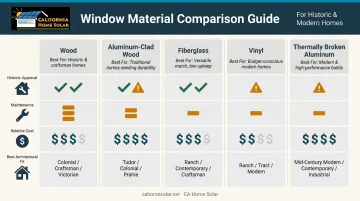
| Material | Historic Approval | Maintenance | Relative Cost | Best For |
|---|---|---|---|---|
| Wood | Primary elevations ✓ | High | $$$$ | Craftsman, Victorian, pre-1960 |
| Aluminum-Clad Wood | Primary elevations ✓ | Low-Medium | $$$ | Any style needing low exterior upkeep |
| Fiberglass | Secondary elevations ✓ | Low | $$$ | UV-heavy Southern CA exposures |
| Vinyl | Rear/non-street only | None | $ | Budget-focused, non-visible facades |
| Thermally Broken Aluminum | Primary elevations ✓ (metal-original homes) | Low | $$$ | Mid-century modern, Eichler-style |
Matching Replacement Windows to Your Home's Architectural Style
Operating style, grid pattern, and proportions all need to match the home's original architecture — not just the material. A mismatched window fails visually and, in historic districts, at the review panel.
Style-to-Window Pairings
- Craftsman bungalow: Double-hung windows with divided upper sash patterns (one-over-one or six-over-one) appear most often; wood casements work well too
- Spanish Colonial Revival: Casement windows with thin grids and recessed profiles; stucco surrounds with modest trim
- Victorian-era: Double-hung sash, often grouped; arched or multi-light arrangements on prominent elevations (verify against the original building — don't assume)
- Mid-century ranch/modern: Sliding, fixed, or clerestory units; simplified frames with minimal or no divided lites
Always photograph neighboring homes of the same style and age. Ask the local historic society for examples of approved replacements in the district before selecting a product.
Once you've confirmed the operating style and proportions, the next decision is how the glass itself is divided — and that choice carries its own historic review implications.
True Divided Lites vs. SDL vs. Grilles Between Glass
| Type | Description | Historic Review Risk |
|---|---|---|
| True divided lites | Individual panes separated by physical muntins | Lowest—most authentic |
| Simulated divided lites (SDL) | Applied interior/exterior grille over one insulated unit | Acceptable when exterior grid is three-dimensional, permanently affixed, and matches historic muntin profile |
| Grilles between glass (GBG) | Internal spacer grille only, no exterior grid | Highest—flat appearance reads as obviously modern |
SDL with an exterior grid, between-glass spacers, and an interior grid is the strongest energy-efficient compromise for historic review. GBG-only solutions carry significant approval risk — avoid them on primary elevations.
What Does It Cost to Replace Windows in a Historic Home?
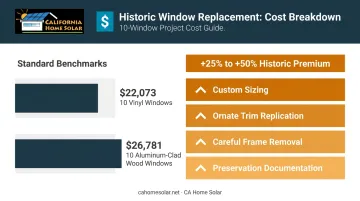
Historic window replacement costs more than standard jobs — typically 25–50% more — because of custom sizing, preservation requirements, and careful removal of original frames. The material you choose and the scope of documentation required drive the final number.
Benchmark Costs for a 10-Window Project
The 2025 JLC Cost vs. Value Report provides the most credible installed benchmarks for standard 3×5 double-hung windows:
- 10 vinyl replacement windows: $22,073
- 10 wood replacement windows (aluminum-clad exterior): $26,781
Per-window estimates from contractor platforms (Angi, HomeAdvisor) suggest:
- Vinyl: $200–$900 per window installed
- Fiberglass: $300–$2,000 per window installed
- Wood: $300–$1,500 per window installed
Historic work adds cost on top of these figures. Custom sizing for non-standard historic openings, ornate trim replication, careful removal of original frames, and preservation review documentation can add 25% to 50% to standard project cost according to Angi data on custom or complex projects.
The Full Cost Picture
Window units are only part of the expense. A realistic historic replacement budget should also include:
- Permit fees — Pasadena's official schedule lists $92 for a 1–5 window change-out; broader LA County fees vary
- Historic documentation — Photos, window schedules, manufacturer cut sheets, and detail drawings required for COA applications
- Trim repair or replication — Especially for full-frame replacements where original exterior moldings must be matched
- Labor premium — Historic work takes longer and requires more precision than standard residential replacement
Financing and Incentives
Once you have a full cost picture, these programs can meaningfully reduce the upfront cost:
- Federal Energy Efficient Home Improvement Credit — 30% of qualified expenses, with a $600 annual cap for exterior windows; windows must meet ENERGY STAR Most Efficient certification
- Mills Act property tax reduction — Available in LA, Pasadena, South Pasadena, Beverly Hills, Glendale, and Long Beach for designated historic properties
- PACE financing through HERO — Zero down, billed through property taxes, terms from 5–25 years
California Home Solar is a HERO-registered contractor serving Southern California homeowners. With 36 years in the business, their team can walk you through which of these programs — HERO, California First, or Ygrene — applies to your project and how to stack them against your total window budget.
Frequently Asked Questions
Is it worth replacing windows in an old house?
Replacement makes sense when windows are structurally failed, severely energy-inefficient, or beyond cost-effective repair. In Southern California's cooling-heavy climate, poor windows directly raise utility bills. Well-maintained originals can sometimes be restored for less, but modern replacements deliver energy savings and comfort that restored single-pane units cannot.
What is the average cost of replacing 10 windows in a home?
The 2025 JLC Cost vs. Value benchmark puts 10 standard vinyl double-hung replacements at $22,073 and 10 wood windows with aluminum-clad exterior at $26,781, fully installed. Historic custom work—non-standard sizes, ornate profiles, preservation documentation—adds 25–50% to those figures.
Is it cheaper to replace a whole window or just the glass?
Replacing just the glass (reglazing or insulated glass unit swap) costs less upfront and makes sense when the frame is structurally sound. Full window replacement is the better long-term investment if the frame is rotted, warped, or out of square—a deteriorated frame will compromise any new glass unit installed in it.
Do I need permits to replace windows in a California historic district?
Yes. In Los Angeles County historic districts, you typically need both a Certificate of Appropriateness from the Historic Preservation Commission and a standard building permit. Unpermitted work can result in fines or a mandated reversal of the installation.
What window style is best for a Craftsman or Spanish Colonial home in Southern California?
Craftsman homes suit double-hung windows with divided upper sash patterns; Spanish Colonial Revival homes typically call for casements with thin grids. Both should use simulated divided lites with three-dimensional exterior grids to preserve historic character with modern insulated glass performance.
Are there tax credits or grants for historic window replacement in California?
The federal Energy Efficient Home Improvement Credit covers 30% of qualifying window costs, capped at $600 per year for ENERGY STAR Most Efficient windows. California's Mills Act reduces property taxes for designated historic properties in exchange for preservation commitments—available in LA, Pasadena, Beverly Hills, and other cities. Note: California's State Historic Rehabilitation Tax Credit is not currently accepting applications.