This scenario isn't rare. Setback violations are one of the most common and costly mistakes homeowners make with ground-mount solar, and they're almost entirely avoidable with the right preparation.
This article covers what setback requirements are, what distances typically apply (property lines, structures, wells, septic systems), how California zoning law and HOA rules factor in, and the concrete steps to take before breaking ground.
Key Takeaways
- Most jurisdictions classify ground-mount solar as an accessory structure, triggering zoning and setback rules that don't apply to rooftop panels
- Setback distances vary widely — San Diego County requires a 3 ft minimum, but many regions require significantly more
- HOAs may have more authority over ground mounts; California's solar access protections are stronger for rooftop systems
- Skipping setback research risks permit denial, forced relocation, and complications at resale
- Confirm all requirements with your local Authority Having Jurisdiction (AHJ) before finalizing your design
What Are Setback Requirements for Ground-Mounted Solar?
Accessory Structures vs. Rooftop Solar
Rooftop solar deals with fire pathway clearances and attachment rules. Ground-mounted solar falls under a different regulatory framework — one most homeowners don't encounter until they're already mid-project.
Most jurisdictions treat residential ground-mount arrays as accessory structures, a classification that triggers a separate layer of zoning compliance rooftop panels never face. The 2022 California Residential Code separately defines both "accessory structure" and "ground-mounted PV panel system," and local zoning codes typically regulate ground-mount PV through those accessory-use standards.
California law also draws a clear line between rooftop and ground-mount permitting. Government Code 65850.5 mandates expedited permitting specifically for "small residential rooftop solar energy systems" — ground-mounted systems don't automatically qualify for that streamlined process.
What "Setback" Actually Means
A setback is the minimum required distance between a structure and a reference point — a property line, a road, a neighboring building, or a utility easement. For ground-mount solar, that structure is the array itself (or its mounting frame).
Why These Rules Exist
Setback rules aren't arbitrary. They serve real purposes:
- Protect neighbor sightlines and property values
- Prevent encroachment onto adjacent parcels
- Maintain access for emergency services
- Account for fire safety — the 2016 California Residential Code Section R324.7.2.6 requires a clear, brush-free area of 10 feet around ground-mounted, freestanding PV arrays, even though zoning setbacks themselves don't apply to freestanding arrays under that same section
Why You Can't Assume Uniform Rules
Setback requirements are set at the local level — by city, county, or municipality. There is no single statewide standard for residential ground-mount solar. Two homeowners in different parts of Los Angeles County can face completely different requirements, including:
- Minimum distances from side, rear, and front property lines
- Maximum structure height limits
- Lot coverage restrictions that count the array footprint
Always verify the rules for your specific parcel — what applied to a neighbor's system may not apply to yours.
How Far Must a Ground-Mount Solar System Be From Property Lines and Other Features?
Setback rules cover more ground than most homeowners expect — property lines are just the starting point. Every category below must be verified before your design is finalized, because missing even one is a common cause of permit rejection.
Property Line Setbacks
Setback distances vary more than most homeowners expect. San Diego County's PDS-276 document (revised January 2018) provides a useful verified benchmark:
| Location on Property | Max Height | Min Distance from Property Line |
|---|---|---|
| Front/exterior side yard | 30 inches | 3 feet |
| Interior side yard | 12 feet | 3 feet |
| Rear yard | 12 feet | 3 feet |
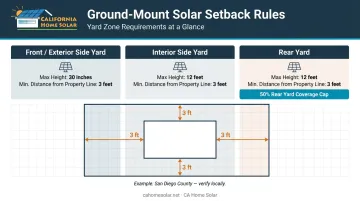
San Diego County also caps rear yard coverage: ground-mounted panels combined with all other structures in the rear yard setback area cannot cover more than 50% of the required yard.
This is one of the more permissive setback frameworks in California. Other jurisdictions require significantly more distance, and requirements within LA County vary by zone and municipality. Never apply one county's numbers to a different jurisdiction.
The practical consequence of getting this wrong: a system installed too close to a property line without a permit may need to be dismantled and repositioned entirely — at the homeowner's expense.
Setbacks From Structures, Wells, Septic Systems, and Easements
Property lines aren't the only reference point. Many jurisdictions also require minimum clearances from:
- Your home or detached garage — commonly 5–10 feet, but verify locally
- Driveways and paved surfaces
- Utility easements — restrictions vary by recorded easement terms, so treat these as parcel-specific legal review items
- Wells and septic systems — setbacks are set locally and frequently missed during site planning, only to surface at permit review
California's onsite wastewater treatment system (OWTS) regulations govern septic siting, but the solar-specific clearance distances are determined at the local jurisdiction level.
Height Restrictions
Many municipalities also cap how tall a ground-mount structure can be above grade — a detail that trips up designs imported from neighboring jurisdictions. LA County's ground-mounted solar summary (revised March 2019) sets a maximum height of 15 feet for small-scale ground-mounted systems. Glendale caps accessory building heights at 12 feet (or 15 feet with a minimum 3:12 roof pitch).
Height caps affect panel tilt angle and row spacing — which directly impacts system output. A design that works in one jurisdiction may be non-compliant in an adjacent city.
California Zoning, HOA Rules, and Permitting for Ground-Mount Solar
What California's Solar Access Laws Actually Cover
California has meaningful solar access protections. Civil Code 714 voids any covenant, restriction, or condition that effectively prohibits or restricts installation or use of a solar energy system. This statute applies to both rooftop and ground-mounted systems.
The law also allows "reasonable restrictions," and the thresholds matter:
- A restriction is unreasonable only if it increases system cost by more than $1,000 or reduces efficiency by more than 10%
- Local zoning, health and safety rules, and permitting requirements still apply regardless of Civil Code 714
- California courts have generally given these protections more practical force for rooftop systems than ground mounts
HOA Rules for Ground Mounts
HOA restrictions are where ground-mount projects run into significant pushback. Here's what homeowners need to know:
- HOAs cannot outright ban a qualifying solar system under Civil Code 714
- But they can impose placement and approval requirements — and many do
- Aesthetic objections to ground mounts are common, and "reasonable restrictions" give HOAs meaningful latitude
- In practice, ground-mount approvals face more HOA scrutiny than rooftop installs
Before purchasing any ground-mount system: Review your CC&Rs and Declaration of Restrictions carefully, then speak directly with your HOA board. A system purchased without HOA approval can create real legal complications, even if Civil Code 714 ultimately protects your right to install.
The Permitting Process
Ground-mount solar in California requires a building permit. Unlike some rooftop systems that qualify for expedited permits under Government Code 65850.5, ground mounts go through a standard building permit process.
A typical permit package includes:
- Site plan: Dimensioned drawing showing array location relative to property lines, structures, easements, wells, and septic systems
- Structural/foundation documentation: Engineering specs confirming the mounting system meets local load requirements
- Electrical diagram: Wiring layout, conduit runs, and interconnection details for the utility tie-in
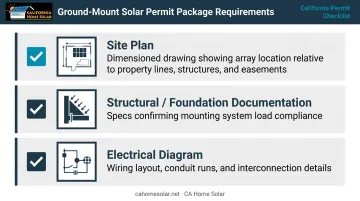
Anaheim's plan check guidelines explicitly require a complete, dimensioned site plan for any ground-mount system. San Diego County directs applicants to the zoning counter for setback information before submitting plans.
Lot Coverage Limits
Permitting is only part of the picture. Many municipalities also cap the percentage of a lot that accessory structures can occupy — a limit that catches homeowners off guard. LA County limits small-scale ground-mounted solar coverage to 25% of the lot or 2.5 acres, whichever is less — including all accessory structures counted together.
If you already have a large shed, detached garage, or sport court on your property, the ground-mount array could push you over the limit. Ask your AHJ specifically about lot coverage rules during your pre-design research.
What Happens If You Violate Setback Rules?
Consequences scale with how far along the violation gets before it's caught.
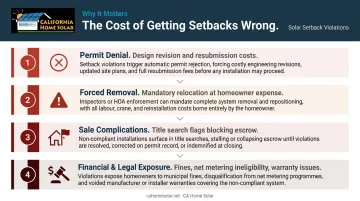
During permitting: Permit denial is the immediate outcome. The design gets kicked back for revision and resubmission — adding weeks and design costs to the project before a single panel goes in the ground.
After installation: This is where violations get expensive. A system built without a permit or outside required setbacks may be subject to mandatory removal and relocation at the homeowner's cost. This isn't a theoretical risk — it's the reason setback compliance needs to happen at the design stage, not after installation.
Long-term consequences include:
- Complications with home sales — unpermitted solar installations appear in title searches and can block or delay escrow
- Potential fines through local code enforcement processes
- Possible ineligibility for net metering under CPUC's Net Energy Metering and Net Billing programs, since interconnection under Rule 21 requires all requirements to be met to receive Permission to Operate
- Equipment warranty complications if the system was installed non-compliantly
Correcting a setback violation after installation — removal, redesign, resubmission, and reinstallation — routinely costs more than the entire original permitting process. Getting the research right before design begins is the only cost-effective path.
Steps to Take Before Installing Ground-Mount Solar in a Setback Area
Step 1: Get a Professional Property Survey
Many homeowners assume they know where their property ends. That assumption has caused expensive violations. Property corners shift in understanding over time, fences don't always follow legal lines, and neighbor disputes over a foot of encroachment are real.
A professional survey is an upfront cost — typically a few hundred dollars — that establishes your property lines with legal certainty before any array location is committed to design.
Step 2: Contact Your Local AHJ Directly
Your local Authority Having Jurisdiction is either your city or county building department. For homeowners in unincorporated Los Angeles County, that's the LA County Department of Regional Planning. For homeowners in incorporated cities like Burbank, Glendale, Pasadena, or Long Beach, it's the city's building department.
Ask specifically about:
- Property line setback requirements for ground-mounted solar
- Height limits for accessory structures
- Lot coverage rules (counting all existing accessory structures)
- Setbacks from wells, septic systems, and utility easements
- Permit requirements and what the application package must include
Step 3: Work With a Contractor Who Knows Southern California Permitting
A licensed local contractor with direct experience across Southern California AHJs has submitted dozens of ground-mount permit packages to the same building departments. That repetition builds familiarity with each AHJ's specific preferences — something no permit checklist can replicate.
California Home Solar has been installing solar in the Los Angeles area for 36 years, including ground-mount systems across the San Fernando Valley, South Bay, and San Gabriel Valley. Site assessment, permit package preparation, and AHJ coordination are part of every installation — so setback issues get caught during design, not at the permit counter.
Frequently Asked Questions
How far can ground-mounted solar panels be from your house?
There's no single universal rule. Most jurisdictions require a minimum setback from on-site structures (commonly 5–10 feet), but requirements vary by municipality. Check with your local AHJ. Note that distance from the house also affects underground conduit runs and voltage drop calculations, so placement decisions have electrical implications beyond just code compliance.
Why would a solar company not do ground mounts?
Ground-mount installations require more than rooftop work: foundation work, underground conduit trenching, structural engineering documentation, and a full building permit rather than an expedited rooftop permit. Some companies avoid them due to permitting complexity or limited structural experience. Look for contractors with documented ground-mount project history before committing.
Do I need a permit for a ground-mounted solar system in California?
Yes. Ground-mounted solar systems require a building permit in California, classified as accessory structures under the standard building permit process. Permit packages typically require a dimensioned site plan, structural documentation, and an electrical diagram.
Can my HOA prevent me from installing ground-mounted solar panels in California?
California's Civil Code 714 limits HOA authority over solar systems, but HOAs can enforce reasonable placement and approval requirements. The protections are generally understood to apply more forcefully to rooftop systems in practice. Review your CC&Rs and speak with your HOA board before purchasing a ground-mount system.
What setback is required for ground-mounted solar in Los Angeles County?
LA County caps small-scale ground-mounted solar at 15 feet in height and 25% lot coverage (including all accessory structures), but setbacks vary by zone and whether your parcel is in an unincorporated area or an incorporated city. Confirm current rules with the LA County Department of Regional Planning or your city's building department, and verify property line, septic, and well setbacks separately.
What happens if I install ground-mounted solar without meeting setback requirements?
Consequences include permit denial, mandatory removal and relocation of the system at your expense, complications with home sales, potential code enforcement fines, and possible issues with net metering eligibility. Confirming setback requirements before installation — not after — is what keeps a project from becoming a costly correction.