This guide covers what California law actually says about DIY solar, what permits you'll need, the safety and financial risks involved, and why most Southern California homeowners ultimately decide a licensed installer is the smarter path.
Key Takeaways
- California allows DIY solar through the owner-builder exemption (Business and Professions Code § 7044)
- Both a building permit and electrical permit are required in virtually every California city and county
- Grid connection (Permission to Operate) is a separate approval from the utility — passing inspection alone isn't enough
- DIY installs can disqualify you from SGIP rebates and may void equipment warranties
- NEM 3.0's lower export rates make professional system design more financially important than ever
Is It Legal to Install Your Own Solar Panels in California?
The short answer: not illegal, but heavily regulated.
California doesn't have a blanket state law prohibiting homeowners from self-installing solar. The legal basis for DIY installation is California Business and Professions Code § 7044, which exempts qualifying owner-builders from contractor licensing requirements when they perform work on their own property. Under this exemption, a homeowner can pull their own permits and complete the installation — provided they do the work personally, or through wage-paid employees (not subcontractors).
There are real constraints on this pathway:
- You must occupy the home as your primary residence
- You cannot sell or offer the property for sale within one year without disclosure that unlicensed work was performed
- If you hire anyone to perform any part of the electrical or solar work, that person must hold the appropriate California contractor's license
On the HOA side, California Civil Code § 714 voids any HOA restriction that effectively prohibits solar installation. HOAs can impose "reasonable restrictions" — meaning conditions that don't increase costs by more than $1,000 or reduce system efficiency by more than 10% — but they cannot simply block you. You'll still need to submit an application and receive HOA approval before installing.
Even with owner-builder status, you're navigating building permits, electrical permits, California Electrical Code compliance, and utility interconnection — all at the same time. Most homeowners who start the process underestimate that paperwork alone can take weeks before a single panel goes up.
California vs. Other States: Why the Rules Are Stricter Here
California's regulatory complexity reflects its scale. Three overlapping frameworks make this state particularly difficult for unlicensed homeowners to navigate independently:
- Title 24 (2022 Energy Code): Expanded solar and battery storage requirements that vary by jurisdiction — and are updated on a rolling basis
- SB 379: Required cities over 50,000 to launch automated online solar permitting by September 30, 2023; smaller non-exempt cities by September 30, 2024
- NEM 3.0: Adopted by the CPUC on December 15, 2022, this shifted exported solar compensation from retail-rate credits to Avoided Cost Calculator values that are lower
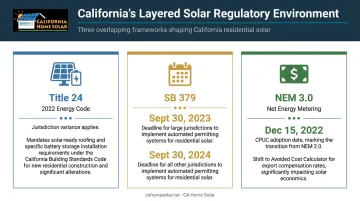
None of these layers exist in most other states, which is why California DIY solar carries a steeper learning curve than the owner-builder exemption might suggest.
California Permit and Inspection Requirements for DIY Solar
Permits aren't optional. Virtually every California city and county requires both a building permit and an electrical permit for rooftop solar. What you'll need to submit includes:
- Site plan showing module and anchor layouts
- Rafter/structural layout documentation
- Single-line electrical diagram
- Equipment spec sheets and manufacturer datasheets
- Fire access pathway diagram
- Structural calculations (for some jurisdictions)
What Varies by Jurisdiction
Requirements and fees vary across Los Angeles-area jurisdictions:
| Jurisdiction | Key Notes | Permit Fee |
|---|---|---|
| City of Los Angeles (LADBS) | Online permits available for systems 10 kW or less on 1-2 family homes; requires roof plan with module/anchor layouts | Verify current fee at LADBS fee schedule |
| Unincorporated LA County | Combined solar permit covers building + electrical; expedited process under Chapter 68 | Not to exceed $500 under Government Code § 66015 |
| Long Beach | Express permit for flush-mount systems 38.4 kW or less; detailed checklist (FORM-016) required | PV only: $386.62; PV + storage: $447.45 |
| Pasadena | Requires three sets of plans; roof plan projection on site plan | Fee not verified; check current schedule |
Once the paperwork clears, the job isn't done. A city or county building inspector must sign off before the system can be activated. An unpermitted system discovered during a home sale or insurance claim creates serious complications — the CSLB is explicit that owner-builders must pull all required permits and pass all inspections.
California Home Solar handles permit filing and inspection coordination across Southern California jurisdictions, drawing on 36 years of local installation experience.
Safety Risks Every California Homeowner Should Know
Two categories of physical risk define DIY solar:
1. Working on a roof Panels weigh between 33 and 50 pounds each. Installing multiple panels on an elevated, angled surface — often in summer heat — requires proper fall protection equipment and technique. One misstep on an angled roof can mean a serious fall.
2. Working with live electrical systems A solar array generates DC voltage the moment sunlight hits the panels, even before any grid connection. The Electrical Safety Foundation International notes that thousands of people in the U.S. are critically injured or electrocuted each year due to electrical fires, accidents, and home electrocutions — and improper wiring is a primary cause.
California's Wildfire Rules Raise the Technical Bar
California's fire environment means solar installations face stricter code requirements than most states. The 2022 California Electrical Code (Title 24, Part 3, incorporating NEC 2020 Article 690) requires rapid shutdown systems — hardware and wiring configurations that allow first responders to de-energize a rooftop array quickly during a fire event. Implementing rapid shutdown correctly without professional training is technically demanding.
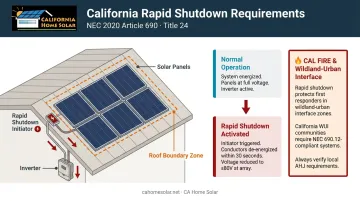
CAL FIRE and the Office of the State Fire Marshal maintain specific guidelines for photovoltaic installations in wildland-urban interface areas. In California's fire conditions, a non-compliant installation puts both your home and emergency responders at real risk.
How DIY Solar Affects Your Warranties and Incentives
Equipment Warranties
Many major solar panel and inverter manufacturers require installation by a licensed or certified professional as a condition of warranty validity. The specific language varies by manufacturer — review the written warranty terms carefully before self-installing. A 25-year panel warranty voided by an improper installation step leaves you fully responsible for replacement costs.
Federal Tax Credit
The IRS allows a 30% Residential Clean Energy Credit on qualified solar electric property costs, per IRS Form 5695 instructions. Retrieved IRS guidance does not categorically exclude DIY installations from this credit. That said, the eligibility turns on what counts as a "qualified cost" and proper documentation — consult a tax professional before assuming your DIY project qualifies.
California-Specific Incentives
This is where DIY costs can really add up:
- SGIP (Self-Generation Incentive Program): The 2026 SGIP Handbook outlines CSLB contractor licensing requirements (section 4.2.3) for program eligibility — unlicensed installs are typically disqualified
- Utility rebate programs: Similar contractor licensing requirements apply; homeowners should verify current program terms before assuming eligibility
Labor savings from DIY can disappear quickly once you factor in lost incentives, voided warranties, and permit correction costs. And under California's current billing structure, the financial stakes go further still.
NEM 3.0 and Why Getting It Right Matters More Than Ever
California's Net Billing Tariff, effective for new customers after April 2023, compensates exported solar energy using Avoided Cost Calculator values rather than retail import rates. The CPUC notes these values are generally lower than import rates.
This shift means the financial case for solar now depends far more on self-consumption than on exporting surplus. A poorly sized system that overproduces relative to your actual load profile earns less under NEM 3.0 than one optimized for your household's usage patterns. Professional system design directly affects your payback period in ways it simply didn't under NEM 2.0.
Utility Interconnection Rules for Grid-Tied Systems
Passing your building inspection is not the finish line. Before your system can legally operate, you need Permission to Operate (PTO) from your utility.
California's major utilities each run their own interconnection process:
- PG&E: Requires an interconnection application, single-line diagram, and copy of the final building permit. Per PG&E's timeline documents, the utility must perform a final inspection within 30 business days of a complete application (if no upgrades are needed).
- SCE: SCE's interconnection process is governed by Rule 21; customers receive PTO once the application is complete and reviewed.
- SDG&E: Customers or contractors submit through the Distribution Interconnection Information System.
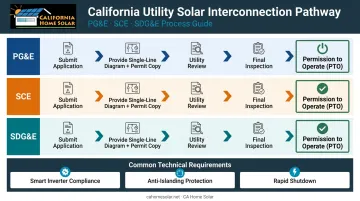
All three utilities share a common set of technical requirements:
- Smart inverter compliance (per CPUC Resolutions E-5000 and E-5036)
- Anti-islanding protection
- NEC 2020 Article 690 rapid shutdown systems
Operating a grid-tied system without valid PTO is illegal and can result in the utility disconnecting your service. If something goes wrong at this stage, you lose grid access entirely — making it the point where most DIY installers choose to bring in a licensed contractor.
California Home Solar handles the full interconnection process — PTO paperwork included — for homeowners across Southern California served by PG&E, SCE, and SDG&E.
Why Most California Homeowners Hire a Licensed Solar Installer
The DIY path is legal, but the full picture explains why most homeowners hand it off:
- Owner-builder permits are legally available but come with disclosure restrictions and resale limitations
- Both building and electrical permits are mandatory, with documentation requirements that vary by city
- Rapid shutdown, fire code, and NEC 2020 compliance require technical knowledge
- Equipment warranties may require licensed installation to remain valid
- SGIP and utility rebates likely require licensed contractors
- Utility PTO is a separate gate that takes weeks to months
A licensed installer handles far more than the physical installation. They manage permit filing, inspection coordination, utility interconnection paperwork, and system design optimized for NEM 3.0 economics. Because they work under a contractor's license, you also have legal recourse if something goes wrong — a protection DIY projects don't provide.
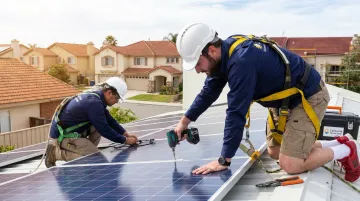
California Home Solar has managed this entire process for Southern California homeowners for 36 years. They handle everything from site survey and system design through permitting, installation, final inspection, and Permission to Operate — with a dedicated project manager on each job. The company is a licensed and bonded contractor and has been recognized as a Top 500 Solar Contractor.
Frequently Asked Questions
Can homeowners install solar panels themselves in California?
Yes, with conditions. California's owner-builder exemption under BPC § 7044 allows homeowners to self-install, but the process still requires building and electrical permits, code-compliant installation, and utility PTO. In most jurisdictions, any hired electrical work requires a licensed contractor.
Do you need a permit to install solar panels in California?
Yes. Both a building permit and an electrical permit are required in virtually all California cities and counties. Unpermitted systems create serious problems during home sales, insurance claims, and inspections, and the CSLB requires all owner-builder work to pass applicable codes.
Can a homeowner pull their own solar permit in California?
Yes, under the owner-builder exemption, but with restrictions. You must occupy the home, and you cannot sell or offer the property for sale within one year without disclosing the self-performed work. If you hire anyone for the electrical portion, they must be licensed.
Will DIY solar installation void my equipment warranty?
Possibly. Many manufacturers require installation by a licensed or certified professional as a warranty condition. Review each manufacturer's written warranty terms carefully before proceeding — a voided 25-year warranty is a serious financial risk.
Does a DIY solar installation qualify for the federal solar tax credit?
The IRS does not categorically exclude DIY installations from the 30% Residential Clean Energy Credit. However, California's SGIP and most utility rebate programs do require licensed contractors, and tax eligibility depends on proper documentation. Confirm your situation with a tax professional.
Can my HOA prevent me from installing solar panels in California?
No outright ban is enforceable. California Civil Code § 714 voids HOA restrictions that effectively prohibit solar. HOAs can impose reasonable aesthetic and placement conditions, but they must approve the installation rather than block it. Submit your application before beginning any work.