Without structured maintenance, output losses accumulate quietly. Dust and particulates cut into production. Inverter faults go undetected for weeks. Mounting hardware loosens after wind events. None of these problems announce themselves — they just steadily erode the return you planned for.
Southern California adds its own complications: wildfire ash and construction dust across inland valleys, marine layer particulate buildup along the coast, and Santa Ana winds that can physically stress rooftop racking systems. Coastal properties from Malibu to Long Beach face different maintenance demands than systems in Antelope Valley or the San Gabriel Valley.
This guide covers why maintenance matters, the four main types of commercial solar maintenance, the warning signs to watch for, and a practical scheduling framework suited to Southern California conditions.
Key Takeaways
- Commercial solar output can drop significantly without regular upkeep — soiling alone causes 1.5% to 6.2% annual losses in California systems.
- There are four maintenance types: preventive, corrective, predictive, and major overhaul — each serving a distinct maintenance role.
- Watch for unexplained utility bill increases, inverter error codes, visible panel damage, and inconsistent monitoring data.
- Bi-annual professional inspections are standard — cleaning frequency depends on your local environment (dust, pollen, marine air).
- NREL benchmarks fixed O&M at roughly $19/kW per year — far less than what deferred maintenance ends up costing.
Why Commercial Solar Maintenance Matters for Your Business
Commercial solar is a depreciating asset when neglected and a performing asset when maintained. The difference between those two outcomes depends on what happens between installation and the system's 25th year.
The Output Loss Picture
Two distinct loss mechanisms chip away at production over time:
- Natural degradation: NREL's analytical review of nearly 2,000 degradation rates found a median module degradation rate of 0.5% per year. That's expected and manageable.
- Soiling losses: A UC San Diego study of 186 California PV systems found annual soiling losses ranging from 1.5% to 6.2%. In SCE territory — covering much of inland and coastal Southern California — mean soiling rates run at 0.083% per day. That adds up fast without regular cleaning.
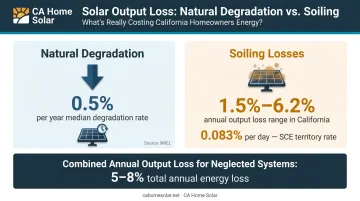
Combined, a neglected system can lose 5–8% of rated output annually from soiling and degradation alone, before any component fault is factored in.
Lifespan and Inverter Reality
Well-maintained panels can produce near rated output for 20 to 30 years. Inverters are typically the first component to fail. Commercial string inverters carry 10–12 year warranties, meaning most systems will need at least one replacement within their operational life.
Planning for that cost upfront is part of sound financial management — and it connects directly to another layer of risk that's easy to overlook.
Safety and Compliance
California commercial properties operate under CEC nonresidential compliance requirements that cover PV system documentation, labeling, and monitoring functionality. Deteriorating wiring, loose disconnects, or damaged mounting hardware don't just hurt performance — they create inspection exposure and potential liability. Keeping maintenance records current is part of staying compliant, not just operational.
The Cost Argument
NREL's 2024 Annual Technology Baseline (ATB) puts commercial PV fixed O&M at $19/kW per year, with a range of $0–$40/kW depending on system configuration and site conditions. For a 100 kW commercial rooftop system, that's roughly $1,900 per year in planned maintenance.
Compare that to emergency inverter repairs, warranty-voiding lapses, or months of reduced output running at 80% capacity — and a proactive maintenance budget consistently costs less than a single unplanned repair event.
Types of Commercial Solar Maintenance
Maintenance isn't uniform across every commercial system. The right approach depends on system age, size, location, and what your monitoring data is telling you. There are four distinct maintenance types, and most commercial operators use a combination.
Preventive (Routine) Maintenance
Preventive maintenance is scheduled, recurring upkeep performed before problems emerge. For commercial solar systems, it typically includes:
- Visual panel inspections for cracks, discoloration, and soiling
- Panel cleaning using appropriate equipment and methods
- Mounting hardware and racking checks for torque and corrosion
- Wiring and conduit visual reviews
- Inverter log review and basic diagnostics
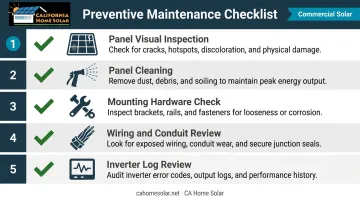
This is the primary mode for newer systems in good condition. Using NREL's benchmark of roughly $19/kW per year for fixed O&M, a 150 kW commercial system would budget approximately $2,850 annually — a modest line item relative to system value.
Corrective (Reactive) Maintenance
Corrective maintenance addresses issues after they've been identified: a failed string, a faulty DC combiner, or a wiring fault flagged by monitoring. It's triggered by alerts, output drops, or visual findings during a routine visit.
A reactive-only approach carries real costs:
- Silent output losses: Problems can go undetected for weeks or months before anyone notices the drop.
- Voided warranties: Most major manufacturers require documented maintenance history. Without it, corrective claims can be denied.
Corrective maintenance is most effective when it complements a preventive program, not when it replaces one.
Predictive (Condition-Based) Maintenance
Predictive maintenance is data-driven: servicing is triggered by what the monitoring system shows, not by a calendar date. Modern platforms track real-time output, flag string-level deviations, and alert technicians to intervene before a minor issue becomes a larger, costlier failure.
Advanced inspection tools are increasingly accessible for commercial owners:
- Thermal imaging and drone inspections: NREL's 2024 aerial infrared thermography report cites a method achieving 94% accuracy in detecting anomalies including hotspots and offline strings.
- Monitoring dashboards: AI-assisted platforms can detect output deviations that visual inspections would miss entirely.
For larger commercial systems, predictive tools reduce unnecessary service visits while catching faults earlier. That means fewer emergency calls and a maintenance budget that goes toward actual problems.
Major Overhaul Maintenance
Major overhaul covers significant component replacement: most commonly inverter replacement, but also racking system upgrades or electrical infrastructure updates.
Key planning points:
- Commercial string inverters typically carry 12-year warranties per NREL's Q1 2021 benchmark, meaning one or more replacements are likely over a 25–30 year system life.
- Replacement costs are site-specific and depend on inverter type, system capacity, roof access, permitting requirements, and current labor costs. Factoring this into your financial model at installation — rather than discovering it mid-ownership — keeps cash flow predictable.
- Central inverters on larger commercial systems have longer service lives, but the replacement cost is proportionally higher when the time comes.
The owners who handle major overhauls smoothly are typically those who accounted for them from day one.
Warning Signs Your Commercial Solar System Needs Attention
Catching problems early prevents small performance losses from becoming expensive repairs. These are the signals worth watching — and acting on before the next scheduled service date.
Performance or Output Changes
The most actionable early indicator is your utility bill. A sustained increase in electricity costs despite consistent usage patterns suggests the system isn't producing what it should.
On your monitoring dashboard, watch for:
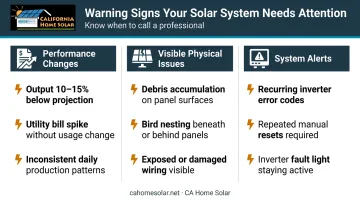
- Output consistently 10–15% below projected levels — this warrants investigation, not a wait-and-see approach
- Inconsistent production patterns with no corresponding weather explanation — good output one week, poor the next — which often points to inverter faults or string-level issues
- Shading changes from neighboring construction or vegetation growth that weren't present during the original system design
Visible Physical Issues
Facility staff don't need specialized training to catch visible problems. During informal walkthroughs, look for:
- Cracked, discolored, or delaminating panels
- Heavy debris accumulation — especially relevant after Santa Ana wind events, periods of wildfire activity, or extended marine layer conditions
- Bird nesting under panel arrays, which can damage wiring and create hot spots
- Corroded or exposed wiring at conduit entries or junction boxes
Any visible physical damage following a weather event — strong winds, heavy rain, or prolonged heat — warrants professional inspection before the next scheduled service date.
System Alerts and Recurring Faults
Inverter error codes and monitoring system alerts are the most reliable early indicators of component degradation. Two patterns that require immediate attention — not a simple reset:
- The same fault code reappearing after being cleared — the root cause hasn't been addressed
- Repeated manual system resets — this is a symptom, not a maintenance task
Each recurrence means the underlying fault is still active — a diagnostic identifies whether it's a failing component, a wiring issue, or something deeper in the inverter.
Commercial Solar Maintenance Schedule
Maintenance frequency isn't one-size-fits-all. A rooftop system in coastal Los Angeles contends with marine layer particulates, salt air, and ocean humidity — has different service needs than a system in the Antelope Valley, where desert dust and temperature extremes dominate. Inland valley systems in areas like the San Gabriel Valley deal with both construction dust and periodic wildfire ash events.
Reference Maintenance Framework
| Frequency | Activity | Who Performs It |
|---|---|---|
| Daily / as-needed | Review monitoring dashboard output data | Facility staff or property manager |
| Monthly | Basic visual scan for debris, visible damage, or obvious soiling | Facility staff |
| Semi-annual | Panel cleaning, electrical testing, inverter diagnostics, mounting hardware review | Licensed professional |
| Annual / lifecycle | Performance benchmarking, inverter health assessment, structural review, warranty documentation | Licensed professional |
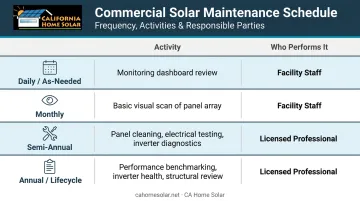
Environmental adjustments: Properties in high-dust corridors (Antelope Valley, eastern San Gabriel Valley), coastal locations with marine layer exposure, or areas with recurring wildfire activity may need cleaning and inspection more frequently than the semi-annual baseline. Local conditions dictate cleaning intervals — not a generic annual rule.
California Home Solar serves commercial properties across Los Angeles County and can assess your specific site conditions — factoring in coastal exposure, dust corridors, or wildfire zones — to help you build a schedule that fits your property rather than a generic template.
Keep Thorough Service Records
Every professional service visit should produce a written record covering:
- Findings from visual, electrical, and structural inspections
- Actions taken and components serviced or replaced
- Output benchmarks before and after service
- Warranty documentation for parts or labor covered
This record serves three purposes: supporting warranty claims, satisfying insurance requirements, and providing the performance history needed to detect gradual degradation trends over time. Missing records can void warranty coverage, complicate insurance claims, and leave slow-developing performance losses undetected until they become costly.
Conclusion
Commercial solar maintenance is the operational practice that determines whether your system actually delivers the financial returns that justified the investment — not a line item to defer.
The numbers are clear: soiling and degradation losses compound annually, unplanned downtime costs real money, and inverter replacements are a predictable lifecycle event. The business owners who treat maintenance as a routine cost manage these variables. Those who don't tend to discover problems when they've already become expensive.
Those financial stakes are higher in Southern California than most markets. Marine layer, desert dust, and wildfire season each degrade system performance in ways a generic service agreement won't account for. A contractor who understands these regional conditions and builds a site-specific maintenance plan is worth considerably more than a one-size-fits-all contract.
California Home Solar has served commercial solar clients across Los Angeles County, Orange County, and Southern California for 36 years — and holds Top 500 Solar Contractor recognition to show for it. Whether you need professional panel cleaning, a site assessment, or help structuring a long-term maintenance program, their team works from direct knowledge of local conditions. Contact them at 877-903-1012 or info@cahomesolar.com.
Frequently Asked Questions
What are the maintenance requirements for a solar PV system?
Commercial PV systems require regular visual inspections, panel cleaning, inverter monitoring, electrical connection checks, and structural assessments. Frequency varies based on system size, age, and local environmental exposure — coastal and high-dust sites generally need more attention than cleaner inland locations.
How often should commercial solar panels be cleaned?
Most commercial systems benefit from cleaning at least once or twice per year. In Southern California, where wildfire ash, marine layer particulates, and inland dust are common, quarterly or more frequent cleaning may be justified — particularly in SCE territory where soiling accumulates at roughly 0.083% per day.
How much does commercial solar maintenance cost per year?
NREL's 2024 ATB benchmark puts commercial PV fixed O&M at approximately $19/kW per year, with a range of $0–$40/kW depending on system configuration and site conditions. Actual costs vary based on roof access, inverter type, soiling exposure, and monitoring scope — contact a Southern California contractor familiar with your system type for a site-specific estimate.
Can I perform solar maintenance myself, or do I need a professional?
Basic visual checks and light debris removal can be handled by facility staff between service visits. Electrical diagnostics, inverter servicing, mounting hardware inspections, and any work related to warranty documentation require a licensed professional technician — a HERO-registered, experienced local provider can also ensure your warranty records stay current.
What happens if commercial solar maintenance is neglected?
Skipping routine maintenance compounds over time. Consequences include:
- Gradual output losses from soiling and unchecked degradation
- Warranty voiding due to undocumented service lapses
- Higher emergency repair costs when minor faults escalate
- Possible safety or compliance issues under California electrical codes
How long do commercial solar panels last with proper maintenance?
Well-maintained commercial panels typically produce reliably for 20 to 30 years. Inverters generally require replacement earlier — often around the 12-year mark for string inverter systems — and should be factored into long-term financial planning upfront.