This guide breaks down cost ranges by material tier, explains what actually drives prices up or down, covers every line item beyond the per-square-foot quote, and walks through a practical approach to building your own estimate — including Southern California-specific requirements that affect nearly every commercial reroof project.
Key Takeaways
- Commercial roof replacement typically ranges from $5 to $30+ per square foot, with total costs varying by building size, material, and complexity
- Key cost drivers include material type, roof size, tear-off requirements, penetrations, and California Title 24 compliance
- Budget membranes work for low-rise, cost-sensitive projects; metal and high-grade PVC offer better lifecycle value for larger buildings
- The right budget weighs upfront cost against lifespan, maintenance, and energy performance, not just the lowest per-square-foot bid
How Much Does a Commercial Roof Replacement Cost?
There's no fixed price for commercial roof replacement. Two buildings with identical square footage can produce vastly different invoices depending on material choice, existing roof condition, and local labor market rates.
Quotes typically come in two formats:
- Total project cost — used for budgeting and owner approval
- Cost per square foot — used to compare material and contractor quotes on an apples-to-apples basis
Both are useful, but at different stages of planning. The per-square-foot number helps you evaluate whether a contractor's material pricing is reasonable; the total project cost is what you actually need to budget.
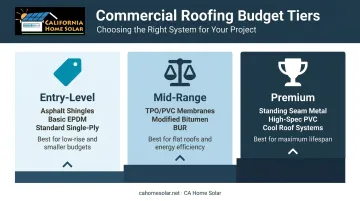
Most commercial roofing projects fall into one of three budget tiers based on material and system type. Here's how they break down:
| Tier | Typical Materials | Best For |
|---|---|---|
| Entry-Level | Asphalt shingles, basic EPDM membranes, standard single-ply | Smaller properties, low-rise buildings, tighter budgets |
| Mid-Range | TPO/PVC membranes, modified bitumen, built-up roofing (BUR) | Mid-size flat/low-slope roofs, energy efficiency, longer service life |
| Premium | Standing seam metal, high-spec PVC, cool roof systems | High-traffic facilities, demanding climates, maximum lifespan |
Budget Tier 1: Entry-Level
Typical materials: Asphalt shingles (sloped roofs), basic EPDM membranes (flat roofs), standard single-ply with minimal penetrations.
Best for smaller commercial properties and single-story low-rise buildings with tighter budgets. The tradeoff is lifespan — asphalt and basic membranes typically require reinvestment sooner than mid-range or premium systems.
Budget Tier 2: Mid-Range
Typical materials: Higher-grade TPO and PVC membranes, modified bitumen (SBS or APP), built-up roofing (BUR/tar-and-gravel). Often includes insulation upgrades and manufacturer warranties.
Best for mid-size commercial buildings with flat or low-slope roofs where energy efficiency and longer service life matter. TPO has become the dominant choice in this category, described by manufacturers like Carlisle SynTec as the fastest-growing commercial membrane for its reflectivity and heat-weldable seams. This tier covers the most common range for typical commercial projects.
Budget Tier 3: Premium
- Standing seam metal — can last 50 years or more with minimal maintenance
- Mechanically seamed systems — engineered for high-wind and demanding climate performance
- High-spec PVC with custom fabrication — suited for complex rooflines and chemical exposure
- Cool roof systems with full insulation packages — maximize energy performance and utility savings
Premium systems typically include NDL (no-dollar-limit) manufacturer warranties. This tier makes the most sense for high-traffic facilities, multi-story or landmark buildings, and owners who prioritize maximum lifespan over the lowest upfront number.
Note on pricing: Published installed cost ranges for commercial roofing vary significantly by region, contractor, and project scope. For Southern California projects, get itemized quotes from at least three licensed commercial roofing contractors and compare them against current RSMeans data or a local estimating database for your specific material specification.
Key Factors That Affect the Cost of Commercial Roof Replacement
Material selection is just the starting point. Even two buildings with identical square footage and the same material choice can produce very different final invoices.
Roofing Material Type
Material is the single largest cost variable. Each system differs across several dimensions that compound into real cost differences:
- Installation complexity: Some systems require specialized crews and longer labor hours
- Underlayment and substrate: Different membranes need different base preparation
- Insulation compatibility: Not all insulation types work with every membrane system
- Warranty tiers: Premium systems typically offer longer manufacturer coverage
Switching from a basic membrane to a standing seam metal system, for example, isn't just a material swap. It changes substrate requirements, fastening design, and installation labor — often adding $3–$6 per square foot beyond the material cost difference alone.
Roof Size and Complexity
Larger, open roofs benefit from economies of scale — labor cost per square foot drops when crews aren't constantly navigating around obstacles. But roofs with numerous penetrations (HVAC curbs, skylights, multiple drains, parapet walls) require considerably more labor for flashing, cutting, and custom sealing at each penetration point. A heavily penetrated roof on a smaller building can cost more per square foot than a clean, open deck on a larger one.
Tear-Off vs. Overlay
Installing over an existing membrane is cheaper upfront — but California Building Code Section 1512.2.1.1 prohibits overlay when:
- The existing roof has two or more applications of any roof covering
- The existing covering is water-soaked or deteriorated
- The existing material is slate, clay, cement, or asbestos-cement tile
This means the low-cost overlay option disappears the moment an inspector finds two existing layers or moisture damage. Budget for full tear-off unless a recent inspection confirms overlay is permitted.
Building Accessibility and Height
Single-story warehouses and low-rise buildings are the most cost-efficient to reroof. Taller buildings require cranes or hoists to lift materials, may need off-hours scheduling if occupied, and require designated staging areas. None of those costs appear in a per-square-foot material quote — which is why building height deserves its own line in any serious estimate. That same logic applies to the compliance costs Southern California adds on top.
Local Climate and Building Code Requirements
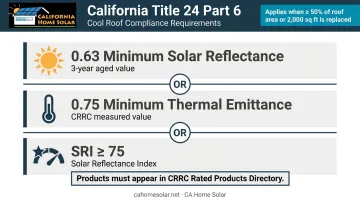
Southern California adds compliance costs that don't apply everywhere. Under 2022 Title 24 Part 6, nonresidential roof alterations must meet cool roof standards when more than 50% of the roof area or 2,000 square feet (whichever is less) is replaced, recovered, or recoated.
For low-slope commercial roofs in Climate Zones 6, 8, 9, and 10 — which cover most of the Los Angeles Basin and Orange County — the minimum code requirements are:
- 0.63 minimum 3-year aged solar reflectance
- 0.75 minimum thermal emittance, or
- SRI 75
Products must appear in the CRRC Rated Products Directory to qualify. The cost impact varies by system: cool thermoplastic membranes (TPO, PVC) typically meet these thresholds at little or no premium, while reflective surfacing for modified bitumen may add approximately $1 per square foot, according to LBNL research.
CBC 2025 Section 1504.1 also requires wind-uplift design for all roof decks and coverings — a particularly relevant requirement for coastal and high-exposure zones in LA and Orange County, where perimeter and corner fastening must meet tested assembly requirements.
Full Cost Breakdown: Beyond the Per-Square-Foot Price
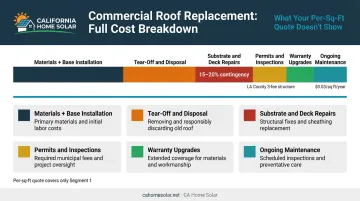
The per-square-foot figure in most contractor quotes covers materials and base installation only. A complete project budget needs to account for several additional line items.
| Cost Category | Type | Notes |
|---|---|---|
| Materials + base installation | One-time | The quoted per-sq-ft figure — this is the starting point, not the total |
| Tear-off and disposal | One-time (if applicable) | Adds labor hours and haul-away fees; cost increases with multiple existing layers or moisture damage |
| Substrate and deck repairs | Variable, one-time | Only fully knowable after tear-off; hidden damage, rot, or compromised insulation must be repaired before the new system goes down |
| Permits and inspections | One-time | Required for virtually all commercial reroofs |
| Warranty upgrades | One-time | NDL/full-system coverage adds a per-sq-ft premium but provides substantially stronger protection than standard product warranties |
| Ongoing maintenance | Recurring | Bi-annual inspections, drain clearing, and minor repairs are required to maintain warranty validity |
Permits in Los Angeles County are made up of three separate fee components — don't assume a flat allowance. LA County's 2025–2026 fee schedule breaks down as follows:
- Inspection fee: $780.81 (roofs up to 5,000 sq ft) to $2,367.74 (roofs over 100,000 sq ft)
- Issuance fee: $39.99 flat
- Valuation-based permit fee: $1,338.98 for a $50,000 project valuation; $2,179.24 for a $100,000 valuation
Your total permit budget should add all three — not just the inspection line.
On substrate repairs: this is the cost category that most frequently breaks budgets. Once the old roofing is removed, damaged decking or saturated insulation that was invisible from above must be addressed. Budget a 15–20% contingency on top of your base estimate to cover this.
Maintenance is the cost most owners underestimate at the outset. An NRCA case study documented proactive roof maintenance averaging $0.83 per square foot over 25 years ($0.03/sq ft/year). That's not a universal benchmark, but it's a useful order-of-magnitude when projecting 20- to 30-year lifecycle costs — and skipping maintenance typically voids the warranty that justified the premium system in the first place.
Low-Cost vs. High-Cost Commercial Roofs: What's the Difference?
Choosing between a budget and premium system isn't simply about spending more for the same result. The performance, longevity, and total cost gaps are significant.
Energy Performance
Entry-level systems (basic EPDM, standard asphalt) provide adequate waterproofing but minimal reflectivity. Premium membranes and cool roof systems perform measurably better — and in Southern California's warm climate, that gap translates directly to HVAC operating costs year-round.
LBNL research documents annual A/C energy reductions of up to 15% for single-story buildings in warm climates with cool roofs installed. California-specific results vary considerably by building type:
- Sacramento retail store: 52% average reduction in A/C energy use
- San Marcos elementary school: 17–18% energy savings
- Cold-storage facilities: only 3–4% chiller savings
For commercial buildings in LA and Orange County with year-round cooling demands, the energy performance gap between a reflective membrane and a standard one is a legitimate financial consideration, not just an environmental one.
Lifespan and Lifecycle Cost
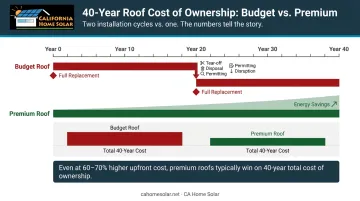
Budget materials typically carry shorter service lives; premium materials extend the replacement cycle significantly. A simplified lifecycle comparison illustrates the point:
- A lower-cost roof replaced twice over 40 years incurs installation costs twice, plus two rounds of tear-off, disposal, permitting, and disruption
- A premium metal or high-grade PVC roof lasting the full 40 years incurs those costs once
Even at 60–70% higher upfront cost, a single premium installation typically wins on total cost of ownership over 40 years. Factor in energy savings and fewer maintenance calls, and the math shifts further in favor of investing more at the start.
How to Estimate Your Commercial Roof Replacement Budget
Step-by-Step Budget Framework
- Measure actual roof area, not just building footprint — parapet overhangs and penetration areas affect material quantities
- Choose your material tier based on building type, expected occupancy period, energy goals, and code requirements
- Multiply by the per-square-foot range for that material category; use contractor quotes alongside RSMeans or a local estimating database as a benchmark
- Add 15–20% contingency for substrate repairs and unforeseen conditions
- List tear-off, permits, and inspection fees as separate line items — don't assume they're bundled into the base quote
Common Budgeting Mistakes
- Focusing only on the per-square-foot material number while ignoring disposal, permits, and substrate costs
- Choosing the lowest bid without verifying contractor licensing, insurance, and what the warranty actually covers
- Delaying replacement until repair costs become unsustainable — once a roof is leaking frequently, each repair bill is money that could be applied toward replacement
- Not getting itemized quotes — a single bundled number makes it impossible to identify what's driving cost differences between contractors
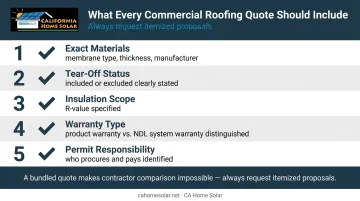
Itemized quotes also make contractor comparisons more accurate. When reviewing each proposal, confirm it specifies:
- Exact materials (membrane type, thickness, manufacturer)
- Whether tear-off is included or excluded
- Insulation scope and R-value
- Warranty type (product warranty vs. NDL system warranty)
- Permit procurement responsibility
Coordinating Roofing with Solar
Commercial roof replacement is a natural trigger point for evaluating solar integration. Installing panels on a new roof eliminates the cost and disruption of later retrofit work, and avoids the scenario of removing a relatively new solar array to address a failing roof underneath.
California Home Solar handles both roofing and solar under one project team, which simplifies scheduling and eliminates coordination gaps between trades. As a HERO Registered Contractor, they can also assess whether HERO financing applies to your commercial energy efficiency project before you commit to a financing structure. Reach them at 877-903-1012 or info@cahomesolar.com.
Frequently Asked Questions
Frequently Asked Questions
Is $30,000 too much for a commercial roof replacement?
$30,000 falls within a reasonable range for smaller commercial buildings (roughly 2,000–4,000 sq ft) using mid-grade materials. It may be high for very small projects or insufficient for larger buildings. Check the per-square-foot figure against current market rates for the specified material, and confirm that tear-off, insulation, and permits are included.
How often should you replace a commercial roof?
Replacement frequency depends on material. EPDM systems can provide 30 or more years of service life when properly installed; TPO and PVC systems often carry warranties up to 30–35 years; metal roofs can last 50+ years. Bi-annual inspections are the most reliable way to catch deterioration early and plan replacement before emergency conditions force the decision.
What is the 25% rule for commercial roofing?
It's an industry guideline suggesting that when repair costs approach 25% of full replacement cost, replacement is typically the more financially sound decision. Continued repair spending on a failing roof consumes budget without resetting the roof's lifespan or resolving underlying deterioration. Consult a licensed roofing consultant or contractor to apply this benchmark to your specific situation.
What is the most cost-effective commercial roofing material?
TPO single-ply membrane ranks among the best value options for flat commercial roofs — offering high reflectivity, heat-weldable seams, energy performance in warm climates, and a mid-range installed cost. For sloped commercial roofs, asphalt shingles have the lowest upfront cost but carry higher long-term maintenance expense.
What hidden costs should I watch out for?
The most commonly overlooked line items include:
- Deck or substrate repairs discovered after tear-off
- Building permit fees (which scale with project valuation and roof area in LA County)
- Upgraded warranty premiums
- Disposal and haul-away fees for old roofing material
- Scheduling premiums for working around occupied buildings
Should I repair or replace my commercial roof?
Repair makes sense for isolated damage on a roof with significant remaining service life. Replacement is the better call when the roof is within 5 years of end-of-life, repairs are recurring, costs are approaching the 25% threshold, or you're planning to install solar or upgrade insulation — all of which require a sound, new substrate to perform correctly.