The spread is wide. Material choice, roof size, your city, and local regulatory requirements can swing the final number by tens of thousands of dollars. A homeowner in Pasadena comparing quotes to a national average is working from the wrong baseline entirely.
This guide breaks down real California pricing ranges, the key cost drivers most homeowners overlook, and what Southern California homeowners specifically need to budget for before signing anything.
Key Takeaways
- Full replacement range: Most California homeowners should plan for $18,000–$32,000, with Southern California (LA metro) projects typically landing in the $18,000–$30,000 range
- Material drives the biggest spread: Asphalt shingles cost far less upfront than metal or clay tile, but durability and California's climate make the trade-off worth a close look
- Labor is often the largest single cost: In high-demand SoCal markets, labor routinely makes up 60% or more of total project cost
- Permits, Title 24, and HOA rules add real cost: All three apply to nearly every California re-roofing project and affect both budget and timeline
How Much Does a New Roof Cost in California?
There's no single fixed price for a roof replacement in California. According to Modernize's 2026 California roofing benchmark, the typical planning range runs $18,000–$32,000, with an average around $26,600 — roughly triple the national average homeowners often see quoted online.
JLC's 2024 Cost vs. Value data for Los Angeles puts a standard asphalt replacement at $33,459 in LA versus $30,680 nationally. Metal roofing runs $54,809 in LA versus $49,928 nationally. Local labor rates, permitting, and compliance requirements all push California costs higher than what national figures suggest.
Two mistakes cause most budgeting problems:
- Using national averages — HomeAdvisor's 2025 national average of $9,544 is not a California number
- Ignoring non-material costs — permits, disposal, structural repairs, and compliance upgrades are real line items that don't show up in material-only quotes
Here's what those costs actually look like broken down by roof type, size, and region.
Pricing by Roof Type
| Roof Type | Installed Cost Range | Notes |
|---|---|---|
| Asphalt Shingles | $5,800–$20,000 | Lowest upfront cost; dimensional shingles at the higher end |
| Metal (Standing Seam) | $14,000–$36,000 | $9–$16/sq ft installed; better longevity and energy performance |
| Clay/Concrete Tile | $20,000–$40,000 | $10–$25/sq ft; dominant in SoCal; structural capacity matters |
| Flat/TPO | $4,000–$18,000 ($4–$14/sq ft) | Common for modern homes and additions; detail-sensitive |
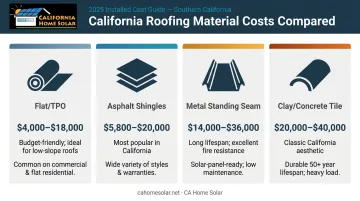
These ranges typically include materials, labor, and basic disposal. Permits, structural repairs, skylights, and compliance upgrades are usually separate.
Pricing by Roof Size
Roofers price by roof deck area, not interior living space. One roofing square = 100 sq ft of roof surface.
| Roof Size | Roofing Squares | Estimated Range |
|---|---|---|
| 1,000 sq ft | 10 | $4,000–$11,000 |
| 1,500 sq ft | 15 | $6,000–$16,500 |
| 2,000 sq ft | 20 | $8,000–$22,000 |
| 2,500 sq ft | 25 | $10,000–$27,500 |
| 3,000 sq ft | 30 | $12,000–$33,000 |
These figures apply Angi's national $4–$11/sq ft benchmark. California projects frequently land above this range — Modernize's $18,000–$32,000 California average reflects local labor and compliance costs that per-square-foot benchmarks don't capture.
Regional Price Differences Across California
| Region | Typical Range |
|---|---|
| San Francisco–Oakland–San Jose | $20,000–$35,000 |
| Los Angeles Metro | $18,000–$30,000 |
| Sacramento–Stockton–Modesto | $17,000–$28,000 |
Southern California (including Los Angeles, Long Beach, the San Fernando Valley, and Pasadena) sits firmly in the mid-to-high range. Contractor demand, permitting complexity, and WUI compliance requirements all contribute. Bay Area projects tend to run slightly higher still.
Key Factors That Affect New Roof Costs in California
Pricing isn't just about material choice. Several compounding factors shape the final number, and understanding them helps homeowners evaluate quotes more clearly.
Roofing Material and Climate Suitability
Material is the single largest cost variable. In California, though, the right choice depends on more than price per square.
- Asphalt shingles are the cheapest option, but Southern California's intense UV exposure and wildfire-risk zoning make them less suited to many areas
- Metal and clay tile cost more upfront but offer better heat resistance, longer lifespans, and stronger performance in fire-hazard zones
- Cool-roof-rated materials are increasingly required under California's Title 24 standards when more than 50% of a single-family roof is replaced — this applies across most of SoCal's climate zones
CA Home Solar installs cool roof systems as part of its roofing remodeling service because Southern California's heat loads make reflective roofing a practical performance upgrade. A standard roof can exceed 150°F in summer sun; cool roofs reflecting 80% of sunlight stay roughly 50°F cooler on a hot afternoon.
Roof Size, Pitch, and Complexity
A steep pitch, multiple roof levels, or irregular geometry all increase cost. Per Angi's 2026 data, a roof with a pitch of 9:12 or greater can add $1,000–$3,000 over a standard-slope project due to added labor, safety requirements, and material handling.
Other complexity factors that raise costs:
- Multiple chimneys or skylights
- Hip or mansard roof designs vs. simple gables
- Two-story homes with limited staging access
- Hidden decking damage requiring sheathing replacement ($2–$6/sq ft for materials alone, up to $17,000 for large steep-pitch projects)
A homeowner in Pasadena or the San Fernando Valley with a two-story hipped roof should not benchmark their quote against a one-story ranch estimate. That complexity directly affects labor — which is typically the largest single cost component in California roofing projects.
Labor Rates and Location Within California
BLS May 2023 data for the Los Angeles–Long Beach–Anaheim market puts the mean hourly wage for roofers at $29.70, but homeowner-facing crew rates run $40–$90 per worker per hour when you factor in supervision, insurance, workers' compensation, overhead, and warranty risk.
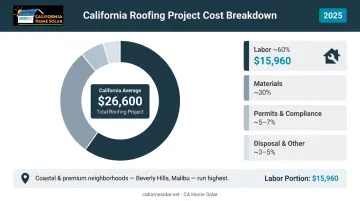
Modernize's California model shows labor at approximately $15,960 of a $26,600 average project, or roughly 60% of total cost. Labor runs highest in coastal and premium neighborhoods like Beverly Hills, Malibu, and Santa Monica. Inland areas such as Palmdale and Lancaster are somewhat cheaper — though the gap is smaller than most homeowners expect.
California Permits, Title 24, and HOA Rules
Nearly all California cities and counties require a permit for re-roofing. LADBS and LA County publish fee schedules rather than a flat rate — actual permit costs depend on project valuation and must be estimated through the city's calculator.
Key compliance points:
- Title 24 cool-roof requirements kick in when more than 50% of a single-family roof is replaced — specific solar reflectance and thermal emittance thresholds apply depending on climate zone
- Wildland-Urban Interface (WUI) rules require Class A fire-rated roof assemblies in fire-hazard severity zones; in communities like Malibu, Santa Clarita, and Antelope Valley, this narrows material choices and can raise project costs
- HOA restrictions can limit material type, color, and profile — always verify architectural approval before selecting a product
Roof Removal, Disposal, and Hidden Structural Issues
Tear-off adds $1,000–$3,000 to most projects. Multi-layer asphalt roofs and clay tile roofs typically require full removal before new material can go down — LA County code prohibits overlaying tile and limits asphalt overlay to single-layer situations.
Once the old roof is stripped, hidden damage often surfaces:
- Rotted or water-damaged decking
- Weakened sheathing around penetrations
- Sagging or cracked structural members
Budget a 10–15% contingency above your base estimate to cover these discoveries. A written quote that doesn't include a sheathing allowance or change-order clause for structural repairs is one to scrutinize carefully.
The True Cost Breakdown of a New Roof
Most homeowners are surprised by the final invoice because material costs are only part of the picture. Knowing every line item upfront helps you budget accurately and avoid last-minute surprises.
One-time costs:
- Shingles, tiles, or panels; underlayment; flashing; and ridge caps — priced per roofing square (100 sq ft) and varying significantly by material type
- Tear-off of the old roof, deck inspection, and full installation — typically the largest single line item, varying with pitch, complexity, and contractor
- Permit fees, Title 24 cool-roof documentation, and any code-mandated insulation or ventilation upgrades triggered during the project
Recurring and long-term costs:
- Routine inspections and gutter maintenance
- Flashing repairs and spot treatments over time
- Extended manufacturer or contractor warranties — these can add $500–$5,000 upfront but reduce out-of-pocket repair costs down the road
If the total project cost is a barrier, financing can make the timeline work. CA Home Solar is a HERO Registered Contractor, and the HERO PACE program offers zero down, zero upfront payments billed through your property tax bill, with flexible terms from 5 to 25 years. Approval is based on home equity and payment history rather than credit score, making it accessible to homeowners who wouldn't qualify for traditional financing.
Budget vs. Premium Roofing in California — What's the Real Difference?
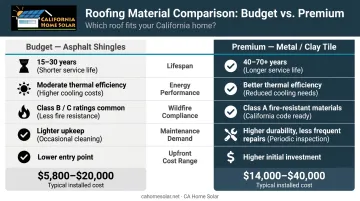
In California's climate, the gap between budget and premium roofing materials shows up in lifespan, fire compliance, and long-term maintenance costs — not just the upfront price.
| Factor | Budget (Asphalt) | Premium (Metal / Clay Tile) |
|---|---|---|
| Lifespan | Shorter expected service life | Significantly longer with proper maintenance |
| Energy performance | Standard | Better heat resistance; cool-roof eligible |
| Wildfire compliance | Requires specific Class A-rated products | Metal and tile more naturally compliant |
| Maintenance | More frequent repairs over time | Lower maintenance demand |
| Upfront cost | $5,800–$20,000 installed | $14,000–$40,000 installed |
When spending more makes sense:
- Older home you plan to stay in for 15+ years
- Wildfire-risk zones like Antelope Valley or Santa Clarita, where Class A ratings are mandatory
- Coastal areas like Malibu or Hermosa Beach, where moisture resistance matters
- Properties where energy savings from cool-roof technology offset the premium over time
For other situations, a mid-range material often delivers better value without the higher upfront commitment.
When a mid-range option is the smarter call:
- Shorter-term ownership horizon
- Home already has solid structure and ventilation
- Budget constraints where financing isn't practical
How to Estimate Your Roofing Budget
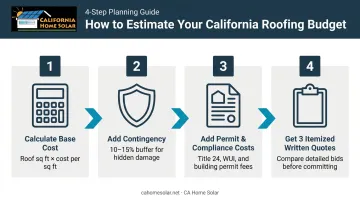
A simple formula gives you a starting point:
Roof deck area (sq ft) × cost per sq ft of chosen material = base estimate
Then add:
- 10–15% contingency for structural surprises, disposal, and permit fees
- Permit fees (variable by city — estimate through your local building department's fee calculator)
- Compliance upgrades if Title 24 or WUI requirements apply
What Most Homeowners Get Wrong
- Focusing only on material price — labor often exceeds material cost in SoCal markets
- Not asking whether permits and tear-off are included — many quotes exclude both
- Not building in a contingency buffer — hidden decking damage is common, not exceptional
- Using national average estimates — California costs run considerably higher
The surest way to cut through the noise is to get at least 3 itemized written quotes from licensed contractors. Ask each one to break out materials, labor, permit handling, disposal, and any compliance line items separately — that breakdown tells you far more than a single lump-sum number.
CA Home Solar has been serving Southern California homeowners across Los Angeles, Orange County, and the San Fernando Valley for 36 years and offers free roofing estimates. Their team walks through the full project cost, including cool-roof options, solar-ready prep, and HERO financing, so you know exactly what you're signing up for.
Frequently Asked Questions
How much would a 2,000 square foot roof cost in California?
A 2,000 sq ft roof in California typically runs $18,000–$30,000 for a full replacement in the LA metro area, depending on material. Asphalt shingles land at the lower end; clay tile or metal can push toward the top. Any full replacement quote should include labor, tear-off, and permits.
What is the most expensive part of replacing a roof?
Labor. In California, labor routinely accounts for the largest share of total project cost — in some SoCal markets, it can represent around 60% of the total. Complex roof designs, steep pitches, or structural repairs push that number higher.
What is the best roofing material for Southern California's climate?
Metal and clay/concrete tile handle Southern California's heat, UV exposure, and wildfire-risk requirements best. Cool-roof-rated materials are increasingly required under Title 24 in California when more than half the roof is replaced, so the right material affects both performance and code compliance.
Does homeowners insurance cover roof replacement in California?
Insurance typically covers damage from covered perils (fire, wind, hail) but not age-related wear or maintenance neglect. Given California's wildfire risk, check whether your policy specifically covers fire damage and review your coverage limits before assuming a claim will cover a full replacement.
Do I need a permit to replace my roof in California?
Yes. Most California cities and counties require a permit for re-roofing. A licensed contractor typically handles the permit application as part of the project scope — confirm this is included when reviewing quotes.
How long does a roof replacement take in California?
Physical installation typically takes 2–4 days for asphalt; tile and metal jobs run longer. Factor in permitting, potential HOA approval, and inspection scheduling. From contract signing to final sign-off, the full calendar timeline is often 2–4 weeks.