SCE customers are already paying an estimated $0.344/kWh in 2025 — up from just $0.182/kWh in 2020, according to the CPUC's 2024 SB 695 Report. Every month you delay going solar means paying those rates in full.
Here's what Southern California homeowners actually need to know about timing a solar installation.
Key Takeaways
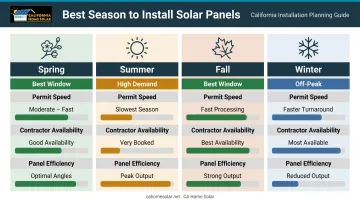
- Spring (Feb–Apr) and fall (Sep–Nov) offer the best combination of mild weather, contractor availability, and permit processing speed in the LA area
- The full installation process — from contract signing to activation — typically takes 6–12 weeks, so start planning at least one season early
- Summer heat reduces panel output by up to 8–11% compared to rated capacity, making spring and fall production conditions more favorable than most people expect
- The 30% federal Investment Tax Credit applies to the tax year your system is placed in service — missing December 31 means a 12-month wait to claim it
- The residential credit is not available for systems placed in service after December 31, 2025 per current IRS guidance — plan your timeline now
Why Timing Matters for Solar Panel Installation
Picking the right season isn't just a convenience decision. It directly affects your system's efficiency, the cost you pay, and whether you collect thousands of dollars in federal credits this year or next.
The Heat Efficiency Problem
Most homeowners think more sun equals more output. That's only half true. Solar panels are rated at Standard Test Conditions (STC) — defined by the Department of Energy as 1,000 W/m² irradiance and a cell temperature of 25°C. In the real world, LA-area rooftops run much hotter.
According to NREL's PVWatts documentation, roof-mounted systems operate at a reference cell temperature of 49°C due to restricted airflow — well above the rated 25°C. The output penalty depends on panel quality:
- Standard crystalline panels (-0.47%/°C): roughly 11% DC output loss at operating temperature
- Premium panels (-0.35%/°C): still lose around 8.4%
- Both figures apply on a typical hot July afternoon in the San Fernando Valley or Antelope Valley
Spring and fall avoid this problem. Mild temperatures keep cells closer to their rated operating range, and solar radiation is still strong — NASA POWER data for the Burbank area shows April and May averaging 6.6 and 7.5 kWh/m²/day, respectively.
Efficiency gains are only part of the timing equation — the financial window adds its own urgency.
The Federal Tax Credit Deadline
The 30% Residential Clean Energy Credit is claimed in the tax year the system is placed in service. Per current IRS guidance, this credit applies to qualifying property installed through December 31, 2025 — and the IRS states the credit is not available for property placed in service after that date. Waiting until January to start means losing a full year of potential savings from that credit.
California's Shifting Net Metering Landscape
SCE customers who applied for interconnection on or after April 15, 2023 are on the Net Billing Tariff (NBT) — SCE calls it the Solar Billing Plan. Under this structure, export credits are no longer a simple retail-rate swap; they vary based on time-of-use and avoided-cost methodology. LADWP operates under separate municipal NEM guidelines, not the CPUC's Net Billing Tariff.
The practical implication: pairing solar with battery storage now recovers the export-credit value that NBT no longer provides at retail rates. Sizing your system without accounting for this policy means leaving money on the table — which is exactly why starting the process before summer pricing and permit backlogs set in makes a measurable difference.
Best Time to Install Solar Panels in Southern California, Season by Season
Southern California's climate makes solar viable year-round. But each season carries distinct trade-offs worth knowing before you schedule.
Spring: The Optimal Window
February through April is widely considered the best time to install in the LA area. Here's why it stands out:
- Mild rooftop temperatures keep installation crews working efficiently and panels operating near rated capacity from day one
- Permit offices are less backlogged than in summer, when solar applications surge across LA County
- Contractor availability is higher, which can translate to faster scheduling and more competitive bids
- Systems go live before peak summer demand, meaning homeowners start offsetting bills exactly when electricity use — and rates — spike
Starting in February or March also gives a comfortable buffer. If permitting runs long, there's still time to be fully operational by June.
Summer: Maximum Sun, Real Trade-Offs
Summer is when solar demand peaks, and the math gets complicated:
- Longest daylight hours and highest solar radiation (June averages 8.1 kWh/m²/day at the Burbank proxy)
- But also the hottest cell temperatures — heat-related output losses of 8–11% are most pronounced in July and August
- Installation backlogs tend to be at their worst; homeowners should expect longer wait times for contractor scheduling
- Inland areas like the San Fernando Valley, Antelope Valley, and San Gabriel Valley see the most extreme heat effects
Summer isn't a bad time to install — it's just the busiest, and often not as efficient as it looks on paper.
Fall: Strong Production with a Hard Deadline
September through November offers a compelling window:
- Temperatures cool down, improving both panel output and working conditions for installers
- Solar radiation remains solid — September averages 6.3 kWh/m²/day, comparable to April
- Permit processing typically eases after the summer surge
- Homeowners who start in September can still complete installation before December 31 and claim the federal ITC for that tax year — if they move promptly
The key word there is promptly. Given typical 6–12 week timelines, waiting until November to start is risky if the December 31 deadline matters to your finances.
Winter: The Underrated Option
Southern California winters are nothing like winters in Michigan or New England. The practical advantages:
- No snow accumulation, minimal freeze risk, mild temperatures throughout LA County
- Contractor schedules open up considerably, with less competition for crews and equipment
- Permit offices are at their least backlogged
- Homeowners who start in December or January are positioned to be fully operational by spring, right before summer demand climbs
Winter solar radiation is lower (December averages 2.9 kWh/m²/day), but the installation itself proceeds without weather-related complications. If the December 31 ITC deadline isn't a factor, winter installations offer shorter wait times and a clean runway into peak production season.
The Installation Timeline Most Homeowners Underestimate
The physical installation of a residential solar system usually takes 1–3 days. That's not what takes 6–12 weeks.
The full process looks like this:
- Site assessment and system design — typically completed within 1–2 weeks of signing
- Permit filing with the local AHJ (Authority Having Jurisdiction) — processing time varies by municipality; some cities move faster than others
- HOA approval (if applicable) — can add weeks if not started early
- Physical installation — 1–3 days for most residential systems
- Utility inspection and interconnection approval from SCE or your local utility — SCE's Rule 21 process governs interconnection for SCE-served homes across much of Southern California
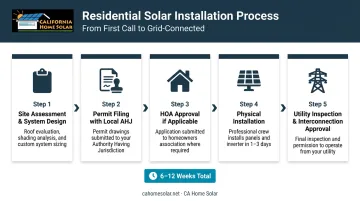
The bottlenecks are almost always permitting and utility interconnection — not the installation itself. Permit and interconnection queues tend to be longest when solar demand spikes, which historically aligns with summer months.
That pattern is worth factoring into your start date.
Working backward from your target activation date:
- Want to be live by June 1? Start the process no later than mid-March
- Want to claim the federal ITC this calendar year? Your system needs to be placed in service before December 31 — which means starting no later than September or October
California Home Solar's 36 years handling permits and SCE interconnections across Southern California — from the San Fernando Valley to Orange County — means fewer delays and no learning curve on the paperwork that holds most projects back.
Signs Now Is the Right Time to Go Solar
Not every homeowner is in the same position. Here are the clearest indicators that acting now makes financial sense:
Roof Readiness
- Roof has more than 5–7 years of remaining life — solar warranties typically run 25 years, so installing on a roof due for replacement adds unnecessary costs
- Adequate south- or west-facing roof space with minimal shading from trees or nearby structures
- CA Home Solar handles roofing remodeling and solar-ready roof upgrades, so a roof issue doesn't have to stop you
Financial Signals
- Monthly electricity bill of $150+ — higher bills mean faster payback
- Recent rate increase notice from SCE or LADWP
- Approaching year-end with a meaningful tax liability (the 30% ITC requires tax liability to offset)
- Local municipality rebates or PACE financing programs — HERO, California First, YGrene — may apply to your property
Policy Signals
- The 30% federal residential tax credit applies to systems placed in service by December 31, 2025
- NEM policies have already shifted once — NEM 2.0 to NEM 3.0 — and may shift again; acting now means you know exactly what you're locking in
CA Home Solar offers free consultations to help Southern California homeowners assess roof readiness, review current incentives, and find the most financially advantageous window to install.
The Real Cost of Waiting
Waiting for the "right time" to go solar has a real dollar cost — and for most Southern California homeowners, that cost compounds every month they delay.
Utility Rates Aren't Static
SCE bundled residential rates have climbed steadily:
| Year | SCE Average Rate |
|---|---|
| 2020 | $0.182/kWh |
| 2021 | $0.213/kWh |
| 2022 | $0.246/kWh |
| 2025 (forecast) | $0.344/kWh |
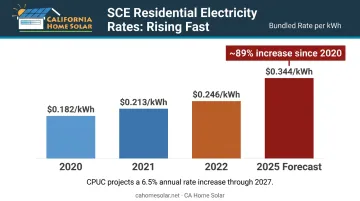
That's roughly a 7% annual increase since 2013, with the CPUC forecasting an average annual increase of 6.5% through 2027. LADWP rates have followed a similar upward trend, rising from $0.155/kWh in 2020 to $0.186/kWh in 2023.
Every month a homeowner waits, they're paying the full retail rate — and that rate keeps moving up. A household paying $225/month in electricity today will pay roughly $15–$20 more per month within a year or two, without solar offsetting any of it.
Incentive Risk Is Real
Rising rates are only part of the equation — the incentives available today aren't guaranteed to stick around either.
The 30% federal ITC has already been subject to policy changes, and current IRS guidance makes clear it applies only to systems placed in service through December 31, 2025. California's net metering structure has already shifted once — NEM 2.0 gave way to NEM 3.0, changing how excess energy is credited and making battery storage more important for maximizing system value.
There's no guarantee the next policy shift favors homeowners. Installing now means locking in today's incentives with full certainty; waiting means betting on rules that could change before you act.
Frequently Asked Questions
What is the best month to install solar panels in Southern California?
February through April and September through November consistently offer the best combination of mild weather, contractor availability, and permit processing speed in the LA area. Southern California's climate makes year-round installation feasible, but these windows tend to move fastest.
Is it worth installing solar panels during a Southern California winter?
Yes — and it's underrated. Unlike colder states, SoCal winters bring no snow, minimal freeze risk, and mild temperatures. Contractors typically have more availability, permit queues are shorter, and homeowners who start in December or January are operational by spring.
How long does it take to install solar panels in the Los Angeles area?
The full process — contract to activation — typically takes 6–12 weeks. Physical installation is usually 1–3 days; the remaining time is permit processing and utility interconnection approval with SCE or LADWP.
Do solar panels work efficiently in Southern California's summer heat?
Peak sunlight hours are highest in summer, but high temperatures reduce output. Using NREL's temperature coefficients, standard crystalline panels can lose roughly 8–11% of their rated output at typical roof-mounted operating temperatures. Spring and fall often deliver strong production with fewer heat-related losses.
Does a 400W solar panel actually produce 400W?
Not in typical conditions. The 400W rating reflects peak output under Standard Test Conditions — 1,000 W/m² irradiance and 25°C cell temperature. Actual output varies based on sunlight intensity, ambient temperature, shading, and panel orientation.
How do California's net metering rules affect when I should go solar?
Under NEM 3.0 (SCE's Solar Billing Plan for new applicants after April 15, 2023), export credits vary by time of use rather than offsetting retail rates directly. LADWP operates under separate municipal guidelines. Reviewing current policy before sizing your system matters — battery storage has become significantly more valuable under the new structure.