Solar panels get discussed constantly, but the conversation often stays vague—"save money," "go green," "energy independence." What most homeowners actually want to know is what the numbers look like, what the process involves, and whether the investment makes sense for their specific situation.
This article walks through the concrete, measurable benefits of going solar in Southern California: the financial case, the resilience case, and the long-term picture—so you can make a decision based on real information rather than sales language.
Key Takeaways
- California homeowners pay roughly 2x the national average for electricity, making solar bill savings among the highest in the country
- A well-sized solar system can offset 100%+ of your electricity consumption, based on EnergySage marketplace data for California
- Solar adds measurable resale value—and California's property tax exclusion means that added value won't raise your tax bill
- Battery storage paired with solar provides backup power during PSPS outages, a recurring reality across Southern California
- The payback period for California solar averages around 7.64 years, after which your system generates essentially free electricity for another 15+ years
What Are Home Solar Panels?
Solar panels are mounted on your roof and convert sunlight into direct current (DC) electricity. An inverter transforms that DC power into alternating current (AC) your appliances actually use. From there, your system handles the surplus automatically:
- Excess power sent to the grid earns a bill credit through net metering
- Excess power stored in a battery is available for use after dark or during outages
- Power drawn from the grid fills any gap when production falls short
The practical result: you buy less electricity from your utility. In months when your system produces more than you consume, your bill shrinks to near zero—or generates a credit balance.
That consistent reduction in grid dependence is what makes solar a financial decision as much as an energy one — you're locking in today's electricity rate for the next 25 years, before utility prices climb further.
Key Benefits of Installing Solar Panels on Your Home
The benefits below aren't projections built on optimistic assumptions. They show up in monthly utility statements, home appraisals, and—when the grid goes down—in whether your lights stay on.
Dramatically Lower (or Eliminate) Your Monthly Electricity Bill
The math is straightforward: every kilowatt-hour your panels generate is one you don't buy from SCE or LADWP.
Why this matters in California specifically: SCE's average residential rate hit 34.5 cents/kWh effective January 1, 2026. LADWP's tiered rates run from 24.4 to 38.9 cents/kWh depending on usage level. Both are well above the national average of 18.83 cents/kWh recorded in March 2026.
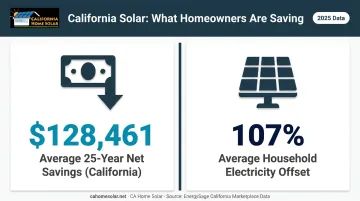
EnergySage's California marketplace data puts the 25-year savings figure at approximately $128,461 after accounting for the upfront system cost, and reports that California solar systems offset an average of 107% of household electricity consumption. Many systems produce slightly more than the home uses annually.
Who saves the most:
- Homes with central air conditioning running most of the year
- EV owners charging overnight
- Households with pool equipment or other high-draw appliances
- Homeowners on time-of-use rate plans with expensive peak-hour pricing
A note on net metering: California's current policy for SCE, PG&E, and SDG&E customers is the Net Billing Tariff (NBT), which replaced NEM 2.0 in April 2023. Under NBT, exported electricity earns credits based on grid avoided-cost values rather than retail import rates. Self-consumption is now more valuable than exporting, so a properly sized system is more financially effective than an oversized one.
LADWP operates under a separate net metering structure and should be evaluated independently.
Increased Home Value and Financial Incentives
What solar does to resale value: Research from Lawrence Berkeley National Laboratory found that owned solar systems added approximately $4 per watt of installed capacity (roughly $15,000 for an average 3.6 kW system) across a dataset of 22,000+ home sales. A California-specific LBNL study found premiums ranging from $3.90 to $6.40 per watt, with average block-group premiums near $24,700.
These findings apply to owned systems only, not leased panels.
The federal tax credit situation: The IRS Residential Clean Energy Credit is 30% of qualified installation costs. Per current IRS guidance, homeowners should verify eligibility for their specific installation timeline, as the credit's availability has been subject to legislative changes—confirm current status with a licensed installer before assuming it applies to your project.
California-specific incentives worth knowing:
| Incentive | What It Does |
|---|---|
| SGIP (Self-Generation Incentive Program) | Rebates for battery storage, ranging from $0.15/Wh to $1.00/Wh depending on eligibility tier; equity and resiliency categories receive higher rates |
| Property Tax Exclusion | Under Revenue and Taxation Code section 73, solar installation does not increase your assessed property value for tax purposes—extended through construction completed before Jan. 1, 2027 |
| Local utility rebates | Vary by utility; check with SCE or LADWP for current programs |
The property tax exclusion is particularly valuable: your home is worth more to a buyer, but your annual tax bill doesn't go up.
When this benefit matters most: Homeowners planning to stay 7–10+ years capture the full financial upside through bill savings. Those who sell earlier still benefit from a higher sale price—California buyers consistently place a premium on solar-equipped homes.
Energy Independence, Grid Protection, and Environmental Impact
The PSPS problem is real. SCE's 2024 post-season report documented multiple Public Safety Power Shutoff events affecting tens of thousands of customers, including 35,081 customers on November 4, 2024 and 27,528 on December 9, 2024, spanning Los Angeles, Orange, San Bernardino, Ventura, Riverside, and other Southern California counties.
Solar alone doesn't keep the lights on during a grid outage. That requires battery storage with islanding capability. A solar-plus-storage system draws from stored power when the grid goes down, for as long as the shutoff lasts.
Rate protection adds another layer of value. California residential electricity rates climbed from 20.96 cents/kWh in 2020 to 31.97 cents/kWh in 2024—a 52.5% cumulative increase in four years. Once your system is paid off, the electricity it generates costs you nothing. Every future rate increase makes that self-generated power worth more.
On the environmental side, the numbers compound over time:
- California's grid averages approximately 0.252 kg CO2e per kWh (2025 CARB data)
- Each solar kilowatt-hour directly displaces that grid electricity
- Over a 25-year system life, cumulative emissions reductions are substantial for a typical Southern California household
What Happens When You Skip Solar
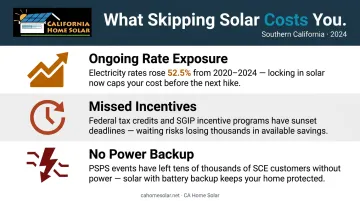
Skipping solar in California means staying fully exposed to utility rates that have climbed 52.5% between 2020 and 2024—with no sign of slowing down.
A few concrete consequences:
- Pays full utility rates on every kilowatt-hour you use. The trajectory on California electricity pricing is clear, and every year of delay compounds the cost.
- Risks missing available incentives. The federal tax credit and California's SGIP program have funding limits and sunset dates—waiting can mean smaller credits or none at all, plus months of bill savings you can never recoup.
- Leaves your home without power backup. Without battery storage, a PSPS shutoff leaves you in the dark alongside everyone else—and in fire-prone areas of Los Angeles County, these events now happen every year.
The upside is that acting now addresses all three of these directly—locking in savings, capturing today's incentives, and adding the resilience that Southern California homeowners increasingly need.
How to Maximize Your Home Solar Investment
Getting the most from your solar investment means making the right decisions before, during, and after installation. Here's what actually moves the needle.
System sizing should be based on 12 months of actual utility bills — not a rough estimate. Targeting 100–110% of your consumption is the right benchmark; oversizing for export credit is less effective under California's current Net Billing Tariff.
Roof condition matters more than most homeowners expect. If your roof needs work in the next five to seven years, address it before installation — removing and reinstalling panels later adds real cost. California Home Solar offers roofing services alongside solar, handled by one contractor, one project manager, one process.
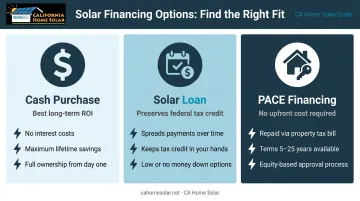
Financing options vary in how much they return over time:
- Cash purchase produces the best long-term return with no interest costs
- Solar loans preserve the federal tax credit while spreading payments over time
- PACE financing (through the HERO program, which California Home Solar is registered to offer) structures repayment through your property tax bill — no upfront cost, terms from 5 to 25 years, and approval based on home equity rather than credit score
Choosing a contractor with local experience matters in California. Permitting requirements, utility interconnection rules, and Net Billing Tariff details vary by jurisdiction — a contractor who doesn't navigate these routinely adds time and risk to your project.
California Home Solar has served the Los Angeles area for 36 years and has been recognized on Solar Power World's Top Solar Contractors list in 2015, 2016, 2018, 2021, 2023, and 2025. The A-to-Z process covers site survey, engineering, permitting, installation, final inspection, and Permission to Operate — with a dedicated project manager on each job.
After installation: Use your inverter's monitoring platform (California Home Solar installs Enphase IQ8 and SolarEdge systems, both with real-time dashboards) to track production versus consumption monthly. Catching underperformance early — from shading, soiling, or equipment issues — protects your savings over the system's life.
Conclusion
For most Southern California homeowners, solar isn't a close call. California's electricity rates are nearly double the national average, the region gets abundant sunshine year-round, incentives exist to offset upfront costs, and the grid disruption risk is well-documented. A properly installed system cuts monthly costs, adds resale value, and delivers returns for 25 years or more—with each rate increase making the decision look smarter over time.
The real question is simply when to start. California Home Solar has been helping Southern California homeowners make that transition for 36 years—reach out for a free assessment and see what your home qualifies for.
Frequently Asked Questions
Is it worth getting solar panels put on your house?
For most California homeowners, yes. High electricity rates, strong regional sunshine, and available incentives create some of the fastest payback periods in the country. Bill savings, home value gains, and rate protection make it one of the stronger home improvement investments available.
Why is my bill so high when I have solar panels?
The most common reasons: the system is undersized relative to actual consumption, household usage has increased since installation, or time-of-use rates mean peak-hour grid draws cost more than expected. Also confirm that net metering credits are appearing correctly on your utility bill.
How long does it take for solar panels to pay for themselves?
EnergySage reports a typical California solar payback period of about 7.64 years—shorter than the national average, largely because California's high electricity rates accelerate savings. The federal tax credit (if applicable to your installation) shortens this timeline further.
Do solar panels increase home value in California?
Yes. LBNL research consistently shows owned solar systems add measurable resale value, and California buyers tend to place a strong premium on solar-equipped homes. California's property tax exclusion under Revenue and Taxation Code section 73 means the value increase doesn't raise your assessed value or annual tax bill.
What tax credits or incentives are available for solar panels in California?
The primary incentives are the federal Residential Clean Energy Credit (verify current availability with your installer), California's SGIP program for battery storage, local utility rebate programs, and the state property tax exclusion for active solar systems. Eligibility and funding availability vary by program—confirm current terms with a licensed installer before finalizing your budget.
How many solar panels does a typical California home need?
It depends on your consumption, roof orientation, and panel wattage. EIA data puts the average California home at about 503 kWh/month, with EnergySage reporting average system sizes around 8.81 kW. A qualified installer will size your system from 12 months of actual utility bills, not a generic estimate.