? Complete Guide](https://file-host.link/website/cahomesolar-9sr760/assets/blog-images/36d7d81c-df77-4662-9b6d-e602fd891b86/1780326373333416_266cea6b94984002b06a1031f0c018ff/360.webp)
Research consistently shows that solar-equipped homes command a real price premium—and in California, where electricity rates are nearly double the national average, the numbers are more compelling than anywhere else in the country. Before signing any installation contract, here's exactly what the data says and what actually drives the difference.
Key Takeaways
- Solar panels increase home value by 4%–10% depending on location, system size, and age
- California homeowners can see dollar gains of $37,500–$75,000 on a $750,000 home
- Owned systems add value; leased systems generally do not
- California offers a property tax exclusion for solar—your assessed value won't increase
- Solar homes tend to sell faster than comparable non-solar homes
How Much Do Solar Panels Increase Home Value?
The research on this question has only gotten stronger over time—and the numbers have grown.
The Zillow 2019 study established the long-standing benchmark: solar homes sold for 4.1% more on average than comparable non-solar homes, translating to roughly $9,274 for the median U.S. home in 2019.
More recent data tells a more optimistic story. A 2025 analysis by SolarReviews put the average premium at approximately 6.9% across the U.S. Then in early 2026, SolarInsure published findings drawing on 5,000 California home sales from 2020–2023, including 2,350 owned-solar homes. Their conclusion: owned solar systems sold for 5%–10% more than comparable homes without solar.
What That Looks Like in Dollar Terms
California's median home price sits at approximately $823,180 (California Association of Realtors, January 2026). Apply a 5%–10% premium to a $750,000 home and you get:
| Premium Range | Estimated Dollar Gain |
|---|---|
| 5% (conservative) | ~$37,500 |
| 7.5% (midpoint) | ~$56,250 |
| 10% (strong market) | ~$75,000 |
For Southern California homeowners in higher-priced markets, the gains at the upper end can be even larger.
Why the Premium Has Grown
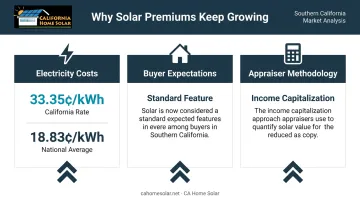
The dollar gains above aren't arbitrary — they're driven by three concrete market forces:
- Electricity costs: California's residential rate hit 33.35 cents/kWh in March 2026 per EIA data — nearly double the national average of 18.83 cents/kWh. Buyers price that savings potential directly into their offers.
- Buyer expectations: Solar has moved from novelty to standard feature. In many Southern California neighborhoods, buyers now expect it and factor its absence into their bids.
- Appraiser methodology: Appraisers use an income capitalization approach — calculating the present value of future electricity savings over the system's remaining lifespan. As utility rates climb, that projected value grows accordingly.
That said, the premium isn't guaranteed. Whether your home captures the full gain — or falls short — depends on the specific factors covered in the next section.
Key Factors That Determine How Much Value Solar Adds
No two solar homes are identical. The actual premium depends on a combination of variables that every homeowner should understand before drawing conclusions about their own property.
Location
Geography is the strongest single driver. States with high electricity rates and established solar markets see the largest premiums. Within Southern California, homes in territories served by utilities like LADWP or SCE—where rates are among the highest in the state—benefit disproportionately. The closer you are to a high-rate utility zone, the more a buyer will pay for a system that offsets those bills.
System Size and Quality
Larger systems with greater electricity output command higher premiums. For California residential installations, the California Energy Commission notes that systems installed on existing homes average around 7.2 kW, though system sizing should match actual household usage.
Equipment quality matters too, particularly for appraisers. Buyers factor in:
- Panel manufacturer and brand reputation
- Remaining warranty coverage
- Inverter type and condition
- Installation workmanship and permitting records
System Age and Condition
Solar panels typically last 25–30 years. Even older systems still add meaningful value, but there's a measurable difference. SolarInsure's California analysis found:
- Systems newer than 5 years: 7%–9% value increase
- Systems older than 5 years: 5%–6% value increase
Regular maintenance and documented upkeep slow this depreciation. A well-maintained 8-year-old system with clean records will appraise better than a newer system with no documentation.
Local Electricity Rates and Net Metering
High per-kWh costs amplify solar's value to buyers. California's rates—currently more than twice the national average—make owned solar particularly attractive to anyone comparing monthly utility bills between properties.
The billing arrangement matters too. Under California's current Net Billing Tariff (for systems interconnected after April 15, 2023), homeowners receive bill credits for excess energy exported to the grid. For buyers, that ongoing credit translates directly to lower monthly costs — a concrete financial benefit that goes beyond simple bill reduction.
Owned vs. Leased Solar: A Critical Distinction for Home Sellers
Whether your solar system adds value at resale comes down to one question: do you own it or lease it?
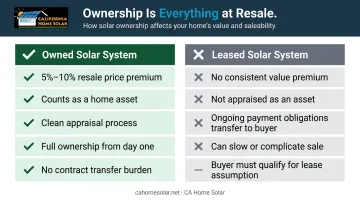
Research from Lawrence Berkeley National Laboratory found that homes with leased solar systems sold for essentially the same price as non-solar homes—no premium, no discount. SolarInsure's California dataset confirmed this: owned systems generated 5%–10% premiums; third-party-owned systems (leases and PPAs) showed no consistent value increase.
Why Leased Systems Don't Add Value
- The homeowner doesn't own the equipment, so it doesn't appear as an asset in an appraisal
- Leases and PPAs carry ongoing payment obligations that transfer to the buyer
- Many buyers are reluctant to inherit a 15–20 year contract with a third-party company, which can slow or complicate the transaction
- As the National Association of Realtors notes, buyers assuming a solar lease are taking on a contract with a solar company—and the terms matter
The Ownership Advantage
That ownership distinction is why California Home Solar only installs customer-owned systems—no lease arrangements. Financing options include PACE programs, where repayment is structured as a property tax line item, keeping full ownership with the homeowner from day one. At resale, you own the asset outright, so it can be appraised like any other home improvement.
If You Currently Have a Lease
If you already have a leased system and are planning to sell, you're not without options:
- Buy out the lease before listing—this converts the system to owned and potentially unlocks the full value premium
- Transfer the lease to the buyer—this is possible but often complicates negotiations
Confirm buyout terms directly with your solar provider before making resale decisions.
How Solar Compares to Other Home Improvements
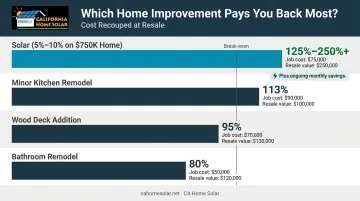
The question of whether solar is a better investment than a kitchen remodel or bathroom renovation comes up constantly — and the numbers make a strong case. The 2025 Cost vs. Value report from the Journal of Light Construction offers a direct comparison:
| Improvement | Job Cost | Resale Value | Cost Recouped |
|---|---|---|---|
| Minor kitchen remodel | $28,458 | $32,141 | 113% |
| Bathroom remodel | $26,138 | $20,915 | 80% |
| Wood deck addition | $18,263 | $17,323 | 95% |
| Solar (5%–10% on $750K home) | ~$20,000–$30,000 | $37,500–$75,000 | 125%–250%+ |
Two additional advantages solar has over every renovation on that list:
- Ongoing monthly savings: A remodeled kitchen doesn't reduce your utility bills. Solar does—every month you own the home.
- Minimal disruption: A typical residential installation takes one to two days. Compare that to a months-long kitchen or bathroom renovation.
Solar functions as both a financial asset at resale and a cost-reducing upgrade during ownership — a combination no purely aesthetic renovation can match.
Will Solar Panels Increase My Property Taxes in California?
This concern stops many homeowners before they even get a quote. If solar raises your home's value, wouldn't your property tax bill rise with it?
California has directly addressed this. Under Revenue and Taxation Code Section 73, the state offers a new construction exclusion for active solar energy systems. This means a qualifying solar installation does not increase your property's assessed value for tax purposes.
Key details:
- The exclusion applies to systems completed before January 1, 2027 (per BOE Letter to Assessors 2024/031)
- Once granted, the exclusion remains in place until a change in ownership occurs
- The exclusion applies whether the system is owned or leased
- Solar swimming pool heaters and passive energy systems are excluded from the definition
One note: the leased vs. owned distinction matters for resale value even though both qualify for the tax exclusion — a topic covered in the ownership section below.
Before installation, confirm eligibility with your local county assessor and keep full documentation of your system. County-level interpretation can differ, so a quick call to your assessor's office is worth it.
Tips to Maximize Your Solar Home Value
Getting the full resale premium from solar isn't automatic. How you size, document, and maintain the system determines how much value buyers and appraisers actually recognize at sale.
1. Size the system accurately A system matched to your actual energy usage produces a clear, documentable savings story for buyers and appraisers. Oversized or undersized systems raise questions. CA Home Solar conducts site evaluations and energy assessments to right-size systems for each property.
2. Keep thorough records The paperwork is the premium. Appraisers and buyers need:
- Installation contracts and permits
- Manufacturer warranty certificates
- Maintenance and cleaning logs
- Monthly production and savings data
A system with complete records will appraise higher than an identical system with missing documentation. CA Home Solar provides 24/7 system monitoring, which builds an ongoing production history that directly supports a stronger appraisal.
3. Maintain the system Dirty or degraded panels produce less electricity, which translates to a lower income capitalization value in an appraisal. Professional cleaning at least twice a year keeps output—and documented output—at its peak.
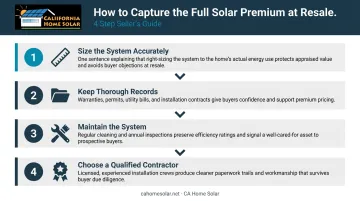
4. Choose a contractor whose work holds up to scrutiny A poorly installed system with code violations can actually complicate a sale. CA Home Solar has been recognized as a Top 500 Solar Contractor by Solar Power World in multiple years, including 2025. With 36 years serving Southern California homeowners, clean installations that pass buyer and appraiser review are the standard.
Frequently Asked Questions
Do solar panels actually add value to your home?
Yes. Multiple studies show solar panels increase home value by an average of 4%–10%, with the strongest gains in high-electricity-cost areas like California. Owned systems consistently outperform leased systems in terms of value added.
How much do solar panels increase home value in California?
Research from SolarInsure analyzing California home sales from 2020–2023 shows a 5%–10% increase for owned systems. On a $750,000 home, that's roughly $37,500–$75,000. Exact figures vary by location, system size, age, and condition.
Does a solar lease affect home resale value?
Leased systems generally do not add resale value and can complicate the sale process, since buyers may need to assume the lease contract. If you have a leased system, ask your provider about a buyout before listing.
Is it harder to sell a house with solar panels?
No. DOE-referenced research indicates solar homes sell faster than comparable non-solar homes, with buyers attracted by lower utility costs and energy independence. Owned systems, in particular, are a clear selling advantage.
Will solar panels raise my property taxes in California?
California's property tax exclusion for active solar energy systems means the added home value from solar is generally excluded from your assessed value. This exclusion applies to systems completed before January 1, 2027 — confirm current eligibility with your local county assessor.
How do appraisers calculate the value of solar panels?
Appraisers typically use an income capitalization approach—calculating the present value of electricity savings the system is expected to generate over its remaining lifespan. System age, condition, documentation quality, and local electricity rates all directly affect the appraised value.