Hiring one contractor to handle both roofing and solar, or engaging two specialists separately, is a decision that affects your total cost, project timeline, and warranty protection for the next 25+ years. Most homeowners don't think about it until they're already mid-project, which is exactly when it becomes expensive to get wrong.
The sequence matters here. The California Public Utilities Commission's Solar Consumer Protection Guide states directly that homeowners planning to replace a roof soon should do so before installing a rooftop solar system. That sequencing logic shapes everything else in this decision.
This article breaks down both contractor approaches — what each looks like in practice, where each fits, and how to choose based on your specific situation.
Key Takeaways
- One contractor for both trades simplifies scheduling and creates a single point of accountability for warranties
- Two separate contractors bring trade specialization, but all coordination falls on you
- Solar should go on after the roof is in good condition; installing panels first and reroofing later adds significant cost
- In California, roofing (C-39) and solar (C-46/C-10) are separate license classifications — verify any contractor holds the right credentials for both scopes
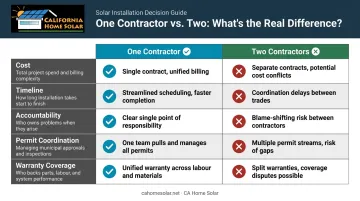
One Contractor vs. Two Contractors: Quick Comparison
| Factor | One Contractor | Two Contractors |
|---|---|---|
| Cost | Often lower — single mobilization, bundled scope | Each contractor prices independently; gaps can add cost |
| Timeline | Integrated scheduling from roof tear-off through solar commissioning | Roof must fully complete before solar begins; scheduling conflicts are common |
| Accountability | Single point of contact for roof-solar interface issues | Roofer and solar installer may blame each other for penetration or leak problems |
| Permit coordination | One team navigates both roofing and PV permit tracks | Homeowner manages two separate permit timelines |
| Warranty coverage | Single warranty covers roof-solar interface | Warranty gaps common at the roof-solar interface |
What Hiring One Contractor for Roofing and Solar Looks Like
A combined roofing-and-solar contractor holds credentials covering both trades — in California, that means a C-39 license for roofing and either a C-46 (solar) or C-10 (electrical) license for the PV work. They handle everything under one agreement: tear-off, re-roofing, panel mounting, flashing, and utility interconnection.
Integrated Project Planning
When the same team designs both the roof and the solar layout, those decisions happen together. Panel placement, roof pitch, load-bearing requirements, and penetration points are all factored in before the first shingle goes down. That upfront coordination prevents the most common conflict in two-contractor projects — discovering that the solar layout doesn't work well with the roof that was just installed.
Warranty Protection at the Penetration Points
Roof penetrations for solar mounts are one of the most common sources of post-installation leaks. When a single contractor handles both the waterproofing and the solar mounting, there's no gap in responsibility. The team that sealed the roof deck is the same team drilling into it for panel mounts.
Roofing manufacturers including GAF, CertainTeed, and Owens Corning publish specific warranty conditions tied to how solar installations interact with their systems. GAF, for example, requires a final roof inspection before PV installation on guaranteed roofing systems and reviews flashing details as part of that process.
With two contractors, meeting those conditions requires active coordination between parties. With one contractor accountable for both, it's handled as a standard step in the project workflow.
Permit and Inspection Sequencing
That same accountability extends to the permit process. In Los Angeles County and surrounding cities, roofing and solar require separate permits and are typically reviewed by different departments. LADBS maintains separate resources for re-roofing certificates and residential PV structural criteria.
A contractor experienced in both trades knows how to sequence those applications correctly — filing roofing documentation first, completing the roof inspection, then advancing the PV permit. That sequencing prevents the project from stalling while one permit track waits on the other.
CA Home Solar, based in Sherman Oaks, is one Southern California contractor that has handled both roofing and solar under a single agreement for 36 years — covering everything from initial roof assessment through solar commissioning.
Best Fit for the Single-Contractor Approach
- Homeowners doing a full roof replacement at the same time as going solar
- Older LA County homes where roof condition needs assessment before solar can proceed
- Anyone who wants a single warranty point of contact and minimal project management involvement
What Hiring Two Separate Contractors Looks Like
The two-contractor approach means engaging a licensed roofing company for the roof work, then contracting separately with a solar installation company once roofing is complete. Both companies have deep expertise in their specific trade. Each scope belongs entirely to the company that performed it — no shared accountability.
When This Approach Makes Sense
There are scenarios where two contractors is the right call:
- Roof is under five years old and in good condition — a solar-only installer is all you need
- Project involves Spanish tile, slate, or historic materials that require craftsmen most solar-roofing companies don't employ
- You have a long-standing roofer you trust and prefer to add a solar company separately
The Coordination Burden Falls on You
In the two-contractor model, you're the project manager. That means:
- Confirming the roof is fully inspected and cleared before scheduling the solar installer
- Communicating specs (roof material, load capacity, penetration locations) between both companies
- Reconciling any conflicts in scope, scheduling, or permit timelines
- Serving as the arbitrator if something goes wrong at the roof-solar interface
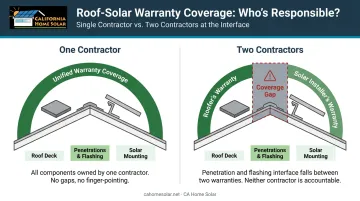
Arbitrating disputes is the sharpest edge of that last point. If a leak develops at a mounting penetration six months after installation, the roofer will point to the solar installer's drilling. The solar installer will point to the roofer's waterproofing. Without a single contractor owning both scopes, resolving that dispute is your problem.
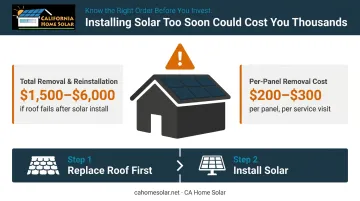
That dispute risk has a direct financial dimension. According to EnergySage, if a roof replacement is needed after solar is already installed, removing and reinstalling the panels costs $1,500 to $6,000, or roughly $200 to $300 per panel. Installing solar over a roof that needed replacement first is one of the most common — and most avoidable — sources of that cost.
Best Fit for the Two-Contractor Approach
- Roof is new or recently replaced; solar is the only scope
- Project requires a highly specialized roofing craftsman alongside a premium solar design firm
- Homeowner has capacity to manage the timeline handoff and permit coordination independently
One Contractor vs. Two: Which Should You Choose?
The right answer depends on four variables: roof condition, project timeline, your tolerance for managing multiple contractors, and total budget.
The Roof Condition Rule
If your roof needs replacement or significant repair, that work must happen before solar is installed. EnergySage notes that asphalt roofs over 10 years old should probably be replaced before going solar. In that scenario, a combined contractor is almost always the more practical choice. Mobilizing two separate crews to the same roof in sequence adds cost and timeline risk with no meaningful benefit.
If your roof is sound, the decision is simpler. A solar-only installer is a reasonable choice, and adding roofing expertise to the equation is unnecessary.
Warranty and Liability Logic
Most solar panel warranties run 25 years — EnergySage confirms this is the industry standard, with manufacturers like REC offering 25-year power output coverage. That warranty is only as good as the roof underneath it and the quality of the penetrations through it.
With two contractors, neither party fully owns the roof-solar interface. Flashing, mounts, and waterproofing around each penetration are the most common failure points in residential solar systems. One contractor owning both scopes closes that accountability gap for the full life of the system.
Decision Summary
Choose one contractor if you are:
- Replacing your roof and going solar at the same time
- Dealing with an older home that needs structural assessment before solar
- Looking for a single warranty point of contact
- Trying to minimize personal project management involvement
Choose two contractors if you are:
- Adding solar to a roof that's recently been replaced and is in good condition
- Working with specialized roofing materials that require a trade craftsman
- Comfortable coordinating permits, timelines, and accountability between two companies
Frequently Asked Questions
Do most roofers use subcontractors?
Many roofing companies subcontract portions of the work, which is legal as long as the licensed contractor maintains oversight. Before signing, ask whether the crew is employed by the company or subcontracted — that distinction affects warranty enforcement and accountability if something goes wrong.
What are some alternatives to rooftop solar?
For homeowners whose roof isn't suitable for panels, options include ground-mounted solar systems, community solar subscriptions, solar carports or pergolas, and solar shingles. Ground-mounted systems typically cost about 51% more than rooftop installations but offer better placement flexibility and easier maintenance access.
Can I install solar panels on an old or damaged roof?
Most solar installers won't install panels on a roof approaching the end of its lifespan. If the roof later needs replacement, the panels must be removed and reinstalled — a process that costs $1,500 to $6,000 according to EnergySage. Replacing the roof first is almost always the more cost-effective path.
What happens to my roof warranty if a solar company drills into it?
Roof penetrations can void manufacturer warranty coverage if the installer isn't credentialed or approved. GAF, CertainTeed, and Owens Corning each publish specific conditions for adding solar — confirm your installer meets those requirements before work begins.
Is it cheaper to do roofing and solar at the same time?
Bundling roofing and solar typically reduces total cost through shared labor, a single permit pull, and roof design that accounts for panel placement from the start. Doing them separately adds expense, and removing panels for a later roof replacement alone can cost $1,500 to $6,000.
What licenses does a contractor need to do both roofing and solar in California?
California requires a C-39 license for roofing work and either a C-46 (solar) or C-10 (electrical) license for solar installation. A contractor performing both scopes must hold the appropriate credentials for each trade. You can verify any contractor's license status through the California Contractors State License Board.