The stakes are real. A poorly qualified contractor can size your system incorrectly, fail city inspections, void equipment warranties, or cause roof damage that costs thousands to repair. The right contractor delivers a code-compliant installation that pays for itself and keeps working long after the check clears.
This guide covers everything you need to evaluate before signing: California licensing requirements, the six factors that separate reliable contractors from risky ones, red flags to watch for, and how to compare quotes intelligently.
Key Takeaways
- California solar contractors must hold a valid CSLB C-46 (Solar) or C-10 (Electrical) license — verify any license free at the CSLB website before signing anything
- Years in business, verified reviews, and a written workmanship warranty are the three strongest indicators of reliability
- Collect at least three quotes and compare price-per-watt, projected energy output, and equipment specs, not just the total price
- High-pressure tactics, abnormally low bids, and no physical address are serious warning signs
- The 30% federal tax credit only applies to homeowners who purchase their system; any reputable contractor will explain this before you sign
What Does a Solar Contractor Do?
A solar contractor is a licensed professional who manages the entire residential installation — not just the panel mounting. According to the CSLB, a C-46 Solar Contractor installs, modifies, maintains, and repairs both thermal and photovoltaic solar energy systems. A C-10 Electrical Contractor handles the wiring, connections, and electrical components that make those systems function.
Here's what you're actually hiring them to handle:
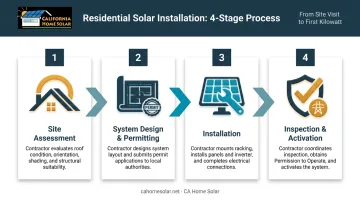
- Site assessment — evaluating your roof condition, shading, orientation, and energy consumption
- System design and permitting — engineering a code-compliant design and filing permits with your local jurisdiction
- Installation — mounting panels, running conduit, connecting the inverter, and completing electrical work
- Inspection and activation — coordinating the final inspection and submitting the utility interconnection application so your system can go live and generate power
Each of those steps carries legal weight. A general electrician or handyman cannot perform this work in California — the full sequence, from permit application to permission to operate, requires a licensed contractor who understands local building codes, utility interconnection rules, and fire safety requirements.
Key Factors to Look for in a Qualified Solar Contractor
Slick sales presentations don't tell you whether a contractor will still answer the phone in year 12 when your inverter needs replacing. These six factors give you a concrete framework for separating reliable contractors from risky ones.
Licensing, Insurance, and Certifications
California law is specific: residential solar must be installed by contractors holding an active C-46, C-10, or B license from the California Contractors State License Board. The lookup takes about two minutes and shows you the license class, current status, and any disciplinary history. Do this before any other evaluation.
Beyond the license, ask for proof of:
- Workers' compensation insurance — California requires this for any employer in construction, even with a single employee. A lapse causes immediate license suspension.
- General liability insurance — not universally required for all license types, but CSLB strongly recommends it. Home-improvement contractors must disclose in writing whether they carry it.
On certifications, the NABCEP (North American Board of Certified Energy Practitioners) PV Installation Professional credential requires documented project experience, OSHA training, advanced technical coursework, and a written exam to earn. You can verify any certified practitioner at directories.nabcep.org. Not every qualified installer holds this credential, but its presence signals a higher baseline of technical training.
Years in Business and Local Track Record
Solar panels are commonly warranted for 25–30 years. If your contractor closes shop in year five, those equipment warranties become much harder to honor and post-installation support disappears entirely. SunPower's 2024 bankruptcy filing is a recent example: customers were left scrambling for service after the company folded.
EnergySage recommends a minimum of three years of solar installation experience as a screening threshold. That's a floor, not a target. Prefer contractors with a longer track record, especially for a 25-year system commitment.
Local experience matters for a separate reason. A Southern California contractor who knows LA County permitting offices, SCE and LADWP interconnection procedures, and HOA approval processes moves faster and avoids costly delays. A national firm learning your jurisdiction on your dime does not.
California Home Solar has operated in Southern California for 36 years, navigating multiple utility policy changes, NEM rule updates, and permitting shifts along the way. That history translates to fewer surprises during your project.
Customer Reviews and Reputation
Online reviews are useful but require critical reading. The FTC notes that fake reviews aren't always positive; some are posted to harm competitors. That's why pattern analysis across multiple platforms matters more than any single review.
Check these sources:
- Google, Yelp — for volume and recency
- SolarReviews — an independent platform specifically for solar contractor comparisons
- EnergySage — searchable review database with installer-specific data
- BBB — useful for complaint history
Look for patterns in the negatives. Repeated complaints about installation delays, no-shows, or poor post-installation communication are more meaningful than a one-off bad review. A company with 400 reviews and a 4.8 rating and three unresolved complaints about roof leaks tells you something specific.
Beyond online reviews, ask for two or three direct references from recent projects similar to yours. Ask specifically: Was the system installed on schedule? Did they handle permitting? Were there post-installation issues, and how were they resolved?
Warranty Coverage
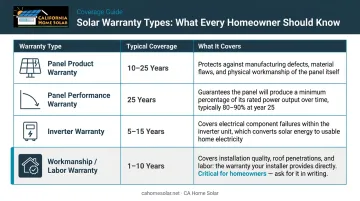
You're juggling three separate warranties, each covering different failure modes:
| Warranty Type | Typical Coverage | What It Covers |
|---|---|---|
| Panel product warranty | 10–12 years standard; 25–40 years premium | Defects in manufacturing |
| Panel performance warranty | 25 years (90% output at year 10, 80% at year 25) | Power degradation over time |
| Inverter warranty | 10–12 years (string); 25 years (microinverters like Enphase IQ8) | Inverter failure |
| Workmanship/labor warranty | Varies by contractor | Installation errors causing leaks, faults, or underperformance |
The workmanship warranty is the one most homeowners overlook. Equipment warranties don't cover roof leaks caused by improper flashing, electrical faults from poor wiring, or underperformance from bad system design. That's on the contractor. Any reputable installer should offer this in writing; one who refuses is a clear red flag.
Financing Options and Transparency
California homeowners have four main paths to solar ownership:
- Cash purchase — lowest total cost, immediate eligibility for the 30% federal tax credit
- Solar loan — you own the system and claim tax credits; watch for dealer fees that inflate the financed price
- Lease — lower upfront cost, but the solar company owns the system and claims the tax benefits, not you
- PPA (Power Purchase Agreement) — similar to a lease; you pay for the electricity generated, not the system
The ownership distinction matters: the IRS states the Residential Clean Energy Credit equals 30% of qualified costs for systems you own. Leases and PPAs transfer that credit to the financing company.
California Home Solar only supports purchase arrangements (cash or financed) and does not offer leases. Customers retain full ownership and full tax credit eligibility from day one.
For homeowners using PACE financing, California Home Solar is a HERO Registered Contractor. PACE financing works through property-tax assessments and carries no upfront cost, but understand the tradeoff: the lien on your property can complicate refinancing or home sales.
Services Offered and Equipment Quality
A contractor who handles roofing assessments, permitting, electrical upgrades, and post-installation support in-house is more accountable than one who subcontracts every component. When problems arise (and over a 25-year system life, something eventually will), a single point of contact makes resolution faster.
Ask about equipment specifics:
- Panel efficiency — most modern residential panels fall between 17% and 23% efficiency, with about 97% of quoted home systems in the 400–460 watt range
- Panel warranty — tier-1 manufacturers offer 25-year product and performance warranties; confirm in writing
- Inverter options — string inverters typically carry 10–12 year warranties; microinverters (like Enphase IQ8) carry 25 years
California Home Solar installs Canadian Solar panels and offers inverter options including Enphase IQ8 microinverters, SolarEdge with optimizers, and SMA Sunny Boy string inverters, allowing system design to match each home's specific architecture and shading conditions.
Red Flags That Signal an Unqualified Solar Contractor
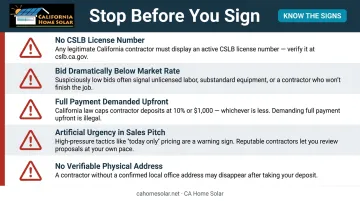
Three warning signs carry the highest confidence:
- No CSLB license number — if a contractor can't provide one or refuses to, stop the conversation. Verify any number given at the CSLB lookup tool before proceeding.
- A bid dramatically below every other quote — California's average installed cost runs around $2.53/watt as of mid-2026, per EnergySage. A bid significantly below this range typically signals substandard equipment, unlicensed subcontractors, or a company that won't survive to honor warranty claims.
- Full payment demanded upfront — legitimate contractors don't require 100% payment before work begins.
Two more patterns should put you on guard before signing anything:
- Artificial urgency in sales presentations — "This offer expires tonight" is a pressure tactic, not a real deadline. A legitimate contractor gives you time to compare quotes, review contracts, and consult your family.
- No verifiable physical address or online presence — contractors who surface during solar booms and vanish when problems emerge rarely leave much of a paper trail. If a company has no traceable address and no review history, that's your answer.
The CSLB received nearly 20,000 contractor complaints in FY 2023/24 and maintains a Solar Complaint Form with a Southern California intake center in Norwalk. The CPUC also maintains a public watch list of solar providers with non-compliant interconnection applications — worth checking before you sign any contract.
How to Compare Solar Quotes Like a Pro
What to Request and How to Evaluate It
Collect a minimum of three quotes before deciding. Price alone is a poor basis for comparison; a lower total price often reflects a smaller system that won't cover your actual energy usage.
A complete solar quote should include:
- System size (kW) and number of panels
- Panel brand, model, and wattage
- Inverter model and warranty term
- Projected first-year energy production (kWh)
- Estimated annual utility savings
- Net cost after the 30% federal tax credit
- All warranty terms (panel, inverter, workmanship)
- Contractor's CSLB (Contractors State License Board) license number
Follow up with direct questions on any missing items before comparing bids.
The Metrics That Matter
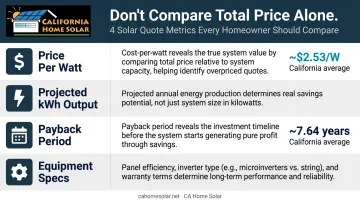
| Metric | Why It Matters |
|---|---|
| Price per watt | Lets you compare cost across different system sizes; California average is ~$2.53/W |
| Projected kWh output | Tells you how much of your electricity bill the system actually covers |
| Payback period | EnergySage estimates California's average at 7.64 years |
| Equipment specs | Determines long-term performance and warranty coverage |
Comparing Cash vs. Financed Pricing
Solar loans often include dealer fees — sometimes 15–25% of the loan amount — that inflate the financed price well above the cash price. Always ask for both a cash price and a financed price so you understand the true cost difference before committing to a loan structure.
Why California Home Solar Is a Trusted Choice in Southern California
One of the central questions when hiring any solar contractor is simple: will they still be around in 15 years when you need warranty service? With 36 years of experience serving Southern California, including both Los Angeles County and Orange County, California Home Solar answers that question directly.
That longevity connects to the evaluation criteria covered in this guide:
- Top 500 Solar Contractor recognition by Solar Power World (including 2023 and 2025), a competitive industry designation based on installation performance
- 5-Star Yelp rating with verified customer reviews across multiple platforms
- Licensed and bonded contractor status with full compliance under California law
- HERO Registered Contractor designation, enabling access to PACE financing for qualified homeowners
Beyond solar, California Home Solar handles roofing remodeling, energy-efficient windows, and HVAC upgrades. When one company manages solar installation alongside a roof assessment, there's no finger-pointing between separate contractors if problems arise — that's a practical advantage worth considering before signing with anyone.
The company serves communities throughout Southern California, including Pasadena, Long Beach, Santa Clarita, Burbank, Glendale, the San Fernando Valley, and Orange County cities such as Anaheim, Irvine, and Huntington Beach.
Conclusion
The right solar contractor is licensed, experienced, and willing to put their track record in front of you before you sign anything. A 25-year system is a long commitment — the company installing it should be around just as long to honor it.
Use this guide as your checklist: verify CSLB license numbers, ask every contractor for references, compare at least three quotes on price-per-watt and projected output, and get workmanship warranty terms in writing. The work you do before signing shapes the return you'll see for decades. If you're in Southern California, California Home Solar has handled residential and commercial installations across the Los Angeles area for 36 years — and holds a Top 500 Solar Contractor recognition to back it up.
Frequently Asked Questions
What is the average cost of installing solar panels in California?
According to EnergySage, the average California residential system (8.81 kW) costs about $22,284 before incentives, or roughly $2.53 per watt. The 30% federal tax credit reduces that to approximately $15,600 for eligible homeowners, though your actual cost varies based on system size and energy usage.
What licenses should a solar contractor have in California?
California requires solar contractors to hold an active CSLB C-46 (Solar Contractor) or C-10 (Electrical Contractor) license, or a B (General Building) license. Verify any contractor's license status for free at the CSLB license lookup tool.
How do I verify a solar contractor's credentials before hiring?
Use the CSLB license lookup to confirm license class and current status. Check NABCEP's directory for certified practitioners. Then cross-reference customer feedback on Yelp, Google, SolarReviews, and the BBB to identify any complaint patterns.
What questions should I ask a solar contractor before signing?
Four questions to ask every contractor:
- How long have you been installing solar in California?
- Can I see your CSLB license number?
- What workmanship warranty do you offer, and is it in writing?
- Can you provide references from recent installations in my area?
What warranties should a qualified solar contractor provide?
Expect three warranties — and get all three in writing:
- Manufacturer panel warranty: 25 years for product and performance from reputable brands
- Inverter warranty: 10–12 years for string inverters; 25 years for microinverters like Enphase IQ8
- Workmanship warranty: Contractor-issued coverage for installation errors
How many solar quotes should I get before choosing a contractor?
Get at least three quotes and compare price-per-watt, projected annual kWh output, equipment specs, and warranty terms. Ask for both a cash price and a financed price so you understand the true cost of any loan structure.