That distinction matters because most homeowners assume their panels go "off" when they flip a switch near the inverter. They don't. And combining water with live electrical components on a rooftop is precisely the kind of situation that turns routine maintenance into a genuine hazard. The CPSC's 2024 Annual Death and Injury Report reported 749,000 medically attended injuries involving ladders and stools in 2024 — a reminder that rooftop work carries real consequences before you even factor in electricity.
This article answers the core question directly: whether shutdown is required before cleaning, what "turning off" actually means for a solar system, and how Southern California homeowners can clean safely without voiding warranties or creating risk.
Key Takeaways
- Shut down your system before cleaning — but switching off the inverter alone doesn't eliminate electrical risk
- Panels generate DC voltage in any daylight, regardless of inverter state
- Clean in early morning using low-pressure water and soft, non-abrasive tools
- Never touch junction boxes or wiring under any circumstances
- Battery storage systems, steep roofs, or any visible damage — call a professional
Why Solar Panels Stay "Live" Even When You Think They're Off
Most homeowners assume turning off the inverter cuts power to the system. It doesn't — and that gap between assumption and reality matters before you get near the panels.
Photovoltaic Cells Don't Have an Off Switch
Solar panels generate direct current (DC) electricity through a physical process that happens at the cell level whenever light hits the panel surface. There's no switch, relay, or circuit breaker that stops this. As Enphase confirms in their microinverter installation documentation, PV DC conductors may be energized and DC voltage is supplied to power conversion equipment whenever the array is exposed to light.
Your inverter converts that DC electricity into usable AC power for your home. Turning the inverter off stops that conversion — but the panels keep generating DC voltage at the surface and along the wiring connecting them.
The Four Levels of Solar System Shutdown
Each shutdown level cuts a different part of the system — and none of the first three eliminate DC voltage at the panels:
| Shutdown Level | What It Does | Still Live? |
|---|---|---|
| Inverter off | Stops DC-to-AC conversion | Yes — DC at panels |
| AC isolation switch | Disconnects from the grid | Yes — DC at panels |
| DC isolation switch | Disconnects panels from inverter | Yes — DC at panels |
| Full verified isolation (professional) | Reduces panel-level voltage to near zero | Significantly reduced |
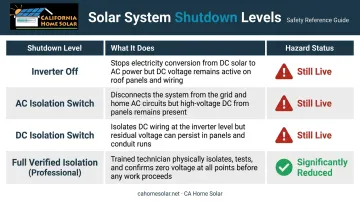
For systems with SolarEdge's SafeDC technology, turning off AC power can reduce DC voltage to approximately 1 V per module — but that's a specific feature, not universal behavior.
Battery Storage Adds Another Layer of Risk
Homes with battery storage (Tesla Powerwall, Enphase IQ Battery, and similar systems) face an added complication. Stored energy can remain active and feed back into wiring even when the panels are isolated from the grid.
Tesla's own Powerwall 3 documentation explicitly states the unit is not user serviceable and should not be opened, tampered with, or modified. Any electrical work near a battery-equipped system should be handled by a qualified technician.
Do You Need to Turn Off Solar Panels to Clean Them?
Yes. Even for a basic rinse, you should shut down your solar system before cleaning. Water conducts electricity. Panels on a live system sit directly above wiring, junction boxes, and connectors. Wet hands, a dripping hose, or accidental contact with a frame edge can all create a conductivity pathway.
Recommended Homeowner Shutdown Sequence
Before cleaning, work through these steps in order — and always cross-reference your system's manufacturer manual, since procedures vary by brand and inverter model:
- Switch off the inverter using its built-in shutdown controls (usually a rotary dial or button on the unit itself)
- Activate the AC isolation switch — typically located near your switchboard or meter box
- Engage the DC isolation switch if your system has one (check with your installer if you're unsure)
- Wait at least 2 minutes before starting any cleaning — Fronius specifically requires this wait time for capacitors to discharge safely
This is not a universal sequence that covers every system. Enphase microinverter systems, Fronius string inverters, and SolarEdge systems each have model-specific shutdown procedures. If you've lost the manual, contact your installer before proceeding.
When Shutdown Is Non-Negotiable
Some scenarios have no acceptable shortcut:
- Any cleaning that involves roof access
- Direct contact with the panel surface, frame, or mounting hardware
- Wet or overcast conditions where moisture is elevated
- Systems with visible wiring damage, frayed insulation, or cracked panels
The One Limited Exception
A very gentle, ground-level rinse from a low-pressure hose — with zero contact with the panels or any electrical components — carries lower risk than roof-level cleaning. Some manufacturers and homeowners treat this as acceptable without full shutdown.
Most solar professionals shut down the system regardless, and it remains the recommended best practice. Skipping shutdown saves a few minutes; an electrical incident costs far more.
Warranty Implications
One more consequence worth noting: improper cleaning of a live system can void your equipment warranty. REC Group's cleaning guide explicitly states that failure to follow their guidelines — including using high-pressure hoses or abrasive tools — invalidates the product warranty. LONGi makes the same point in their installation manual.
How to Safely Clean Solar Panels: Precautions and Process
General Safety Precautions Before You Start
Before touching anything, run through these checks:
- Inspect all visible cabling — frayed insulation, discolored connectors, or exposed wiring is an immediate stop signal; call your installer before proceeding
- Check the panel surfaces — cracked glass or visibly damaged panels present a lethal shock hazard when wet (REC's cleaning guide warns of this directly); don't clean around damaged panels
- Choose your timing carefully — early morning on a cool, lightly overcast day is ideal for Southern California conditions; panels can run up to 20°C above ambient temperature at midday, and cold water on hot glass risks thermal shock cracking
Gather these tools before you begin:
- Rubber-soled footwear
- Soft-bristled brush or microfiber cloth
- Telescoping handle for ground-level reach
- Low-pressure garden hose or gentle spray nozzle
- Biodegradable, mild soap or plain deionized water
Several tools cause more damage than dirt does. Avoid all of the following — manufacturers like REC, LONGi, and LG explicitly list them as warranty-voiding:
- Pressure washers or steam cleaners
- Abrasive scrubbing pads or steel wool
- Acid or alkaline chemical cleaners
Any of these can scratch the anti-reflective glass coating, compromise panel seals, or force water into electrical components.
Cleaning from the ground is always the safer option. If your panels can't be reached with a telescoping brush or hose, hire a professional rather than climbing up.
Cleaning Process Step by Step
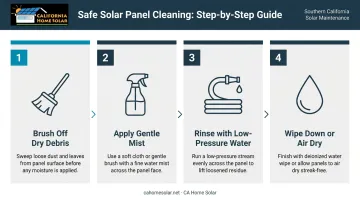
Once the system is shut down and your tools are ready, work through these steps in order:
- Brush off dry debris first — loose dust, leaves, and bird droppings should be cleared before any water is applied
- Apply a gentle mist of water or diluted biodegradable soap using a soft cloth or brush; work in sections
- Rinse thoroughly with low-pressure water — leftover soap film attracts dust faster and can reduce efficiency
- Wipe down or allow to air dry — in Southern California's hard water areas, deionized water prevents the mineral deposit streaks that tap water leaves behind; it's the same reason California Home Solar uses deionized water in their professional cleaning process
Common Solar Panel Cleaning Mistakes to Avoid
Avoid these four mistakes that homeowners make most often:
- Assuming inverter-off means safe. DC voltage stays live at the panel surface and wiring even after the inverter is switched off. Add water to that equation and the shock risk increases significantly.
- Cleaning at midday or on a hot day. High surface temperatures cause water to evaporate almost instantly, leaving mineral deposits and streaks — and higher heat also means higher voltage output. In Southern California summers, midday cleaning creates safety and performance problems both.
- Using a pressure washer. REC, LG, and LONGi all prohibit high-pressure washing outright. Beyond the warranty issue, pressure washers can force water into seals and conduits, creating ingress faults that surface as inverter errors weeks later.
- Cleaning damaged panels. Cracked glass or exposed wiring is an electrical hazard when wet. A 2025 Solar Energy journal article also found abrasive cleaning methods deteriorate anti-soiling coatings over time. If you spot physical damage, stop and contact a licensed solar contractor.
When to Call a Professional to Clean Your Solar Panels
Some situations fall outside what a homeowner should handle. Don't attempt DIY cleaning if any of the following apply:
- Steep or high roof with no safe ground-level access — Maxeon strongly recommends homeowners avoid roof access for cleaning; LG recommends certified contractors for all residential array cleaning
- Battery storage system requiring complex shutdown procedures beyond standard inverter isolation
- Visible physical damage — cracked panels, loose mounting hardware, or exposed wiring
- Unexplained energy output drop — if your system is underperforming beyond what surface dirt would explain, cleaning isn't the fix; something else needs diagnosis
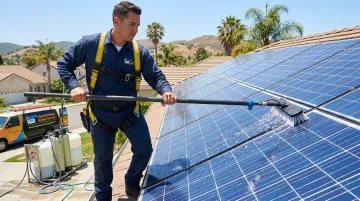
Professional technicians use layered isolation procedures verified with testing equipment, bring water-fed poles and purified water systems, and can identify performance or electrical issues during the same visit.
California Home Solar's cleaning service covers an initial assessment, gentle cleaning with biodegradable solutions and deionized water, a final inspection, and a post-cleaning performance check. For Southern California homeowners who want a professional cleaning and inspection, their team serves Los Angeles County and surrounding communities and can be reached to schedule a service visit.
Frequently Asked Questions
Do solar panels need to be shut off when cleaning?
Yes. Shutting down the system before cleaning is strongly recommended. Note that switching off the inverter alone is not sufficient; the panels remain live in daylight. Full shutdown involves the inverter, AC isolation switch, and DC isolation switch, following your manufacturer's specific procedure.
Can you get electrocuted cleaning solar panels?
Yes, electrocution is a real risk if proper precautions are skipped. Water contacting live wiring or junction boxes creates a direct conductivity hazard. This is why both system shutdown and careful tool selection are essential before any cleaning begins.
Does turning off the inverter make solar panels safe to clean?
No. Turning off the inverter stops energy conversion but doesn't stop the panels from generating DC voltage in daylight. Safe operation requires engaging both AC and DC isolation switches and following the manufacturer's complete shutdown sequence.
What happens if you clean solar panels without turning them off?
Water increases electrical conductivity around live panel surfaces and junction boxes, creating a real shock hazard. Moisture intrusion into live components can also cause inverter faults, equipment damage, and may void your manufacturer warranty.
How often should solar panels be cleaned in Southern California?
Most Southern California homeowners should clean panels every 6 to 12 months. A 2013 California PV soiling study estimated 7.4% output loss over an average 145-day summer drought. Clean more frequently if you're near construction sites, wildfire ash zones, or areas with heavy bird activity.
Should I hire a professional to clean my solar panels?
Professional cleaning makes sense in these situations:
- Panels are on a steep or high roof
- The system includes battery storage
- There's visible damage or unexpected output drops
A professional can safely isolate the system and identify underlying issues in the same visit.
Conclusion
Solar panels are never fully "off" during daylight. That electrical reality shapes every decision about how and when to clean them. The risk is real, but it's manageable: shut down the system properly, work in the early morning, use the right tools, and stay off the roof if there's any doubt about safe access.
Those safety habits work best when cleaning is part of a regular maintenance routine — not something you do only when output drops enough to notice. For any system with battery storage, visible damage, or limited ground-level access, calling a professional is the right call for both your safety and the long-term output of your system. California Home Solar's cleaning and maintenance team handles exactly these situations for homeowners across Southern California.